

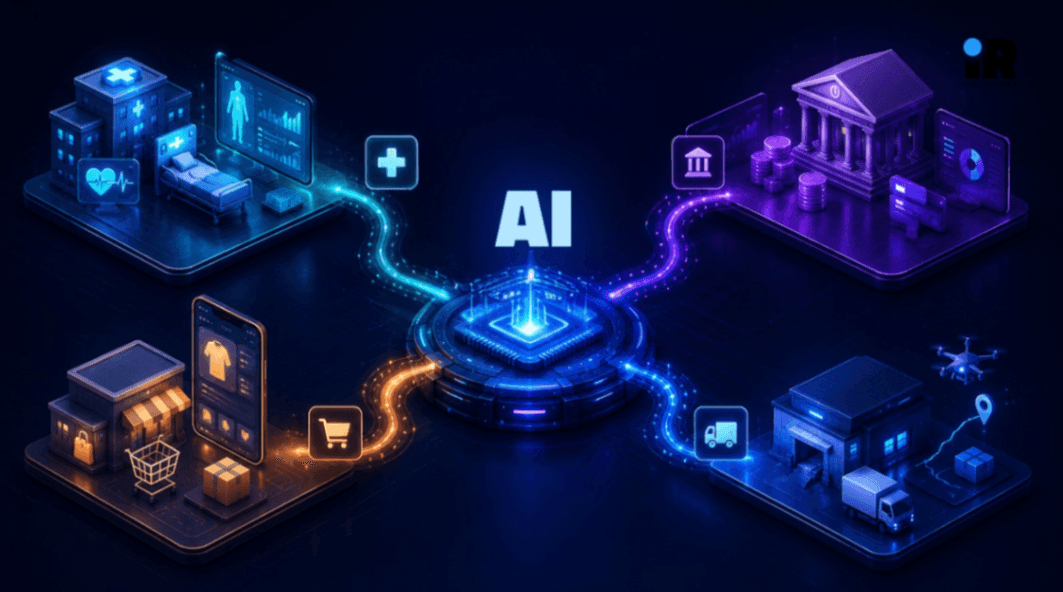

A hospital in Texas cut misdiagnosis rates by 37% after adding AI to its radiology workflow. A mid-size retailer in the UK reduced overstock losses by $2.1 million in one year using demand forecasting tools. These are not headlines from the future, they happened in the last two years. Businesses that ignored this shift lost ground to competitors who did not. AI is no longer a tech experiment reserved for Silicon Valley. It is a practical, revenue-affecting tool that companies across healthcare, finance, retail, and logistics are using right now. If your business operates in any of these sectors, the question is not whether AI applies to you. The question is how much longer you can wait. AI development companies help businesses implement AI/ML services that actually work for their operations.
How AI Improves Efficiency, Accuracy, and Decision-Making
Cuts the Busy Work
Most businesses are bleeding time on tasks that do not actually need a human brain behind them, such as data entry, report generation, scheduling, and follow-ups. AI handles that layer automatically, and your team gets to focus on the work that actually moves the needle. The hours add up faster than most owners expect once they start tracking them.
Gets the Numbers Right
Human error is expensive, especially when it shows up in invoices, inventory counts, or compliance documents. AI processes large volumes of data consistently and catches discrepancies that would slip through a manual review. Over time, that accuracy compounds into fewer costly corrections and more reliable operations across the board.
Backs Every Decision With Data
Gut instinct still matters, but it works much better when it sits alongside actual data. AI pulls patterns from your sales history, customer behavior, market signals, and operational performance to surface insights that would take a team of analysts weeks to compile, especially when supported by a skilled data analyst.
If you want a broader view of where AI adoption is heading beyond these sectors, our guide on AI for business in 2026 covers implementation, automation, and what companies need to prepare for next.
How AI Is Changing Healthcare Operations
Diagnosis and Early Detection
Doctors miss things not because they are careless, but because they are human. AI diagnostic tools scan imaging data, lab results, and patient history simultaneously. They catch patterns that would take a physician much longer to spot.
- AI-assisted mammography catches up to 20% more cancers than standard screening alone.
- Sepsis prediction models flag at-risk patients 6 hours earlier than traditional monitoring.
- Skin lesion classifiers now match the accuracy of dermatologists in controlled studies.
For hospitals and clinics, earlier detection means fewer complications, shorter hospital stays, and better patient outcomes. That translates into cost savings and better ratings.
Administrative Burden Reduction
A large chunk of healthcare costs comes from paperwork, not treatment. Scheduling, billing, prior authorizations, and documentation eat hours every day. AI tools handle these tasks automatically:
- Smart scheduling: It reduces no-shows by predicting cancellations and filling gaps.
- Auto-coding: Converts clinical notes into billing codes with less human review.
- Prior auth bots: Submit insurance requests and follow up without staff involvement.
One regional hospital network cut administrative costs by $1.3 million annually after automating prior authorization workflows.
Personalized Treatment Plans
Generic treatment protocols were designed to work reasonably well for the average patient in the average clinical scenario. AI builds care plans around individual patient data, including genetics, daily lifestyle habits, and past responses to specific medications, so clinicians can make adjustments well before a serious problem has time to develop. This is not some experimental technology sitting behind closed doors in a research lab waiting for approval. It is already running inside oncology wards, cardiology units, and chronic disease management programs operating across the US and Europe right now.
How AI Is Reshaping Finance and Banking
Fraud Detection That Actually Keeps Up
As digital payments continue to grow, credit card fraud has become faster and more difficult to detect, exposing the limitations of traditional rule-based detection systems that often flag legitimate transactions and miss real threats. AI fraud models analyze hundreds of variables in real time:
- Device fingerprint
- Spending velocity
- Geographic patterns
- Time-of-day behavior
They update continuously, so when fraud tactics change, the model adapts. Banks using AI fraud detection report up to 50% fewer false positives and significantly higher fraud catch rates.
Credit Scoring Beyond the Credit Report
Traditional credit scores leave out millions of creditworthy people who simply do not have enough credit history. AI models can assess risk using alternative data:
- Rent payment history
- Utility bill records
- Cash flow patterns from bank accounts
- Employment stability signals
This expands who qualifies for credit, reduces default risk, and opens new market segments for lenders.
Algorithmic Trading and Portfolio Management
Investment firms use AI to process market signals, news feeds, earnings reports, and social sentiment all at the same time, human traders cannot do this at scale. For wealth management businesses, AI-powered robo-advisors have made portfolio rebalancing and risk adjustment automatic. Clients get faster responses to market shifts without more staff.
Regulatory Compliance
Financial compliance is not getting any simpler, and the regulatory burden keeps growing every year. Regulations multiply constantly, and manual compliance reviews remain far too slow and dangerously error-prone for modern firms. AI tools are:
- Monitor transactions continuously for suspicious patterns
- Flag anomalies before regulators do
- Generate audit-ready reports automatically
For financial firms operating under serious regulatory pressure, this is simply not a nice-to-have. It has become a core risk management tool that directly protects your firm from costly consequences.
How AI Is Giving Retail Businesses a Real Edge
Demand Forecasting That Reduces Waste
Stocking too much inventory drains capital, and stocking too little results in sales to competitors. Retail has always been a balancing act, and the margin for error keeps shrinking. AI demand forecasting changes the math by pulling in sales history, weather, local events, and social trends to predict what customers will actually buy and when, so your decisions reflect the real world, not last quarter's spreadsheet.
- Grocery chains using AI forecasting have cut food waste by as much as 30% in their day-to-day operations.
- Fashion retailers have reduced end-of-season markdowns by identifying emerging product trends earlier in the cycle.
This directly protects profit margins without forcing you to cut corners on quality or walk back service promises.
Personalized Customer Experience
Generic promotions get ignored as AI-powered personalization serves the right offer to the right customer at the right moment.
- Recommendation engines increase average order value by showing relevant products.
- Dynamic pricing adjusts in real time based on demand, competition, and stock levels.
- Personalized email campaigns use purchase history to drive repeat purchases.
Amazon built a significant portion of its market dominance on recommendation algorithms that felt genuinely useful rather than random. That same level of personalization capability is now accessible to mid-size retailers through off-the-shelf AI tools that require no custom engineering team to run.
Many retailers are also using AI chatbots for customer support and product guidance, especially when they want more control over the experience than off-the-shelf tools provide, which is why it helps to understand how to build a custom AI chatbot for your business.
Store Operations and Loss Prevention
Theft and operational inefficiency both hit the bottom line in ways that quietly compound over months and years of inaction.
- AI-powered cameras and analytics detect unusual behavior patterns before staff would ever notice something was off.
- Computer vision systems monitor shelf stock levels in real time and alert employees before a gap becomes a lost sale.
- Retailers using AI-based loss prevention tools report shrink rate reductions anywhere between 15% and 25% compared to baseline.
How AI is Transforming Logistics and Supply Chain
Route Optimization at Scale
Fuel is expensive, driver time is expensive, and making the wrong routing decisions across hundreds of daily deliveries adds up to a genuinely large number by the end of the year. AI route optimization does not just plan the morning route and leave it, it recalculates delivery paths continuously throughout the day based on what is actually happening on the ground.
- Live traffic conditions that shift unexpectedly during peak delivery windows.
- Weather disruptions that close roads or slow movement in specific zones.
- New delivery additions that come in after the morning schedule were already locked.
- Vehicle capacity constraints that affect what can be rerouted and what cannot.
UPS credits its AI-powered routing system, ORION, with saving 100 million miles and $400 million annually. Similar tools now exist for smaller fleets.
Predictive Maintenance for Fleet and Equipment
Breakdowns are expensive, but breakdowns mid-delivery are worse. AI predictive maintenance uses sensor data from vehicles and warehouse equipment to flag failures before they happen.
- Fewer emergency repairs
- Less unplanned downtime
- Longer equipment lifespan
For logistics companies with large fleets, this alone can recover high operating costs.
Warehouse Automation
AI-powered warehouse robots pick, pack, and sort faster than human workers without sick days or shift limits. Alongside robots, AI warehouse management systems:
- Organize stock based on order frequency
- Predict replenishment needs
- Reduce picking errors that lead to returns
Supplier Risk Management
A supplier located in a flood zone or a politically unstable region is a real operational risk that most procurement teams simply do not see coming until it is already disrupting their supply chain. AI tools monitor supplier locations, financial health indicators, geopolitical signals, and shipping disruption data on a continuous basis rather than during quarterly reviews. They surface warning signs early enough that procurement teams can identify and qualify alternative sources before a crisis forces a panicked decision under pressure.
Why Delaying AI Adoption Can Cost Your Business
Every month you wait on AI is a month your competitors who have already moved are getting faster, leaner, and harder to compete with on price and speed.
Here is what that delay actually costs you:
- Lost time: Repetitive manual tasks keep eating hours your team could be spending on work that grows the business instead.
- Missed revenue: Without personalization and smarter forecasting, you are leaving money on the table that better-equipped competitors are picking up.
- Higher error rates: Manual processes carry a consistent error risk that accumulates into real financial damage over quarters and years.
- Weaker decisions: Making calls without data-backed insight means relying on assumptions that the market will eventually punish.
- Talent friction: Good employees do not stay long in roles built around repetitive, low-value work that a basic AI tool could handle in seconds.
The businesses that waited on cloud software, e-commerce, and digital marketing all paid a catch-up tax later. AI is following the same curve, and the gap between early movers and late adopters is already visible. Businesses that want to move faster often choose to hire AI/ML developers instead of overloading internal teams.
If you want to understand how AI applies to your specific situation, book a free consultation call with our team, and we'll walk through it with you.
Conclusion
Businesses that moved on to AI early are not just saving time, they are compounding real advantages across every part of their operations. Healthcare, finance, retail, and logistics have all moved well past the experimental phase and into results that show up directly on the bottom line. Waiting for a perfect moment or a clearer roadmap is how companies end up rebuilding under pressure instead of growing with confidence. Every quarter spent on manual processes and disconnected systems is a quarter your competitors are using to pull further ahead. IR Solutions works with businesses across these industries to identify where AI creates the most immediate impact and build toward it in a way that actually sticks.
Frequently Asked Questions
Do small businesses benefit from AI tools?
Absolutely, purpose-built AI tools for small businesses now exist across retail, finance, logistics, and several other sectors with real traction. Many of them require no technical team to set up and start delivering value within the first few weeks of use.
How long does AI implementation typically take?
A well-scoped project with clear goals and clean data can show measurable results within 60 to 90 days. The businesses that move fastest are usually the ones that start with one focused process rather than trying to overhaul everything at once.
Does AI replace human workers in these industries?
AI takes over the repetitive, low-value tasks that burn through your team's time without adding anything meaningful to the business. Most implementations redeploy staff toward higher-value work rather than reducing headcount, and employees tend to respond better than most managers expect.
What industries benefit most from AI today?
Healthcare, finance, retail, and logistics currently show the highest documented ROI from AI adoption across real-world business deployments. These are also the sectors where the gap between early adopters and late movers is becoming the most visible and hardest to close.
Is our business data safe when using AI tools?
Reputable AI providers use enterprise-grade encryption and comply with the data protection regulations relevant to your industry and region. Before any implementation, it is worth reviewing vendor compliance certifications and understanding exactly where your data gets stored and processed.
Can AI integrate with our existing software systems?
Most modern AI platforms offer API-based integration with common ERP, CRM, and POS systems that businesses are already running day to day. IR Solutions begins by understanding your current stack and planning the transition carefully so operations continue without unnecessary disruption.