


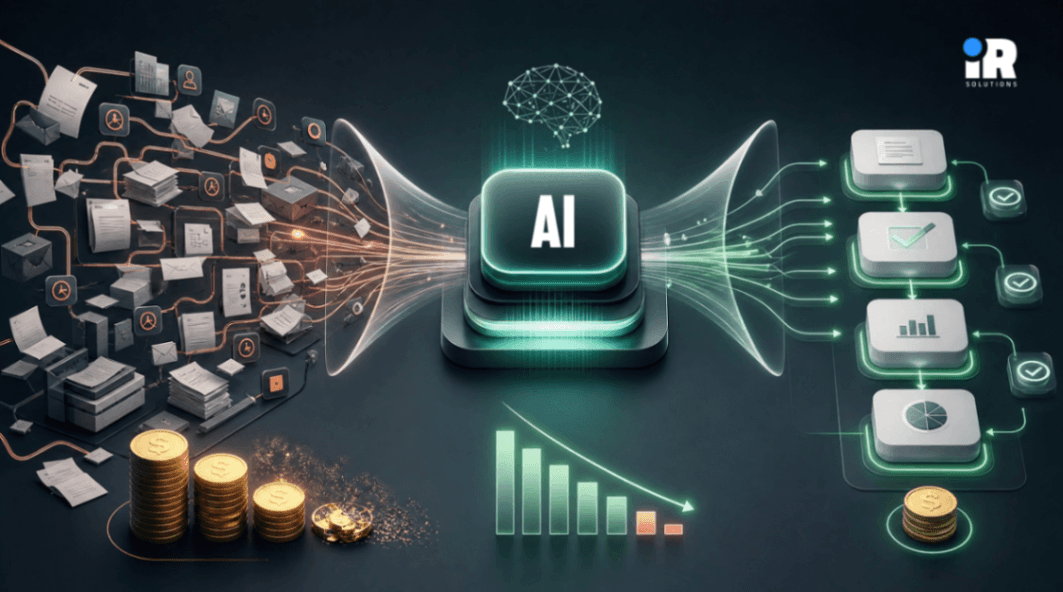
Businesses using AI automation effectively are not chasing trends, they are solving operational bottlenecks with measurable outcomes. A mid-size logistics company reduced invoice processing time by 80% by automating a repetitive workflow instead of expanding its team. That approach is becoming common among businesses focused on efficiency, lower operational costs, and faster execution. The real difference lies between companies still discussing AI and those already applying it to daily operations.
Many businesses get stuck because most AI discussions focus on generic tools and unrealistic promises instead of practical implementation. Businesses seeing results are prioritizing data readiness, phased deployment, and clear operational goals. They are also paying close attention to how agentic AI is changing workflows and decision-making processes. Agentic AI and ML services help businesses deploy production-ready AI systems built for real operational impact, not short-term experiments.
How AI Automation Actually Reduces Real Operational Costs
The cost reduction from AI doesn't come from replacing entire departments, it comes from eliminating the slow, repetitive work that quietly drains high-value time across every business function. A support team spending 60% of their day answering the same ten questions is leaving significant capacity untapped that could go toward genuinely complex work.
The real savings are distributed across the operation rather than concentrated in one visible place. AI reduces approval turnaround times, catches data errors before they become expensive corrections, surfaces financial anomalies before they compound, and delivers insights that would have taken an analyst days to produce manually. When those savings stack across departments, the cumulative impact becomes measurable and significant within one or two quarters of deployment.
Companies extracting the largest returns don't treat AI as a cost-cutting tool in isolation. They treat it as a lever that makes every hour of human effort more productive, more focused, and of higher quality. That framing is what separates businesses that implement AI effectively from those that simply replace one operational bottleneck with a more expensive one.
Business Functions AI Is Silently Automating Right Now
This is where many businesses are surprised not by AI's capabilities, but by how many departments are already running partially on automation without leadership realizing the full scope of what's possible across the operation.
- Finance Operations: AI handles invoice processing, expense categorization, cash flow forecasting, and anomaly detection in accounting data far faster than any manual review process allows.
- HR and Recruitment: Resume screening, candidate ranking, interview scheduling, and onboarding document processing are compressing hiring cycles from months to weeks with AI assistance.
- Marketing Execution: Campaign personalization, A/B test analysis, content scheduling, and lead scoring are handled by systems that continuously adapt based on real audience engagement data.
- Customer Support: Intelligent chatbots and AI-driven ticketing systems resolve the majority of inbound queries without human escalation, cutting response time from hours to under a minute.
- Legal and Compliance: Contract review, regulatory monitoring, and audit documentation are increasingly handled by AI tools trained on domain-specific language, reducing review time significantly.
- Supply Chain: Demand forecasting, inventory optimization, and logistics routing are already AI-driven at scale across most industries.
Businesses adopting AI automation today are positioning themselves for faster growth and smarter operations in the years ahead. Read more in: Will AI Automation Redefine Business Growth in the Coming Years?
Build, Buy, or Partner - Your AI Implementation Decision
This decision gets made wrong more often than any other in the AI adoption process, and the consequences typically drag on for six months or longer before they get addressed.
- Build: Developing a proprietary AI system provides full control over data, logic, and customization but requires significant upfront investment in engineering talent, infrastructure, and time before any business value becomes visible.
- Buy: Off-the-shelf AI tools deploy faster but come with data privacy trade-offs, limited customization, and per-seat pricing that becomes expensive as usage scales beyond initial estimates.
- Partner: Working with a specialized AI development partner combines speed with customization, giving businesses production-grade systems built around real workflows without maintaining a full internal AI engineering team.
Most mid-size businesses do not have the internal depth to build AI from scratch, and off-the-shelf tools hit a ceiling quickly when operational requirements become specific. Partnering with a firm that builds AI around actual workflows is usually the highest-value path for businesses past the early exploration phase. AI & ML Development services are structured around exactly this model, building production systems on real business workflows, not sandbox demonstrations.
Getting Business Infrastructure AI-Ready Before You Build
AI systems produce results that are only as reliable as the data they're trained and fed on in a live production environment. Before any deployment can succeed, businesses need to audit their operational data where it lives, how consistent it is, how accessible it is across teams, and whether it reflects reality or just what was convenient to record at the time of capture.
Most businesses discover during this audit that their data is far more fragmented than expected. Sales data lives in the CRM, operations data in a separate legacy system, and finance data in spreadsheets that haven't been reconciled consistently in years. AI cannot learn reliably from inconsistent inputs, and automating a broken process doesn't fix the underlying problem, it scales the inconsistency at a speed that manual processes never could.
Infrastructure readiness also means confirming that the platforms AI will interact with can expose data through accessible APIs and support reliable real-time data exchange. If a core business system can't surface data consistently, the AI layer above it breaks in ways that are difficult to debug and expensive to maintain over time. DevOps engineering is what bridges the gap between an AI model's requirements and the infrastructure reality most businesses are actually running on. Addressing these prerequisites before buying or building anything is not a delay, it's what determines whether the investment ever produces a meaningful return.
Addressing these prerequisites before buying or building anything is not a delay, it's what determines whether the investment ever produces a meaningful return. In many cases, deploying an agentic AI solution on top of a fragmented infrastructure without proper readiness only amplifies inefficiencies instead of solving them.
When Custom AI Beats Off-the-Shelf Tools
Off-the-shelf AI tools have improved significantly and genuinely solve a real set of problems for businesses at early stages of adoption. But they were designed for a broad range of customers, which means they're rarely optimized for what any one business actually needs at an operational level.
- The moment workflows don't fit a standard template that applies to most businesses past the early SMB stage, generic tools start creating more friction than they remove. Custom AI becomes the stronger option when:
- The business handles sensitive data that cannot flow through third-party infrastructure without regulatory exposure or data residency compliance requirements being triggered.
- Workflows are complex enough that a generic tool requires excessive configuration or workarounds that ultimately defeat the purpose of deploying AI in the first place.
- Usage volume is large enough that per-seat or consumption-based pricing for an off-the-shelf product becomes more expensive than maintaining a purpose-built system over 12 months.
- Competitive differentiation matters if a direct competitor can buy and configure the identical AI tool, it creates operational parity rather than any meaningful advantage in the market.
To see how businesses are implementing custom chatbot systems with AI, check: How to Build a Successful Custom AI Chatbot for Your Business.
Scale AI Output Without Growing Your Team Size
One of the biggest constraints businesses face when scaling AI adoption is the shortage of specialized AI and ML engineers available to hire at any given moment. It's rarely a budget problem, it's a market availability and hiring speed problem that most internal HR processes aren't set up to solve quickly.
Staff augmentation addresses this without the uncertainty, instead of running a four-to-six-month hiring cycle for a single senior AI engineer, businesses embed vetted specialists directly into the existing team and workflow. Businesses looking to move quickly can hire AI & ML developers, an augmentation model, and have engineers contributing within 48 hours of submitting a brief, not a speculative onboarding timeline that shifts week to week.
The augmented engineers work under the company's direction, on the company's systems, as part of the active product team rather than as external contractors managing a separate deliverable from the outside.
This model works particularly well during intensive AI buildouts, where demand for engineering hours is high for a defined period and then shifts toward a lighter maintenance and optimization phase. Scaling an augmentation engagement up or down as the project moves through phases avoids full-time employment overhead during lower-intensity periods while maintaining continuity across the entire build cycle.
For a practical view of how resource augmentation works at a project level, read our blog on What are Resource Augmentation Services, and How Can They Help You Grow?
Hidden AI Costs That Most Business Budgets Miss
Most AI project budgets account for the tool license or the development work itself, but miss the surrounding costs that determine whether a deployment actually sustains and delivers value after the initial launch date.

- Data Preparation: Cleaning, labeling, structuring, and migrating the data an AI system depends on is often the most labor-intensive phase of any deployment, frequently taking longer than the build itself.
- Integration Work: Connecting AI systems to existing platforms, ERPs, CRMs, databases, and third-party APIs requires engineering effort that's rarely included in a standard tool license or development quote.
- Model Maintenance: AI models degrade over time as business conditions shift. Ongoing monitoring, retraining, and performance evaluation are recurring costs that don't stop after the initial deployment goes live.
- Change Management: Getting teams to actually use an AI system productively requires real investment in training, workflow redesign, and, in some cases, managing internal resistance across multiple departments.
- Security and Compliance: Depending on the industry, AI deployments require access controls, data residency documentation, audit trails, and governance frameworks that add both time and direct cost to every rollout.
Understanding these costs upfront doesn't make AI less valuable, it makes the ROI calculation more accurate and the business case more defensible to leadership stakeholders who need credible numbers to approve the investment.
How Businesses Implement AI Without Disrupting Existing Operations
Most AI implementations fail not because the technology doesn't work, but because the rollout was structured without clear phases or defined checkpoints at each stage of the deployment.

- Discovery Phase: Map the specific workflows AI will touch, identify all relevant data sources, assess integration requirements, and define measurable success metrics before any build work starts.
- Data Readiness: Clean and consolidate the data that AI will be trained on or continuously fed. This phase almost always surfaces structural issues in how operational data is stored and accessed.
- Pilot Build: Develop a narrow, focused AI implementation targeting one high-impact use case small enough in scope to move fast and demonstrate value without putting broader operations at risk.
- Testing and Validation: Run the AI system against real inputs in a controlled staging environment, measure output accuracy against defined success metrics, and identify edge cases before any production release.
- Production Deployment: Go live with the pilot, monitor performance closely, establish feedback loops with the teams actively using the system, and document what AI is and isn't handling well.
- Iteration and Scale: Use production performance data to refine the model, expand to adjacent use cases, and build the broader automation roadmap based on what the pilot genuinely revealed about the operation.
You can also check AI for Business in 2026: Use Cases, Automation, Tools & Implementation Guide for practical insights into tools, use cases, and implementation strategies.
This phased structure prevents the most common AI rollout failure pattern: building too much too quickly and discovering critical operational problems after the system is already embedded in live workflows, where reverting is expensive and disruptive.
Talk with our AI expert to evaluate where AI can create a real, measurable impact in your operations today.
Conclusion
The gap between exploring AI and extracting real business value from it comes down to one thing specificity. Generic AI adoption produces generic results that are difficult to attribute, measure, or scale into something meaningful. AI built around actual workflows, real operational data, and specific business constraints produces returns that compound across departments over time.
Businesses moving fastest with AI are not always the ones with the largest technology budgets; they're the ones that defined the problem clearly, chose the right implementation path, and treated data readiness as a prerequisite rather than a phase two concern. IR Solutions supports that process from the first scoping conversation through live production deployment, providing end-to-end AI development services built for businesses that need production results, not extended pilot programs that never graduate to real business impact.
FAQs
What makes AI automation different from standard rule-based business process automation?
While traditional automation processes are programmed and cannot adapt, AI can process new inputs and learn from real-world results
Can small and mid-size businesses afford custom AI without an enterprise-scale technology budget?
Phased pilot builds and staff augmentation models make custom AI accessible without requiring the infrastructure investment or headcount of a large enterprise technology program.
What should a business define before approaching any AI development partner or provider?
The specific workflow AI will improve, where the relevant operational data lives, and a measurable outcome that would confirm the deployment has delivered real value.
What is agentic AI, and how does it differ from standard AI automation for businesses?
Agentic AI can reason through a multi-step workflow and can operate independently between tools and systems, whereas standard AI automation can only execute one pre-built task at a time.
How does IR Solutions collaborate with businesses without their own AI or technical team?
End-to-end delivery, from data readiness assessment to production deployment, all without the need for technical staff on the client side to work on it.