



Blockchain technology is reshaping how industries handle data, transactions, and trust between parties. But before any business commits to building on it, one decision tends to get rushed or skipped entirely, choosing between a public and a private blockchain. That single choice affects transaction speed, data privacy, regulatory compliance, and long-term infrastructure costs in ways that cannot be easily undone later. Getting it wrong means rebuilding from scratch, usually months down the line. This guide breaks down how each model works, where each one genuinely fits, before making a final decision. If you're exploring blockchain development services for your business, understanding these two architectures is the right place to start.
The Core Difference Between the Two Blockchain Models
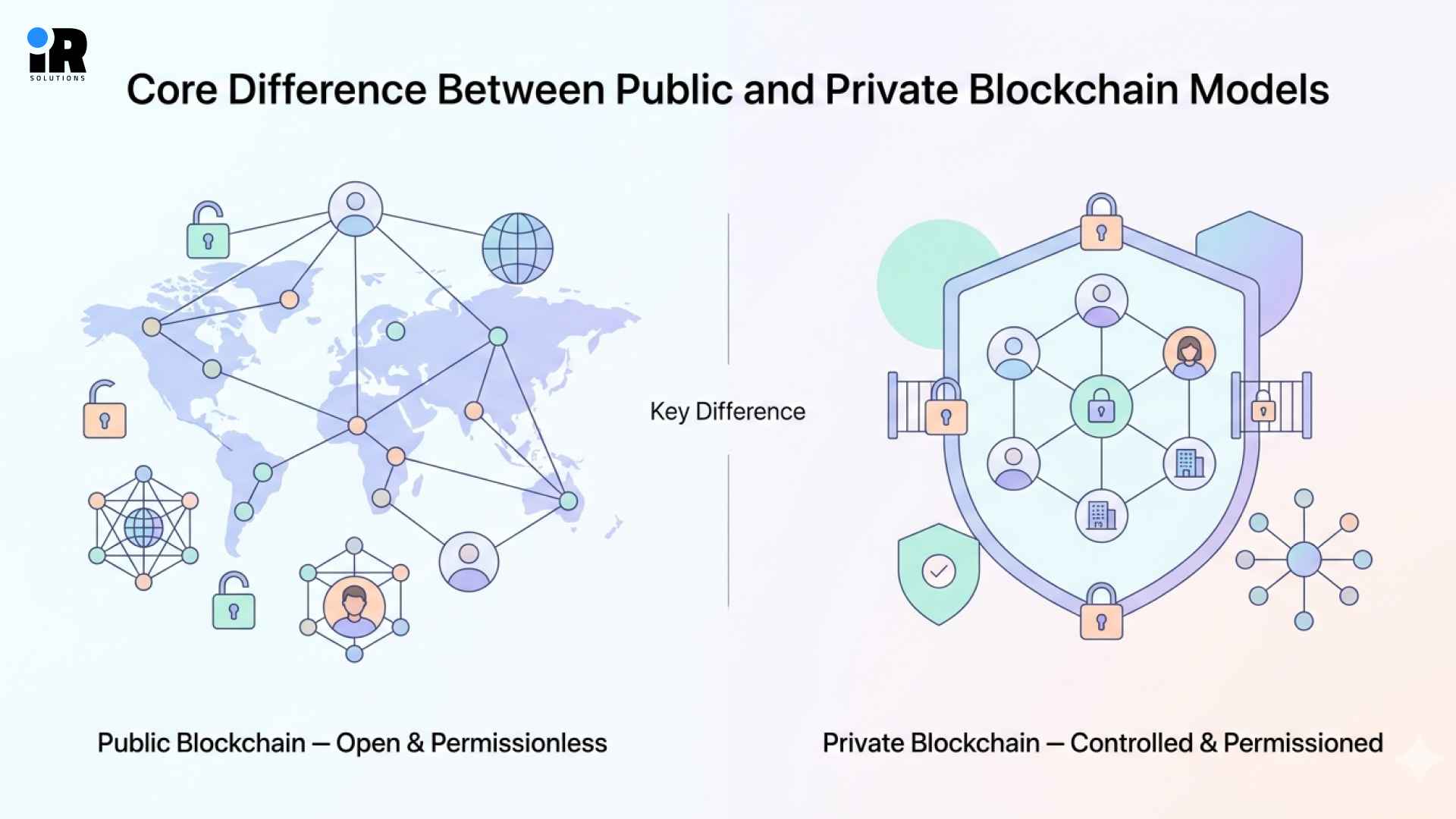
A public blockchain is an open network that anyone can join, read, and interact with freely. Bitcoin and Ethereum are the most recognized examples of public blockchains operating globally today. No single company, government, or organization controls who participates or what gets recorded on the chain. Thousands of independent computers around the world validate transactions through consensus mechanisms that keep the system honest. Anyone with an internet connection can submit transactions, read the full ledger, and interact with deployed smart contracts without asking for permission. This open structure makes public blockchains highly resistant to censorship, data manipulation, and single points of failure over time.
A private blockchain works on a fundamentally different principle from the start. Access is restricted to verified participants approved by a governing organization or a consortium of trusted companies. Administrators control who can read data, who can write to the chain, and how governance rules are structured and enforced. The network is not fully decentralized by design, and that is an intentional trade-off for greater operational control. Businesses handling sensitive client data or operating in regulated industries consistently find this model more practical and manageable in real-world deployments.
How Transaction Speed Separates These Two Architectures
Speed is where the difference between public and private blockchains becomes measurable in practical, business-critical terms.
Ethereum currently processes roughly 15 to 30 transactions per second under normal network conditions. That documented ceiling affects real applications, particularly those requiring fast payment settlement, real-time confirmation, or high-frequency processing at scale. When network congestion increases, confirmation times stretch longer and fees climb without any reliable warning.
Hyperledger Fabric, one of the most widely deployed private blockchain frameworks for enterprise use, handles over 3,500 transactions per second under well-configured network conditions. That difference reflects a structural architectural choice, not just hardware improvements. Private chains reach consensus faster because they coordinate among a smaller group of known, trusted nodes rather than seeking agreement from an open global validator network. For businesses where transaction throughput is a daily operational requirement, this gap has direct and measurable consequences on system performance.
What Businesses Actually Pay on Each Model
Choosing the wrong cost model early creates budget problems that compound quickly as transaction volume grows. Understanding what you will actually pay on each model before you build saves far more than it costs to get it right from the start.

- Unpredictable Bills: Public blockchain gas fees move with network demand, not your business volume, making budgets hard to predict.
- Peak Pain: During congested periods, a single Ethereum transaction has cost businesses hundreds of dollars in fees alone.
- Owned Infrastructure: Private blockchains replace volatile token fees with fixed server and maintenance costs you actually control.
- Higher Upfront: Setting up a proper private network starts in the tens of thousands, but per-transaction costs stay flat and foreseeable.
- Long-Term Wins: For fintech and banking businesses running high daily volumes, predictable infrastructure saves substantial money over twelve months.
Where Public Blockchain Genuinely Earns Its Place
Public blockchains are well-suited for specific types of applications, and those applications should absolutely use them rather than working around their strengths.
Peer-to-peer cryptocurrency payments are the clearest established use case for public blockchain infrastructure. Businesses accepting Bitcoin or Ethereum process transactions directly without any bank or financial intermediary handling the settlement. That is what public networks were originally designed for, and they continue to handle it well at scale.
Decentralized finance applications can only function properly on public blockchains because of how composability works across that ecosystem. Lending protocols, decentralized exchanges, and yield platforms depend on the ability to interact with other smart contracts deployed across a shared, open network. A private chain cannot replicate this environment because open participation and shared state are fundamental to how DeFi products operate and deliver value.
NFT markets and digital asset provenance tracking are another strong fit for public chain infrastructure. Proving that a specific digital asset belongs to a specific wallet address, with a verifiable and permanent transaction history, is a problem that public blockchains solve cleanly. The value comes precisely from the fact that no central authority needs to confirm ownership, the chain handles it transparently and independently.
Organizations running transparent governance processes, community voting, or grant allocation also benefit from public chains. Any participant can independently verify the outcome without needing to trust the organization running the process.
For a clear breakdown of blockchain development in 2026, this guide explains Blockchain Development Guide 2026: Use Cases, Costs, Technologies & How to Get Started.
Where Private Blockchain Delivers Real Business Value
Private blockchains are built for industries where controlling who sees data, how fast transactions are processed, and whether compliance requirements are met are non-negotiable from day one.
Supply chain and healthcare are two of the strongest use cases. Large manufacturers need tamper-resistant records across supplier networks without exposing sensitive pricing or sourcing data on a public ledger. Businesses in supply chain and logistics, and the healthcare and wellness sector, consistently turn to private deployments because public chains simply cannot meet their data privacy or regulatory requirements.
Financial institutions, legal teams, and internal audit functions follow the same logic. Speed, privacy, and compliance integration all point toward permissioned systems. Hyperledger Fabric and Corda were built specifically for these environments and continue to lead enterprise deployments.
For teams exploring how programmable logic fits into these workflows, What Role Do Smart Contracts Play in RWA Transactions? gives useful context on how private and permissioned systems actually operate in practice.
The Security Trade-Off Most Articles Get Wrong
Public and private blockchains are not competing on the same security dimensions, and choosing between them comes down to understanding which threats actually matter for your specific business context.

- Tamper Resistance: Public chains like Bitcoin have a decade-long track record of making confirmed transaction tampering economically and technically impossible at scale.
- Transparency Risks: Full public visibility lets competitors analyse on-chain patterns and extract sensitive information about your business relationships and financial activity.
- Compliance Exposure: Storing personal or regulated financial data on a permanently public ledger creates direct conflicts with privacy laws and regulatory requirements.
- Controlled Access: Private blockchains protect the ledger through verified participant identities and governance rules, so compromised accounts can be revoked and errors corrected through defined processes.
- Right Fit Wins: The stronger security model is not the most decentralised one, it is the one built around the actual threat landscape your business and industry faces.
The real mistake is treating security as a single axis where one model scores higher than the other. Both models are genuinely secure within the boundaries they were designed for, and misapplying either one creates vulnerabilities that the other would have avoided entirely.
Compliance Requirements Often Make the Decision Straightforward
In regulated industries, legal and compliance requirements frequently resolve the architecture debate before it becomes a lengthy technical discussion.
GDPR is the most commonly encountered compliance constraint in blockchain architecture decisions for businesses serving European customers. The regulation gives EU residents the right to request deletion or correction of their personal data. That right conflicts directly with blockchain immutability, because confirmed records cannot be altered or removed after they are written. Storing personally identifiable information on a public chain creates compliance exposure that is technically difficult and expensive to remediate after the fact. This applies to any business with EU customers, regardless of where the organization is based.
HIPAA creates equivalent constraints for healthcare organizations operating in the United States. Financial regulations governing data residency, access logging, and audit trail requirements often require permissioned systems where every data interaction is documented and controllable. PCI-DSS standards for payment card data add additional requirements that are difficult to satisfy on a public, fully transparent blockchain infrastructure. Startups in particular tend to treat compliance as a later problem, which regularly turns an expensive rearchitecture several months into a live product.
Hybrid Blockchain Combines Both Without Full Compromise
Some business models genuinely need elements of both architectures, and a hybrid setup lets organizations run sensitive internal operations on a private chain while anchoring specific records to a public chain for independent verification by customers, regulators, or external partners.
A pharmaceutical company might keep batch records and quality certifications on a private network while publishing final product authenticity data publicly so retailers and regulators can verify it without needing system access. A financial platform follows the same logic as private chains handle internal settlements, while selected regulatory events get recorded on a public ledger for external compliance purposes.
Managing two environments does add infrastructure overhead and requires careful coordination between systems over time, but that investment makes sense when your stakeholders genuinely have incompatible data access requirements. For straightforward use cases, a hybrid setup usually adds unnecessary complexity without a real payoff. Hiring dedicated blockchain developers with cross-architecture experience significantly reduces the design risk and deployment time that hybrid builds typically carry.
Popular Frameworks Every Development Team Should Know
When a project is moving toward a private deployment, the framework chosen early shapes nearly every technical decision that follows, so getting this choice right matters more than most teams initially expect.
Hyperledger Fabric remains the most widely deployed enterprise blockchain framework in production, and for good reason, it is modular, handles high transaction volumes cleanly, and integrates well with existing enterprise systems and compliance infrastructure. Hyperledger development is a natural starting point for organizations that need a proven, well-supported private foundation. Corda sits alongside it for financial services specifically, where its model of sharing transaction data only between the parties directly involved fits the privacy demands of banking, insurance, and trade finance far better than a broadcast model ever could. Quorum fills a different gap teams already deep in the Ethereum stack can move into a permissioned environment without rebuilding their technical knowledge from scratch.
On the public side, Ethereum remains the most mature smart contract platform available, with the largest developer community and tooling ecosystem behind it. Solana handles significantly higher throughput for applications where speed on a public network is a genuine requirement. Depending on which direction a project points, teams can bring in dedicated Ethereum developers or smart contract developers with the specific expertise the build actually needs.
The Real Cost of Choosing the Wrong Architecture
Rebuilding a blockchain architecture because the original choice was wrong for the use case typically burns between two and six months of development time, and that estimate does not even cover rewriting smart contracts, rearchitecting the data model, or rebuilding integrations from scratch. The financial hit is real, but the timeline damage tends to hurt more in practice. Stakeholder confidence drops fast when a product slips by months, and competitors do not wait around while a team fixes something that should have been right the first time.
Most architectural mistakes follow one of two patterns. A team building a DeFi product on a private chain loses the open composability that makes DeFi work. Standard wallets cannot connect, other protocols cannot integrate, and the product ends up technically functional but completely isolated from the ecosystem it was built for. A business putting sensitive personal data on a public chain creates compliance violations that only surface during legal review, long after the data model was locked in. Both failures trace back to decisions made early without the right review process in place before development started.
Conclusion
Choosing between public and private blockchain is a business decision with significant technical consequences. Public chains offer openness, decentralization, and access to a global network of protocols, developers, and users. Private chains offer speed, controlled access, compliance alignment, and infrastructure that organizations manage on their own terms.
The right model depends on the product being built, the users it serves, the data it processes, and the regulatory environment it operates in. Making that decision carefully and early, before any code is written, is what separates teams that build the right thing the first time from teams that rebuild it later at high cost. Start your blockchain development journey with solutions built on a solid, well-informed framework.
Frequently Asked Questions
Which blockchain model works better for most businesses?
Private blockchains suit most businesses better because of faster transaction speeds, controlled access, and easier regulatory compliance alignment.
Is a private blockchain more secure than a public one?
Private blockchains offer stronger data governance and access control, but public blockchains are more resistant to record tampering through decentralized consensus.
Can a business use both public and private blockchain together?
Yes. A hybrid model uses a private chain for internal operations and a public chain for externally verifiable or customer-facing records.
What are the most widely used public blockchain networks today?
Bitcoin, Ethereum, Solana, and Cardano are among the most widely used public blockchain networks operating at meaningful scale today.
Which private blockchain frameworks do enterprises use most?
Hyperledger Fabric, Corda, and Quorum are the three most widely deployed private blockchain frameworks across enterprise applications globally.
Does a private blockchain need its own cryptocurrency?
No. Private blockchains can operate with internal tokens or with no token or cryptocurrency component at all.