





Key Takeaways
- Smart contract development starts with requirements and specifications, not coding.
- Architecture decisions should define permissions, integrations, upgradeability, trust assumptions, and security risks before implementation.
- Development and testing should happen continuously rather than as separate end-stage activities.
- Independent audits work best once the specification, codebase, and test suite are already stable.
- Testnet validates the complete deployment and integration flow before real assets get involved.
- Mainnet readiness includes key management, monitoring, incident response, deployment rehearsal, and clear operational ownership.
Writing Solidity is only one part of the smart contract development process. A production-ready contract requires careful planning across requirements, specification, architecture, development, testing, security review, deployment, and ongoing monitoring.
Each stage helps define how the contract should behave, how it interacts with other systems, and how risks are identified before real assets are involved. Smart contracts can control valuable assets, execute automatically, and interact with untrusted users without manual intervention. They can also be difficult or impossible to modify once deployed.
Understanding how smart contracts work provides the foundation for understanding the broader smart contract lifecycle. For teams looking at how to develop smart contracts safely, following a structured smart contract development workflow is essential rather than treating Solidity coding as the entire process.
The Smart Contract Development Lifecycle
Smart contract development follows a defined development lifecycle, including requirements and architecture, testing, security review, deployment, and ongoing maintenance.
Phase | Core Question | Primary Output | Release Gate |
Discovery | What needs to exist on chain? | Scope and business rules | Requirements agreed |
Specification | Exactly how should it behave? | Technical specification | Functions, states, and invariants approved |
Architecture | How should the system be built? | Architecture and threat model | Trust model reviewed |
Development | How will the design become code? | Contracts and documentation | CI and reviews passing |
Verification | Does the implementation behave correctly? | Test suite and results | Critical tests passing |
Security Review | What could break or be exploited? | Findings and remediation | Audit-ready codebase |
Independent Audit | What did the team miss? | Audit and fixes | No unresolved critical or high issues |
Testnet | Does the complete product work? | Release candidate | End-to-end validation complete |
Mainnet Readiness | Can production be operated safely? | Deployment runbook | Operational checks complete |
Mainnet | Is the reviewed build deployed correctly? | Verified production contracts | Post-deployment checks pass |
Discovery: Turn the Idea Into Clear Requirements
Clear requirements give the team a stronger foundation for architecture, development, testing, and security decisions.
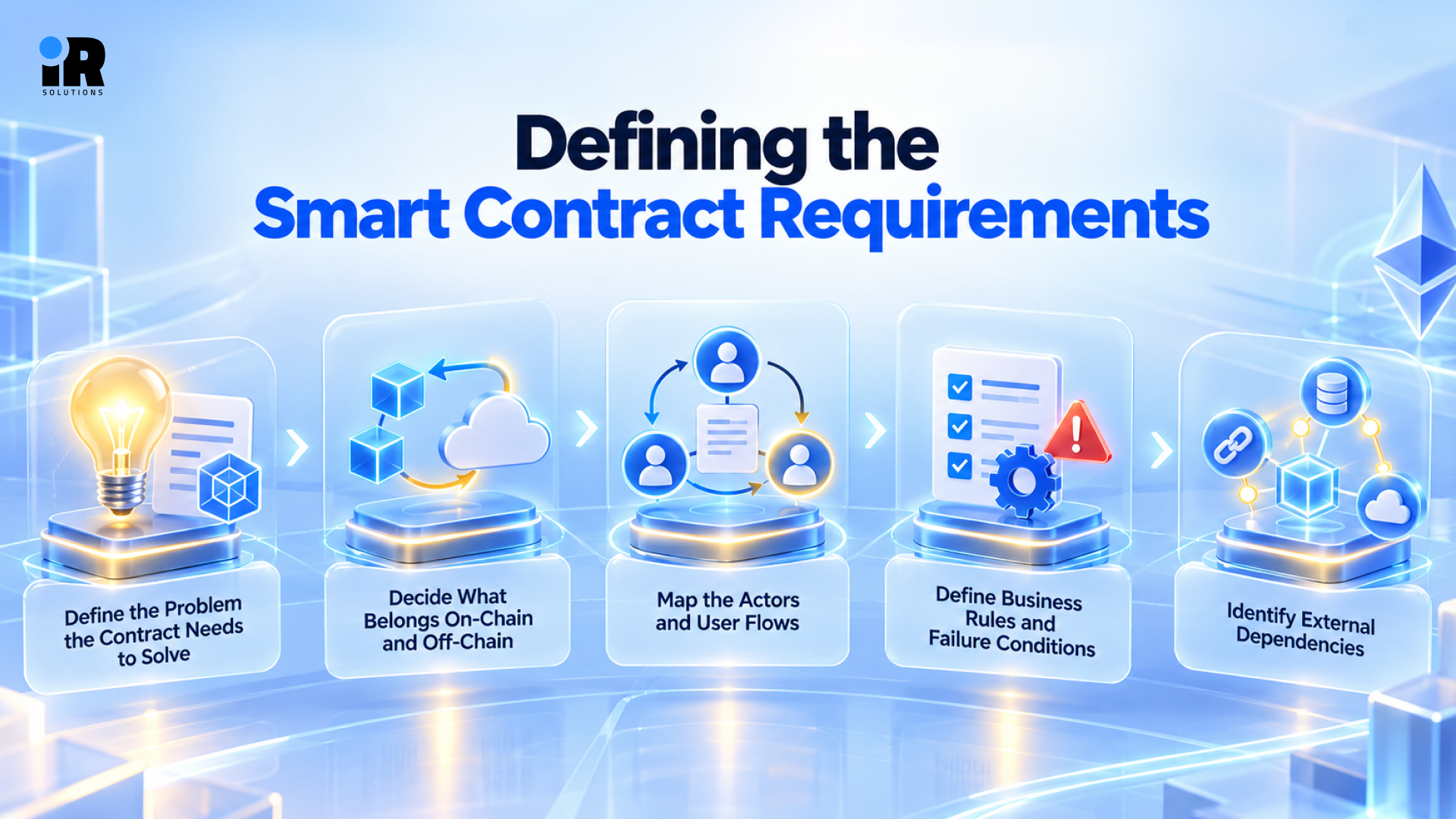
Define the Problem the Contract Needs to Solve
Ask which business rule genuinely needs blockchain enforcement, who will interact with the contract, and what assets it will control. Consider what needs transparency or trust minimization, and whether this functionality truly needs to live on-chain at all.
Decide What Belongs On-Chain and Off-Chain
Good on-chain candidates include ownership, balances, settlement, permissions, token rules, and verifiable state transitions that need public trust. Large files, sensitive personal data, expensive computation, and frequently updated data usually belong off-chain instead.
Map the Actors and User Flows
Identify users, admins, operators, governance participants, external protocols and automated services that interact with the system. Then, for each relevant actor, map specific actions, such as deposit, validate, update state, emit event, and withdraw.
Define Business Rules and Failure Conditions
Document limits, fees, deadlines, eligibility rules, reward formulas, withdrawal rules, emergency behavior, and prohibited actions clearly upfront. The specification should describe both what should happen normally and what must never happen under any circumstance.
Identify External Dependencies
List price oracles, tokens, bridges, decentralised exchanges, lending protocols, wallets, cross-chain messaging, and backend systems the contract depends on. Each external dependency has its own assumptions and potential failure modes that are worth documenting well.
The smart contract requirements gathered during discovery directly impact any smart contract design decisions made later on. Discovery should provide product scope, user flows, business rules, and full integration inventory before specification begins. Here, the release gate means stakeholders are in agreement on what goes on-chain, what contracts must do, who can do what, and major dependencies involved.
Contract count, integrations, and overall complexity all influence smart contract development cost significantly at this early stage.
Specification: Define Exactly How the Contracts Should Behave
A clear specification and threat model establish expected behavior, permissions, state transitions, and security assumptions before implementation begins.
Define Functions and State
Document every function, its inputs and outputs, state variables, structs, mappings, events, and custom errors the contract will use. This becomes the shared reference point for development, testing, and later security review discussions.
Define State Transitions
Show exactly how the contract moves between states, such as created, active, paused, and closed throughout its lifecycle. Document precisely which actors can trigger each specific transition and under what particular conditions.
Build the Permission Matrix
A permission matrix clearly and consistently clarifies which role can perform which action across the entire system.
Action | User | Operator | Admin | Multisig |
Deposit | ✓ | ✗ | ✗ | ✗ |
Withdraw own funds | ✓ | ✗ | ✗ | ✗ |
Update parameters | ✗ | ✓ | ✗ | ✗ |
Pause | ✗ | ✗ | ✗ | ✓ |
Upgrade | ✗ | ✗ | ✗ | ✓ |
Define the Contract Invariants
Invariants are conditions that must always remain true, such as withdrawals never exceeding balances or token supply never exceeding its cap. Unauthorized accounts should never mint tokens, and users should never claim the same reward twice under any sequence.
Define Edge Cases and Error Behavior
Cover zero values, maximum values, duplicate actions, expired deadlines, external call failures, insufficient balances, stale data, and unexpected transaction ordering. These edge cases become essential inputs for both architecture decisions and later testing work.
Specification should produce a technical specification, state model, permission matrix, invariants, and documented edge cases together. The release gate here means the team can explain expected behavior clearly without needing to reference unfinished Solidity code at all.
Architecture and Technology Selection
Smart contract architecture defines how contracts interact, how permissions are managed, how upgrades work, and where security responsibilities sit.
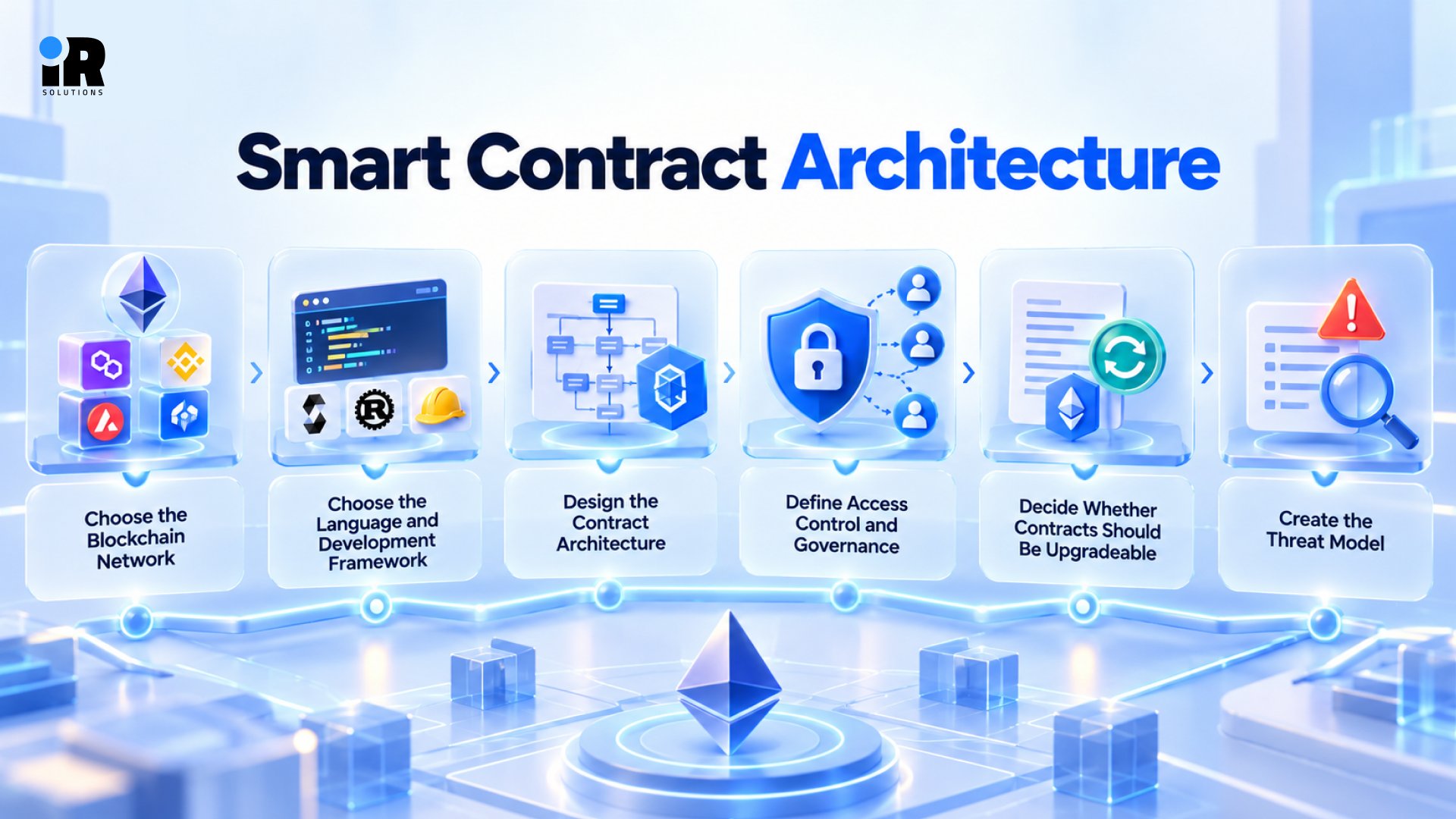
Choose the Blockchain Network
Evaluate security, liquidity, transaction costs, finality, ecosystem maturity, tooling, integrations, and relevant compliance or privacy requirements for your project. Avoid treating this as a simple ranking exercise, since the right choice depends entirely on your specific use case.
Choose the Language and Development Framework
EVM chains commonly use Solidity alongside Foundry or Hardhat as the primary development framework for building and testing contracts. Other ecosystems may use Rust, Move, or platform-specific languages depending on the underlying chain selected.
Design the Contract Architecture
Decide whether functionality should live in one contract, multiple modular contracts, shared libraries, or a proxy and implementation structure. Modularity can improve maintainability considerably, but it also creates more interactions that genuinely need careful testing.
Define Access Control and Governance
Consider ownership structures, role-based access control, multisignature wallets, timelocks, and dedicated governance contracts for sensitive operations. Apply least privilege permissions consistently, so no single role holds more power than it genuinely needs.
Decide Whether Contracts Should Be Upgradeable
Immutable contracts offer a simpler trust model and reduced upgrade authority, but they become genuinely difficult to patch afterward. Upgradeable contracts let logic evolve, though they add proxy complexity and introduce real governance risk.
Create the Threat Model
Identify key assets like tokens, deposits, and governance power, alongside potential attackers including compromised admins or manipulated oracles. Consider attacks such as reentrancy, access control failure, oracle manipulation, flash loan exploits, and front-running carefully.
Architecture should produce a diagram, technology stack, permission model, upgrade strategy, and documented threat model together. The release gate confirms the team has documented why the chain was chosen, contract relationships, trust assumptions, and major threats identified.
Smart Contract Development and Continuous Testing
Smart contract development best practices treat testing as a continuous activity rather than a separate phase saved for the end
Set Up the Development Environment
A typical EVM stack includes Solidity, Foundry or Hardhat, OpenZeppelin Contracts, a local blockchain, Git, continuous integration, and RPC forking infrastructure. Our guide to smart contract development tools covers each of these options in much greater depth.
Use Maintained Libraries Instead of Reinventing Standards
Rely on established standards like ERC-20 and ERC-721, along with maintained access control, cryptographic utilities, and proxy components. Reinventing these standards from scratch introduces unnecessary risk without offering any meaningful benefit over proven implementations.
Write Clear, Reviewable Contracts
Use small functions, explicit names, simple control flow, exhaustive NatSpec documentation, and minimal privileged logic throughout the codebase. Reduce external calls, validate inputs explicitly, and avoid unnecessary cleverness that makes code harder to review
Write Tests Alongside the Code
As you implement each function, write tests right away for expected behaviour, failure conditions, permissions, state transitions, and boundary values. This is a huge departure from quality assurance as a separate phase, dealt with only at the very end.
Run Static Analysis and CI Continuously
Run automated tests, static analysis, linting, compiler warnings, dependency checks, and gas tracking continuously throughout active development work. Catching issues early through continuous integration costs far less than discovering them during a later audit.
Keep Specifications and Tests Synchronized
When business logic changes, update the specification, code, tests, and threat model together in that same order every time. Auditors should never receive documentation that no longer matches the actual implemented behavior of the system.
Development should deliver reviewed code, automated tests, documentation, and a working continuous integration pipeline together. The release gate requires core functionality implemented, tests passing, analysis passing, peer review completed, and documentation matching the real implementation.
Verification and Security Testing
Thorough smart contract security testing at this phase tests complete system behavior, going well beyond the unit tests already written during active development work.
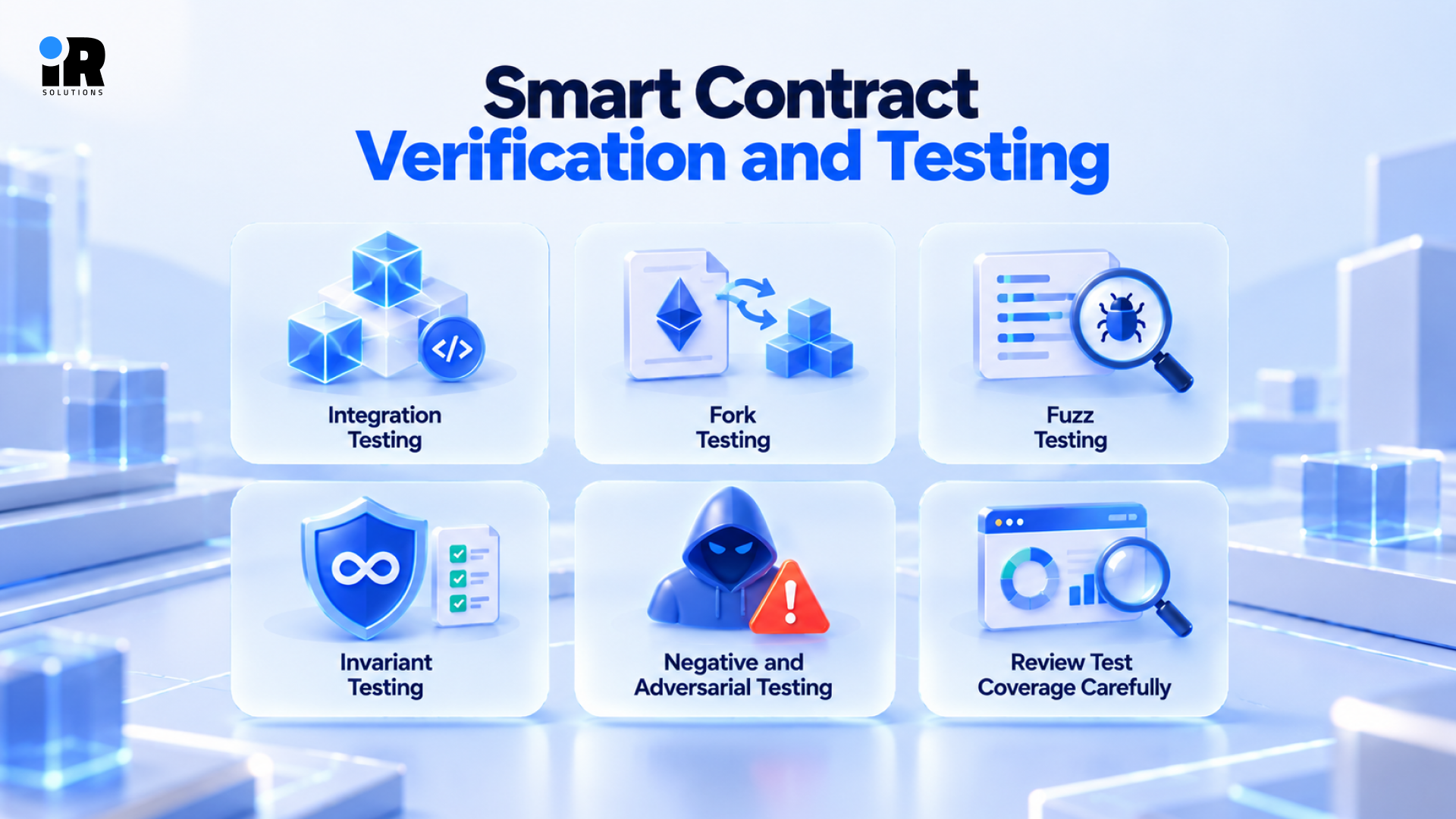
Integration Testing
Test interactions between contracts, tokens, oracles, decentralized exchanges, lending protocols, bridges, and other external systems your contract depends on. These interactions often reveal problems that isolated unit tests alone simply cannot catch beforehand.
Fork Testing
Use real network state to test interactions with already deployed dependencies in a realistic, production-like environment. This approach can expose problems that simplified mocks never reproduce during earlier development testing stages.
Fuzz Testing
Automatically generate a lot of unpredictable inputs to stress test the contract logic beyond what can be achieved by manually writing tests. This smart contract testing process is especially good for finding edge cases that devs would never have thought of themselves manually.
Invariant Testing
Verify that important system properties hold for long, diverse sequences of actions, not just for single isolated transactions. This directly relates back to the invariants documented above in the specification phase of the development.
Negative and Adversarial Testing
Actively try to break permissions, withdrawals, accounting, limits, transaction ordering, external calls, and upgrade paths deliberately. Thinking like an attacker during this stage often reveals issues that normal functional testing overlooks entirely.
Review Test Coverage Carefully
Coverage reveals untested code, but high coverage alone never proves correctness or genuine security on its own. Focus instead on meaningful paths, failure conditions, invariants, and integrations rather than chasing a specific coverage percentage. Our smart contract testing resource covers unit, integration, fuzz, invariant, and fork testing in greater detail.
Verification should produce a complete test suite, documented results, identified issues, and clear remediation plans together. The release gate requires critical workflows covered, core invariants tested, integrations tested, and no known critical correctness failures remaining.
Internal Security Review and Audit Preparation
Internal review helps stabilize the codebase and documentation before an external auditor begins the formal security assessment.
Run an Independent Internal Code Review
A developer who did not write the original code should review logic, access control, state transitions, and external calls carefully. Fresh eyes often catch assumptions the original author simply stopped noticing after extended exposure to the codebase.
Revisit the Threat Model
Compare the original architecture against the final implementation, checking whether new privileged roles or dependencies quietly appeared. Confirm whether upgrade logic or economic assumptions changed meaningfully since the threat model was first written.
Test Emergency Controls
Verify that pause functions, emergency withdrawals, access revocation, multisig operations, upgrades, and role transfers all genuinely work correctly. Emergency controls that fail silently during a real incident defeat their entire intended purpose completely.
Prepare the Audit Package
Provide the specification, architecture, contract scope, threat model, test suite, coverage data, deployment scripts, and exact commit hash. A thorough audit package helps auditors focus their limited time on genuine security analysis instead.
This stage should deliver a stable audit scope, complete documentation, reviewed code, and solid test evidence together. The release gate confirms the codebase is stable enough that auditors will not be reviewing a constantly moving target.
Independent Smart Contract Audit
An independent smart contract security audit provides an external review of the implementation before the reviewed release moves toward mainnet deployment.
Select an Auditor With Relevant Experience
Consider auditors with direct experience in DeFi, real-world assets, bridges, staking, governance, token systems, or upgradeable contracts depending on your project. Relevant domain experience often catches risks that general smart contract knowledge alone would miss.
Give Auditors a Frozen Scope
Record the exact repository, commit hash, included contracts, excluded dependencies, and deployment assumptions before the audit formally begins. A frozen scope prevents confusion and ensures the final audit report applies to exactly what gets deployed.
Classify and Remediate Findings
Findings typically get classified by severity, moving through root cause identification, a fix, a regression test, and re-review. Treat every finding seriously, even lower-severity ones that seem minor at first glance.
Re-Test the Entire Affected System
A single vulnerability fix can introduce unexpected new behavior elsewhere in the system without anyone immediately noticing. Avoid only testing the exact line that changed, and re-test surrounding functionality thoroughly instead.
Freeze the Release Candidate
Once material findings are resolved, tag the release, record the commit, freeze deployment artefacts, and do not make any additional unreviewed code changes. This discipline actually keeps the audited version and the deployed version the same.
The output of this phase should be an audit report, a remediation log and a final review of a release candidate ready for testnet. The release gate requires no unresolved critical or high severity findings, and any accepted lower severity risks must be well documented. Even if you pass this gate , the contract is never 100 % safe in any possible scenario.
Smart Contract Testnet Deployment and Validation
Smart contract testnet deployment should validate the complete release, including contract behavior, integrations, deployment scripts, source verification, and monitoring.
Deploy the Exact Release Candidate
Use the same compiler settings, scripts, initialization flow, roles, and configuration planned for production wherever that is practically possible. This ensures testnet results genuinely reflect what mainnet deployment will actually look like.
Test the Full Application Flow
Test the complete path from wallet through frontend, smart contract, external service or protocol, event emission, and backend indexer. Testing contracts in isolation misses problems that only appear across this full, connected application flow.
Test User Scenarios
In this stage, cover normal usage, failures, duplicate transactions, wallet changes, permission failures, emergency actions, and external service failures. Real users are unpredictable; therefore, testnet scenarios should be as close as possible to unpredictable.
Validate Deployment Scripts
Check constructor parameters, proxy initialization, contract addresses, admin roles, upgrade roles, and token configuration carefully during this validation step. Script errors caught here cost far less than the same errors discovered during actual mainnet deployment.
Practice Source Verification
Confirm the team can reproduce and verify deployed bytecode against the source code before attempting this on mainnet. Struggling with verification for the first time during a real launch creates unnecessary pressure and avoidable delay.
Test Monitoring and Alerts
Confirm monitoring tools and alerts genuinely work correctly now, rather than discovering silent failures only after mainnet deployment occurs. Testnet is the right place to catch a monitoring gap, not launch day itself.
Testnet should deliver a validated release candidate, a tested deployment procedure, and complete end-to-end results. The release gate confirms the full production-like application genuinely works correctly across the chosen test environment.
Post-Mainnet Smart Contract Lifecycle
Mainnet readiness bridges the gap between successful testnet validation and the final production deployment.
Secure Admin and Deployment Keys
Decide clearly who controls the deployer, owner, upgrader, pauser, treasury, and governance roles across the entire system. Use stronger operational controls such as multisignature wallets wherever privileged access genuinely warrants that extra protection.
Validate Every Production Address
Check token addresses, oracle addresses, decentralized exchange routers, multisigs, bridge contracts, governance contracts, and the correct chain ID carefully. One single wrong production address can make otherwise correct Solidity code behave completely incorrectly in production.
Rehearse the Mainnet Deployment
Use fork testing, transaction simulation, deployment scripts, exact constructor arguments, and the exact initialization sequence planned for production. Rehearsing this process removes surprises and builds genuine confidence before the real smart contract deployment process begins.
Prepare Monitoring Before Deployment
Monitor asset movements, privileged transactions, role changes, upgrades, pauses, abnormal events, large withdrawals, and dependency failures from day one. Proper smart contract monitoring should already be running before any real assets touch the contracts.
Create the Incident Response Plan
Document who receives alerts, who investigates issues, who can pause the system, and the multisig approval procedures required for action. Include clear user communication plans, migration procedures, and specific escalation contacts for serious incidents. Our blockchain development services help businesses handle exactly this kind of production readiness work.
Mainnet Deployment: Release the Reviewed Build
The mainnet deployment stage should execute the reviewed release candidate using the same validated configuration and deployment process established during testnet.
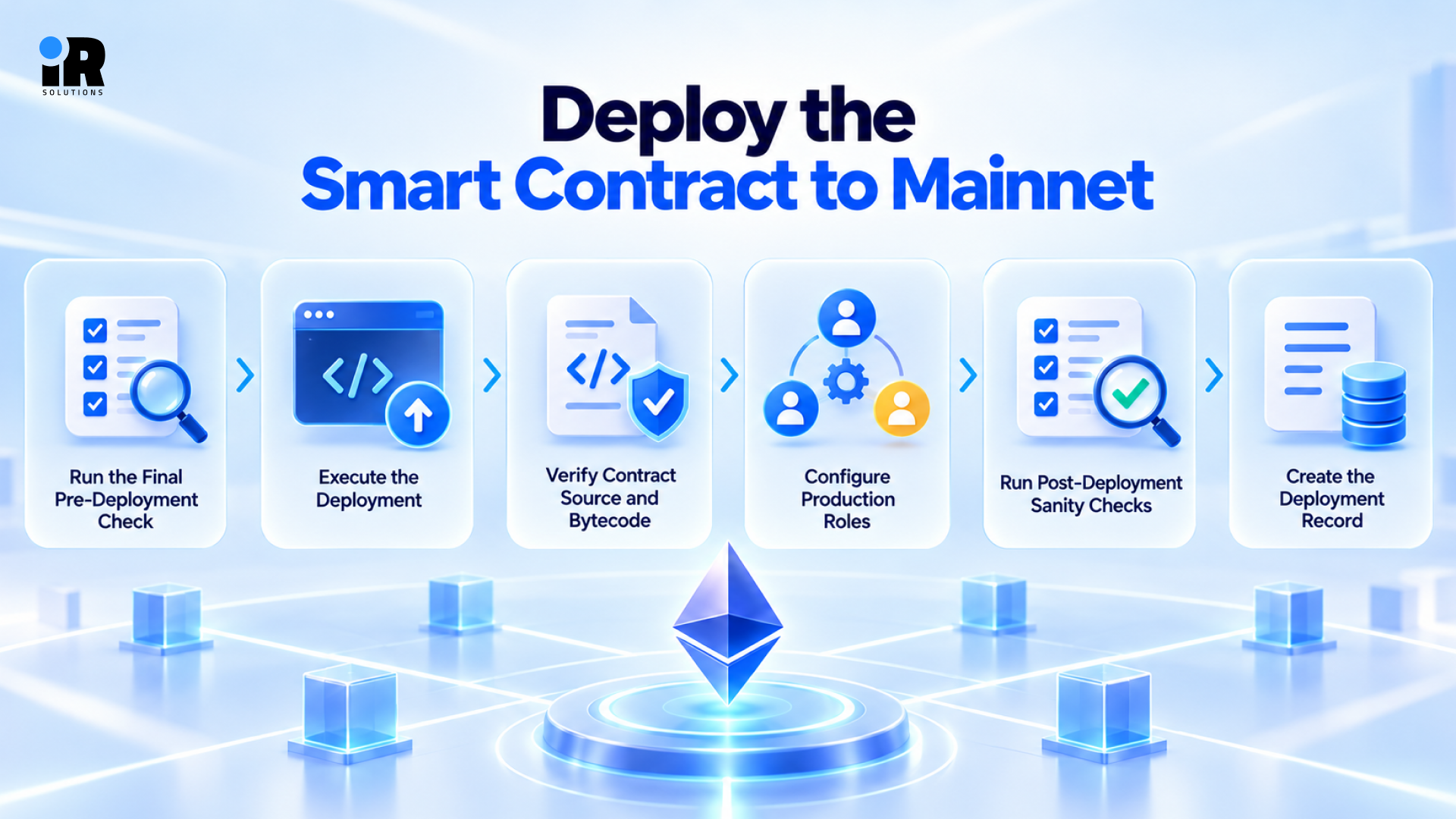
Run the Final Pre-Deployment Check
Check the final commit, compiler version, optimisation settings, target chain, constructor parameters, deployer address, balances, and all dependencies carefully. This final check catches last-minute errors before they become permanent on-chain problems.
Execute the Deployment
Use the same reviewed deployment scripts that have been exercised on the testnet, avoiding any last-minute manual changes to production. Often, entire preventable deployment mistakes result from manual changes under launch pressure.
Verify Contract Source and Bytecode
Check deployed contracts on the relevant block explorer - make sure the verified source code is an exact match for the actual production bytecode. This step of transparency builds user trust and makes it easier to audit the live contract afterwards.
Configure Production Roles
Transfer temporary deployer control to the intended multisig, governance contract, or timelock as originally planned during architecture design. Check carefully that no unintended privileged roles accidentally remain with the original deploying wallet.
Run Post-Deployment Sanity Checks
Confirm addresses, ownership, roles, balances, integration addresses, initial state, contract configuration, and proxy implementation details immediately after deployment. These checks catch configuration mistakes before real users start interacting with the live contracts.
Create the Deployment Record
Record the network, contract addresses, transaction hashes, release commit, compiler configuration, ABI, and the exact deployment date. This record becomes essential reference material for future audits, upgrades, and incident response efforts.
This stage should deliver verified production contracts alongside a complete deployment manifest documenting everything recorded above. The release gate confirms the deployed system genuinely matches the audited and approved release candidate exactly.
Mainnet Is a Release, Not the End of the Lifecycle
Reaching mainnet marks a release milestone, not the actual end of the full smart contract development lifecycle.
Monitor Contract Activity
Monitor contract events, balances, privileged operations, unusual transaction patterns, and dependency failures continuously after launch, not just immediately after launch. Constant monitoring of intelligent contracts usually detects issues well before they become big problems.
Maintain Operational Security
Periodically review signers, multisigs, admin roles, API credentials, monitoring rules, and incident procedures as your team and systems evolve. Operational security naturally decays over time without this kind of regular, deliberate review.
Re-Test and Re-Audit Material Changes
Upgradeable contracts should never treat an audit of version one as blanket approval for every future implementation that follows. Material changes deserve their own dedicated testing and audit cycle before deployment.
Maintain an Upgrade or Migration Path
For upgradeable contracts, follow change, test, review, audit where appropriate, governance, and deploy in that consistent order every time. Immutable contracts instead need a clear plan for how users and assets would migrate to any replacement. A documented smart contract upgrade strategy, decided during architecture rather than improvised later, keeps this entire process far more predictable.
Deliverables at Each Smart Contract Development Stage
Each stage of the process should leave behind a concrete, reviewable deliverable rather than just completed work.
Stage | Key Deliverable |
Discovery | Requirements and business rules |
Specification | Technical specification and state model |
Architecture | Architecture diagram and threat model |
Development | Reviewed source code |
Testing | Automated and security test results |
Audit | Audit report and remediation record |
Testnet | Validated release candidate |
Mainnet | Verified contracts and deployment record |
How Long Does the Smart Contract Development Process Take?
The timeline depends on the type and complexity of the smart contract project. Simple tokens require less development and testing, while projects with multiple contracts, integrations or higher security needs take more time.
The table below indicates the primary factors that can expand the development scope for various project types.
Project Type | Factors That Usually Increase Scope |
Basic token | Token logic, access control, testing |
NFT or vesting | Token standards, schedules, permissions |
Staking | Rewards, accounting, timing, integrations |
Governance or DAO | Voting, proposals, permissions, execution |
RWA platform | Asset rules, compliance requirements, integrations |
DeFi protocol | Multiple contracts, economic risks, integrations |
Cross-chain protocol | Messaging, bridges, multiple networks |
For a detailed timeline and budget estimates, see our smart contract development cost guide, which covers costs across different project types.
Conclusion
Errors become harder and more expensive to correct the closer a project gets to production deployment. That is why an effective smart contract development process should front-load clear requirements, thoughtful architecture, continuous testing, and thorough security review. Each stage builds on the previous one, from defining requirements and designing the architecture to development, verification, auditing, testnet validation, and mainnet readiness.
Treating these stages as connected parts of one lifecycle helps teams identify issues earlier and maintain consistency between specifications, code, tests, and deployment. A structured approach creates a clearer path toward a production-ready smart contract system while supporting safer ongoing monitoring, maintenance, and future upgrades.
Frequently Asked Questions
What are the stages of smart contract development?
This is the complete flow from requirements and specification to architecture, development, testing, auditing, testnet validation, and mainnet deployment. But broadly, there's a much wider, more structured process, and writing Solidity code is only one part of that.
What are the stages of smart contract development?
The stages are discovery, specification, architecture, development, verification, security review, independent audit, testnet validation, mainnet readiness, and mainnet deployment. Each stage has a specific deliverable that must be produced before the project can proceed to the next stage.
What should be done before writing a smart contract?
Firstly, teams should define business rules, map user flows, decide what goes on-chain and document invariants and edge cases. Writing a technical specification before coding helps avoid costly rework after implementation has begun.
How do you design a smart contract architecture?
Smart contract architecture involves choosing the blockchain, selecting a language and framework, deciding on modularity, defining access control, and building a threat model. These decisions shape security and maintainability far more than implementation details later on.
When should smart contract testing begin?
Smart contract testing should begin alongside development itself, with tests written for each function as soon as it gets implemented. Treating testing as a separate, later phase usually produces weaker coverage and more expensive late-stage fixes.
What is the difference between testing and auditing a smart contract?
Testing is performed continuously by the development team to verify expected behavior, while an audit is an independent, external security review. Both serve different purposes, and neither one should be treated as a complete substitute for the other.
Should a smart contract be audited before mainnet?
Yes, an independent smart contract security audit should happen after specification, development, and internal testing are already stable and complete. Audits catch issues that internal teams, having built the system, may simply no longer notice themselves.
Why deploy a smart contract to testnet first?
Testing in testnet verifies the full application flow, including wallets, frontends, external integrations, and monitoring, prior to the use of any real assets. It is the last chance to catch integration issues before real financial risk comes into play.
How long does smart contract development take?
Timelines range greatly based on contract complexity, integrations, upgradeability, audit scope, and the number of rounds of remediation afterward. Simple token contracts are faster, while complex DeFi or cross-chain protocols take significantly longer to finish.
What tools are used for smart contract development?
Typical tools include Solidity, Foundry, Hardhat, OpenZeppelin Contracts, static analysis tools, and CI pipelines for automated testing and review. The right combination depends mostly on the blockchain chosen and the particular needs of the project involved.
Should smart contracts be upgradeable?
That's a trade-off between simplicity and flexibility. Immutable contracts have a simpler trust model; upgradable contracts give you the ability to change things later. Upgradeable contracts add proxy complexity and real governance risk that must be managed carefully.
What should be checked before mainnet deployment?
Teams should check production addresses, practice the deployment, secure admin keys, prepare monitoring, and complete an incident response plan in advance. Nothing needed for a safe operation should be left to be configured after launch.
What happens after a smart contract goes live?
Once deployed, teams should monitor contract activity and maintain operational security. Any material future changes should be re-tested or re-audited carefully. The release milestone within the lifecycle is reaching mainnet, not the actual end of ongoing responsibility.


