


Key Takeaways
- The tokenized asset market is projected to reach into the trillions by the early 2030s, making platform selection a higher-stakes decision than it was even a year or two ago.
- RWA tokenization platforms vary significantly in the asset classes they support, blockchain networks they integrate with, and compliance infrastructure they offer.
- Securitize and Tokeny lead for institutional and regulated securities work while Centrifuge and Ondo Finance serve different market needs.
- Choosing between an existing platform and custom development depends on project complexity, budget, and long-term scalability requirements.
- Compliance infrastructure, smart contract security, and secondary market support are the three features that most consistently determine platform suitability.
- No single platform is the best choice for every asset type, investor audience, or regulatory environment simultaneously.
Real-world asset tokenization is changing the way businesses invest, raise capital, and manage ownership. Instead of keeping assets like real estate, private equity, or commodities in traditional systems, companies can now represent them as digital tokens on a blockchain. This makes buying, selling, and managing assets faster, more transparent, and accessible to a wider range of investors.
As regulations become clearer and blockchain technology continues to mature, more businesses are exploring tokenization. The market is also growing quickly. Ark Invest estimates that tokenized assets could be worth more than $11 trillion by 2030, while BCG and Ripple expect the market to reach $18.9 trillion by 2033.
Today, there are many RWA tokenization platforms to choose from, but each one serves a different purpose. Some are built for regulated securities and institutional investors, while others focus on DeFi, tokenized treasury products, or white label investment platforms.
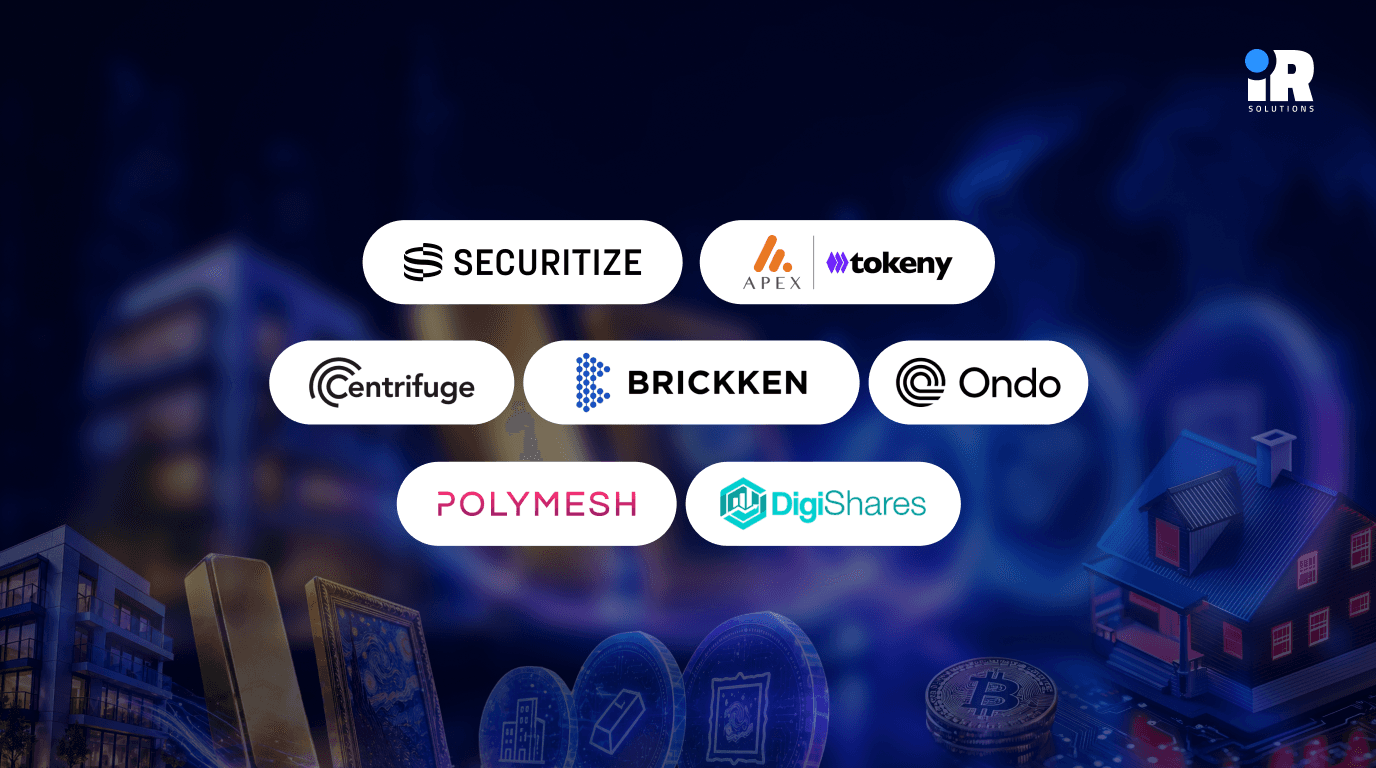
Choosing the right platform is about more than creating digital tokens. You also need to think about compliance, smart contract security, supported blockchains, investor management, secondary trading, and how well the platform can grow with your business. In this guide, we compare seven leading RWA tokenization platforms to help you find the right fit for your business goals.
What Is an RWA Tokenization Platform?
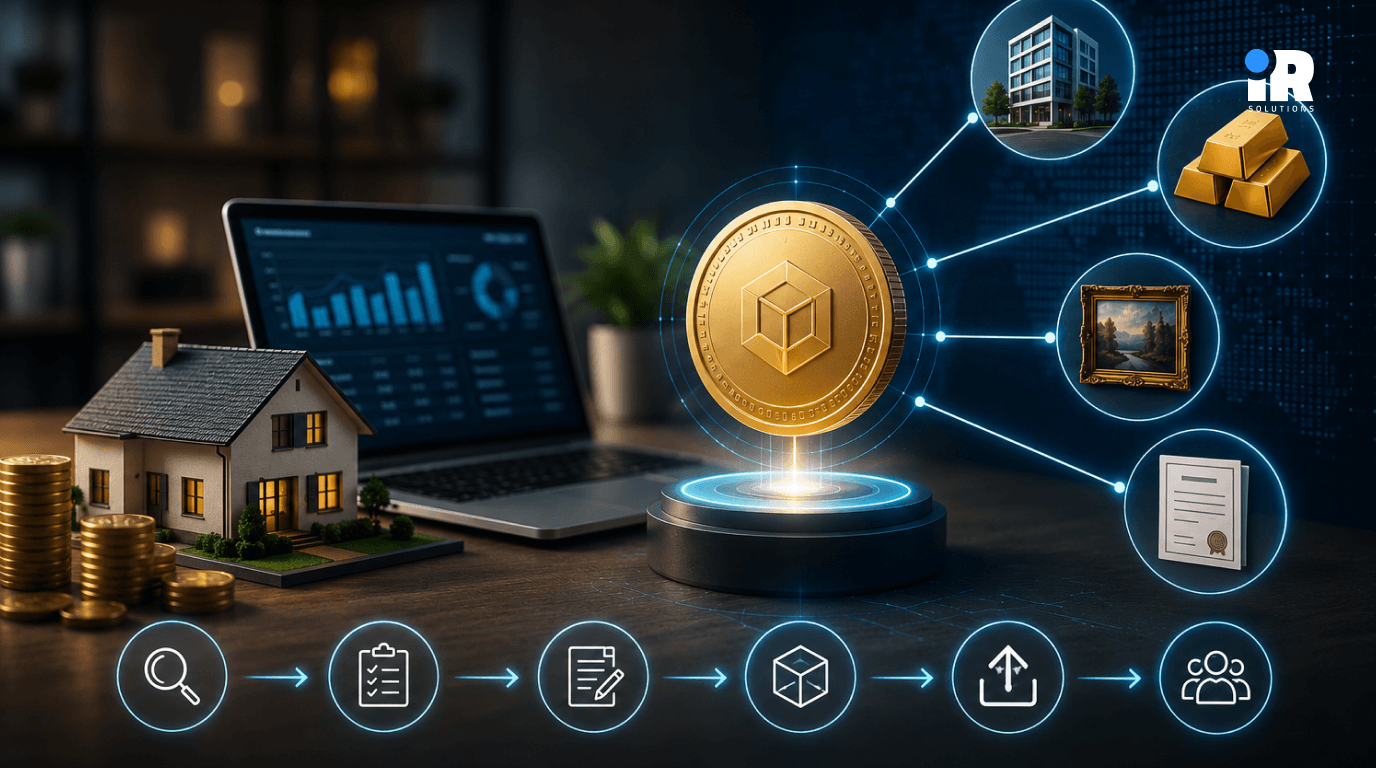
RWA tokenization platform is software infrastructure that allows real-world assets to be represented as digital tokens on a blockchain, managing the legal, technical, and operational layers required to issue, distribute, and manage those tokens throughout the asset's lifecycle.
The platform handles more than the technical minting of tokens. It covers KYC and AML verification for investors, transfer restrictions that enforce regulatory compliance at the transaction level, income distribution through smart contracts, investor management dashboards, and in many cases secondary market access that gives token holders a liquidity pathway after the initial issuance. Understanding the full scope of what a platform covers, and what it leaves to the issuer to arrange separately, is the first thing to get clear before any comparison makes sense.
Not sure where to start with your own asset? This guide on how to tokenize assets walks through the process step by step.
Criteria for Ranking the Best RWA Tokenization Platforms
This is not a ranking based on platform marketing or funding rounds. Each dimension below reflects what actually matters when a project is live, and investor capital is committed.
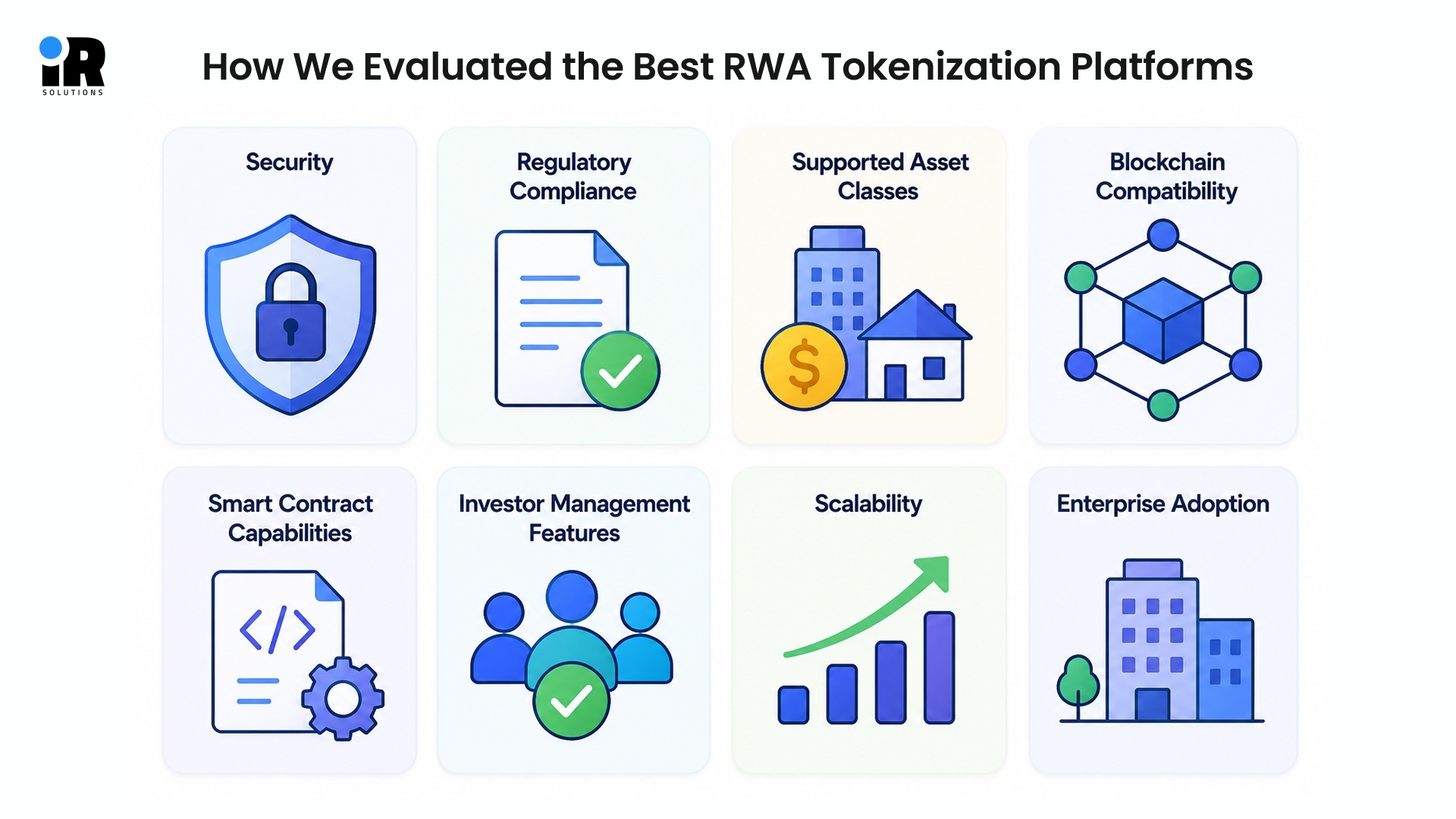
Security
The strength of the platform's smart contract auditing process, its track record in production deployments, and its approach to protecting investor assets from technical vulnerabilities at every layer of the system, not just at token issuance.
Regulatory Compliance
Whether the platform has built compliance infrastructure natively into the token transfer logic or relies on external processes that create gaps between the technical system and the legal requirements the offering must actually meet in the jurisdictions where it operates.
Supported Asset Classes
Some platforms are built around a specific asset class and have limited capability outside of it. Others support a broader range but with varying depth across each category. The breadth of the asset list on a website does not tell you which asset classes the platform has actually deployed in production.
Blockchain Compatibility
Whether the platform operates on a single blockchain network or supports multi-chain deployment affects investor access, transaction costs, and the token's regulatory compatibility across markets over the asset's operational life.
Smart Contract Capabilities
The sophistication of the smart contract infrastructure, including automated income distribution, programmable transfer restrictions, governance logic, and the platform's ability to update contract behaviour as regulatory requirements evolve, without requiring a full rebuild.
Investor Management Features
The quality of the investor portal, the reporting tools available to both issuers and investors, and how easy it is to manage investor onboarding and ongoing communication through the platform instead of separate external systems.
Scalability
Whether the platform can support the transaction volume, investor count, and asset portfolio size the project is likely to reach across its full operational life, not just at initial launch, when everything is still small
Enterprise Adoption
The track record of institutional adoption, the quality of the enterprise integration options, and the platform's stability as a long-term infrastructure partner for a project that may need to run reliably for a decade or longer without a platform migration.
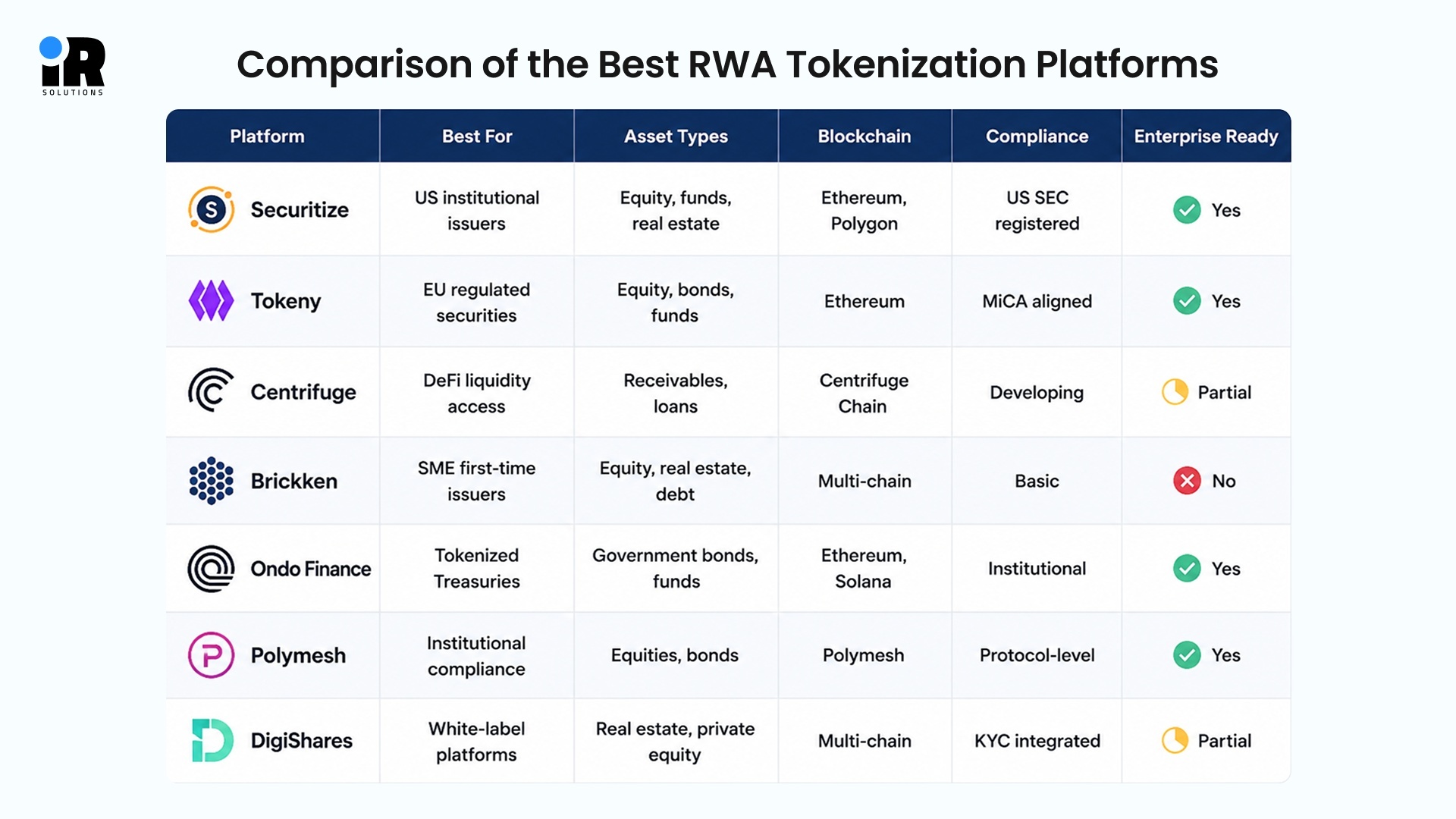
Leading RWA Tokenization Platforms Compared
Each platform reviewed here has been deployed in production environments with real investor capital. That is the baseline requirement for inclusion. There are many platforms claiming tokenization capability that have not cleared it yet. Businesses evaluating different tokenization approaches often need to consider their long-term technology strategy alongside available platform options. Companies such as IR Solutions work with organizations exploring blockchain-based solutions across different industries and use cases.
Securitize
Securitize is the most established platform in the regulated digital securities market and has processed more institutional token issuance than any other platform in this comparison by a considerable margin.
Overview
Founded in 2017, Securitize operates as a registered transfer agent and alternative trading system in the United States, which gives it a regulatory standing that most competitors cannot match in the US market. That regulatory standing matters for issuers who need it. For issuers who do not, it adds cost without proportional benefit.
Key Features
- Full KYC and AML integration with transfer restriction enforcement at the token level
- Secondary market access through the Securitize Markets ATS
- Automated dividend and income distribution through smart contracts
- Multi-jurisdiction compliance support across the US, Europe, and Asia
Supported Assets
Private equity, real estate, investment funds, debt instruments, and venture capital fund interests.
Pros
- Strongest regulatory infrastructure of any platform in this comparison
- Established institutional client base including BlackRock and KKR
- ATS licence provides legitimate secondary market access in the US
Cons
- Higher cost structure than most alternatives in this comparison
- Less flexible for non-US issuers who do not need US regulatory infrastructure and are paying for it anyway
Best For
US-based issuers targeting accredited investors and institutional capital in a fully regulated environment where compliance infrastructure is the primary requirement over cost efficiency or speed to market.
Tokeny
Tokeny focuses specifically on compliance-first tokenization for regulated securities markets in Europe and has built a strong institutional client base across the EU since its founding.
Overview
Built around the ERC-3643 token standard, which encodes compliance rules directly into the token transfer logic. This matters more than it might sound because it removes a category of compliance gap that exists when enforcement relies on external processes instead of the token itself.
Key Features
- ERC-3643 standard with built-in transfer restriction logic
- Full EU regulatory compliance including MiCA framework alignment
- White-label platform options for financial institutions issuing their own tokens
- Integration with major European custody providers
Supported Assets
Equities, bonds, real estate funds, investment funds, and structured products.
Pros
- Best compliance infrastructure for European issuers in this comparison
- ERC-3643 is becoming the standard for institutional regulated tokens
- Strong white-label capability for financial institutions that want their own branded platform
Cons
- Primarily focused on European regulatory environments, with limited global deployment
- Less suitable for US-focused offerings without additional legal structuring that adds cost
Best For
European financial institutions, asset managers, and fund administrators issuing regulated digital securities under EU frameworks including MiCA, where compliance infrastructure is more important than cost.
Centrifuge
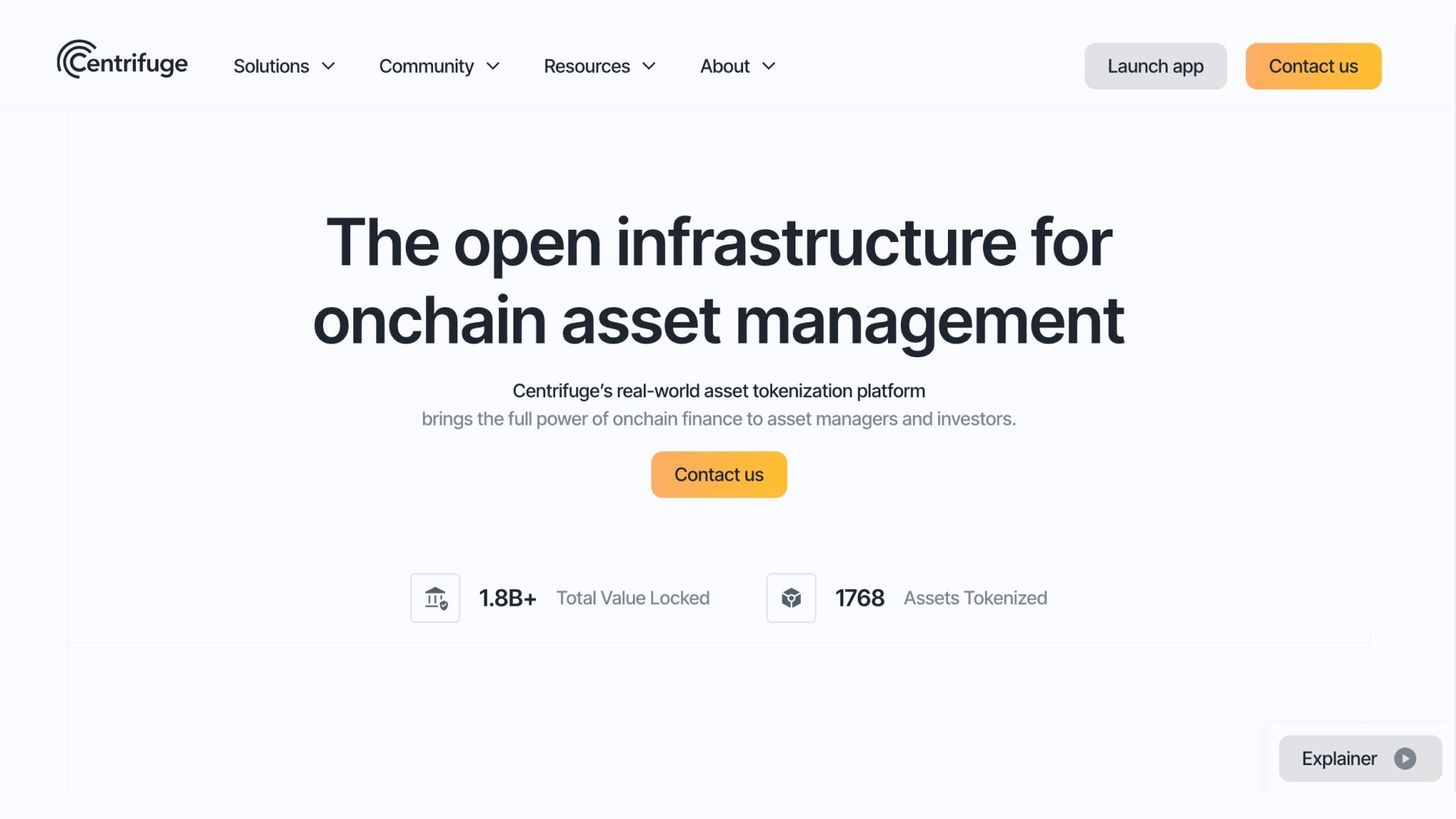
Centrifuge is a genuinely different type of platform from the others in this comparison, rather than competing with Securitize on regulated securities. It connects real-world assets to DeFi liquidity, which is a different problem entirely.
Overview
Centrifuge allows businesses to tokenize invoices, trade receivables, and other income-generating assets to access on-chain liquidity from DeFi protocols. If that is not what the project needs, Centrifuge is not the right fit regardless of how it compares on other dimensions.
Key Features
- Native integration with DeFi protocols including MakerDAO and Aave
- Centrifuge Chain built on Polkadot for cross-chain asset bridging
- Pool-based structure for managing multiple asset originations simultaneously
- Transparent on-chain reporting for all pool participants
Supported Assets
Trade receivables, invoices, real estate loans, microfinance assets, and revenue-based financing.
Pros
- The strongest option for accessing DeFi liquidity against real-world assets
- Established relationships with major DeFi protocols and lending pools
- Strong transparency and reporting for DeFi-native investors who demand it
Cons
- Not suitable for traditional investor audiences unfamiliar with DeFi protocols
- Regulatory framework less developed than compliance-first platforms designed for traditional capital markets
Best For
Businesses wanting to access DeFi liquidity against income-generating real-world assets rather than raising capital from traditional regulated investor bases through a structured securities offering.
Brickken
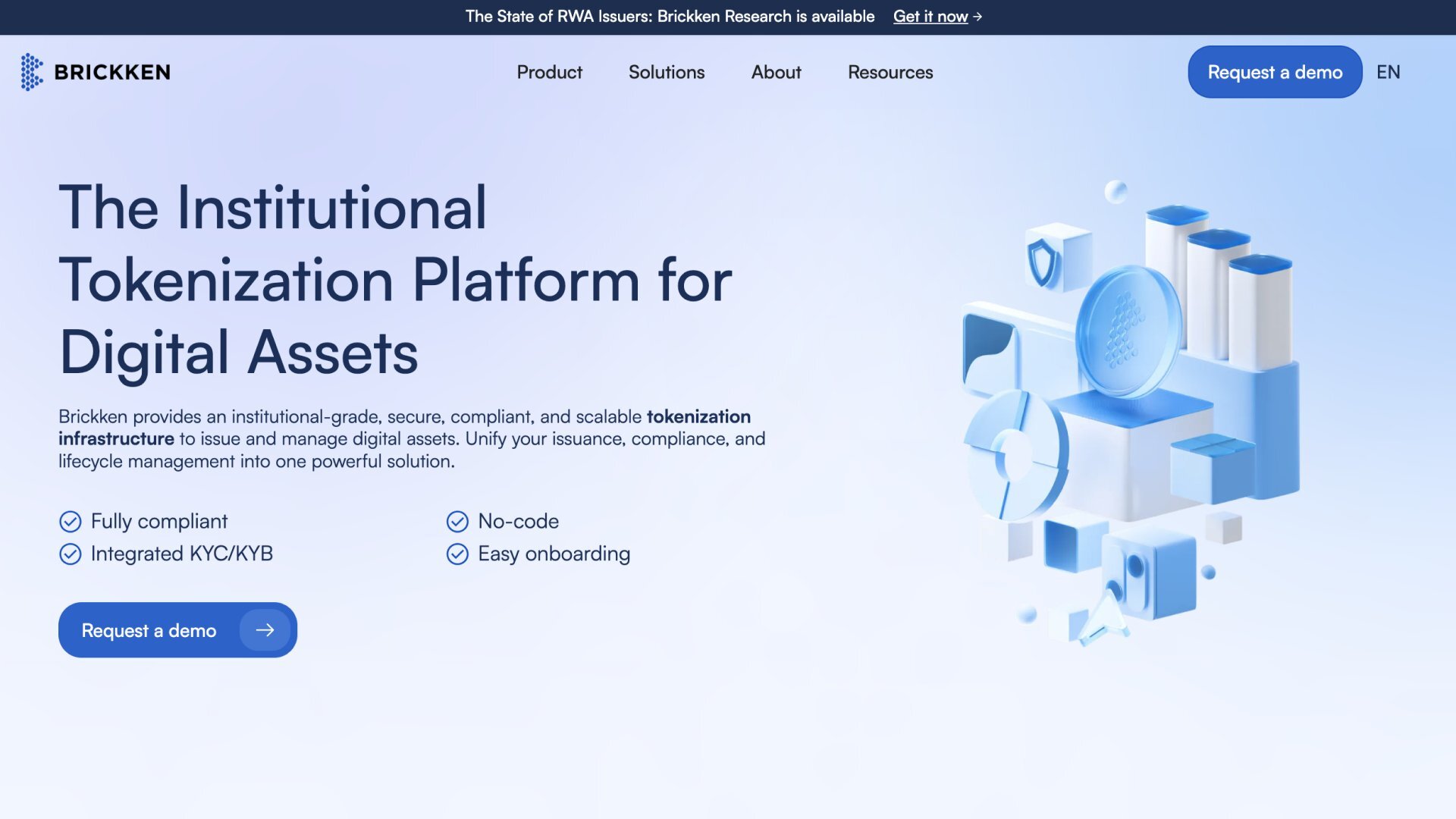
Brickken is the most accessible platform in this comparison for first-time issuers. It trades some of the compliance depth of the enterprise platforms for a significantly lower barrier to entry.
Overview
Brickken provides a self-service tokenization interface that allows businesses to design, issue, and manage security tokens with less technical overhead than most platforms in this comparison require. That accessibility is genuinely useful for the right project and a limitation for the wrong one.
Key Features
- Self-service token design and issuance workflow
- Multi-blockchain support including Ethereum, Polygon, and BNB Chain
- Built-in cap table management and investor dashboard
- Integrated KYC and payment processing for investor onboarding
Supported Assets
Real estate, equity, debt instruments, and revenue-sharing tokens for small and medium businesses.
Pros
- Most accessible platform for first-time issuers without deep technical resources
- Lower cost structure than enterprise platforms with comparable core functionality
- Multi-chain support gives flexibility on transaction costs depending on the asset and investor base
Cons
- Less regulatory depth than Securitize or Tokeny for complex institutional offerings
- Secondary market infrastructure is less developed than larger platforms with dedicated ATS licences
Best For
Small and mid-market businesses issuing their first security token offering with limited technical resources and a budget that rules out enterprise platform costs before the project has demonstrated commercial viability.
Ondo Finance
Ondo Finance has become the most visible platform in tokenized Treasury products. The concentration is deliberate, and the result is a platform that does one thing very well and is not trying to do everything else.
Overview
Ondo tokenizes US Treasury bills and money market fund exposure, giving institutional and retail investors on-chain access to yield-bearing government-backed instruments. The product works, and the AUM numbers back that up, but Treasury tokenization is essentially all Ondo does.
Key Features
- Tokenized US Treasury and money market products with daily liquidity
- Integration with major DeFi protocols for yield deployment
- On-chain proof of reserve for all tokenized fund holdings
- Institutional-grade custody through established partners
Supported Assets
US Treasury bills, money market funds, and short-duration government bond exposure.
Pros
- Market leader in tokenized Treasury products with substantial AUM
- Strong institutional partnerships and custody infrastructure
- Daily liquidity on tokenized products that traditional equivalents do not offer
Cons
- Limited to fixed income and Treasury asset classes with no meaningful expansion into other categories
- Not suitable for real estate, equity, or alternative asset tokenization projects
Best For
Institutional and DeFi-native investors wanting on-chain exposure to government-backed yield instruments with daily liquidity, verifiable reserve backing, and the credibility that comes with established institutional custody arrangements.
Polymesh
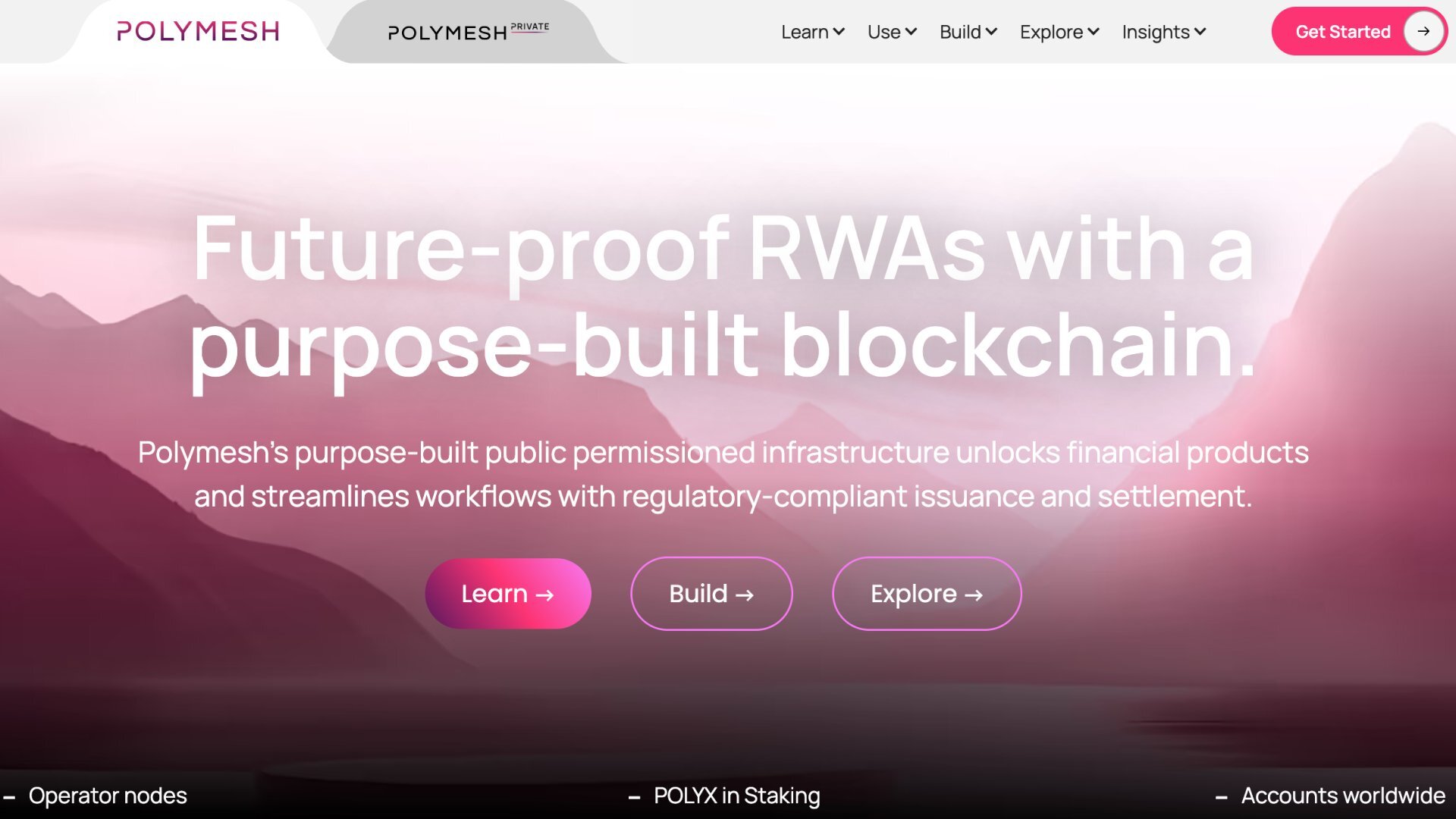
Polymesh took a different architectural approach from every other platform in this comparison. Rather than adding compliance features on top of a general-purpose blockchain, it built compliance into the protocol layer from the start.
Overview
Compliance enforced at the protocol level rather than through smart contracts removes a category of security risk that exists on other networks. Whether that trade-off against ecosystem size and developer tooling is worth it depends entirely on how much the project prioritises settlement certainty over investor familiarity with the network.
Key Features
- On-chain identity verification built into the protocol layer
- Compliance rules enforced at the blockchain level rather than the smart contract level
- Native settlement finality without the transaction ordering risks on public networks
- Integration with traditional financial infrastructure through established custodians
Supported Assets
Equities, bonds, funds, and other regulated financial instruments requiring institutional-grade compliance certainty.
Pros
- Most technically robust compliance architecture of any blockchain in this comparison
- Settlement finality and certainty that public networks cannot guarantee at the same level
- Built specifically for institutional security token issuance from day one
Cons
- Smaller ecosystem than Ethereum-based platforms, which reduces investor familiarity and creates onboarding friction
- Less developer tooling available compared to EVM-compatible networks with much larger developer communities
Best For
Institutional issuers requiring the highest level of compliance certainty and settlement finality for regulated securities where public network risks are not acceptable to the legal or compliance team signing off on the infrastructure.
DigiShares
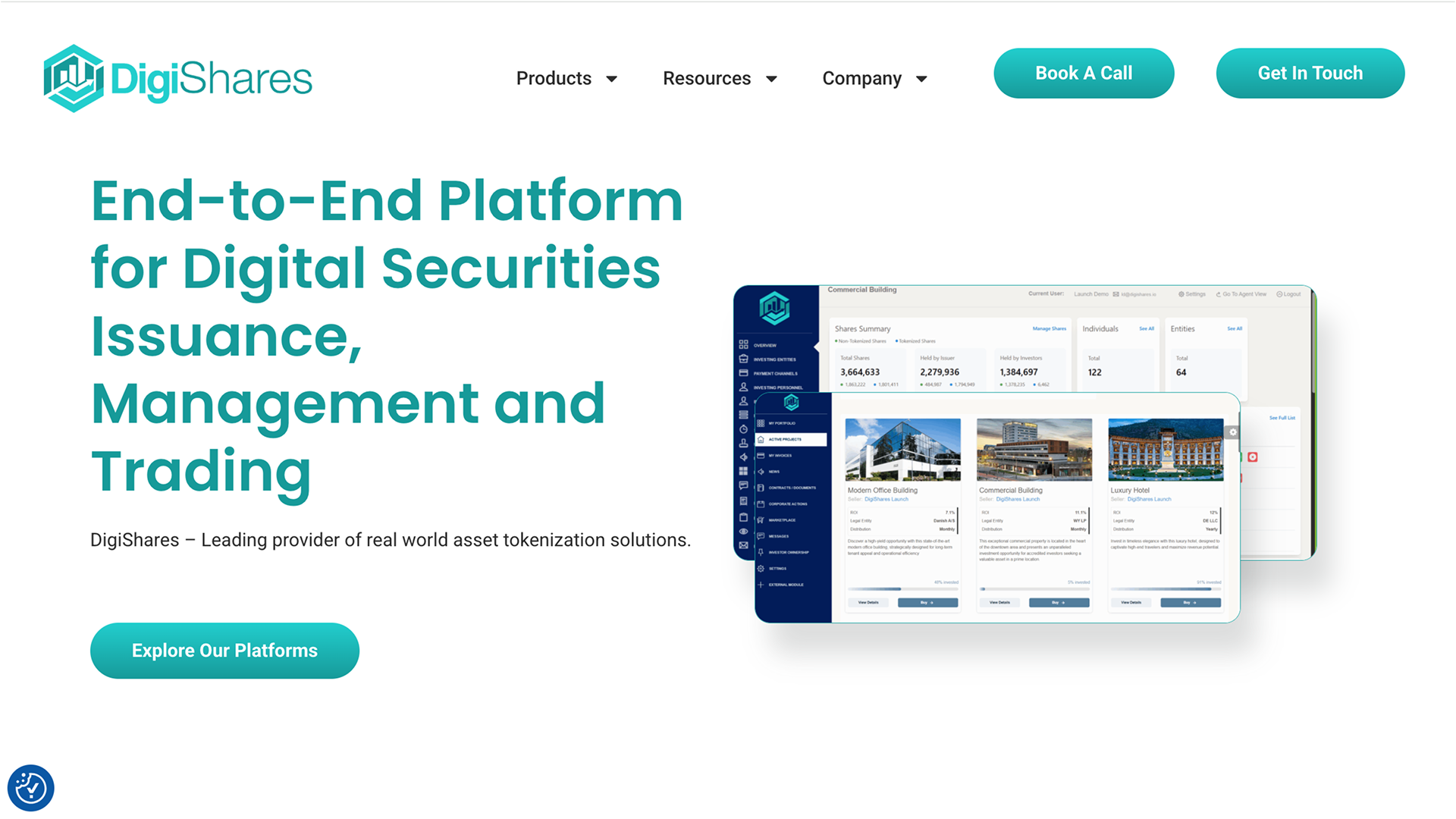
DigiShares serves a specific need that the larger platforms in this comparison do not prioritise: giving issuers full control over their investor experience through a white-label platform they operate themselves.
Overview
DigiShares provides the full technology stack for tokenization platforms rather than operating as a marketplace. That distinction matters for issuers who want to build their own branded investor relationship rather than issuing through a third-party platform that carries its own brand identity alongside theirs.
Key Features
- White-label investor portal with full branding customisation
- Multi-blockchain support including Ethereum, Polygon, and Algorand
- Integrated KYC, payment processing, and cap table management
- Secondary market module for enabling peer-to-peer token trading
Supported Assets
Real estate, private equity, funds, and alternative investment vehicles.
Pros
- Best white-label option for issuers wanting full control over the investor experience without building from scratch
- Competitive pricing for the feature set provided relative to enterprise alternatives
- Strong real estate tokenization track record across multiple markets
Cons
- Less institutional name recognition than Securitize or Tokeny which affects investor confidence in some markets
- Secondary market module is less developed than dedicated ATS providers with longer track records in this area
Best For
Real estate developers and alternative asset managers wanting to operate their own branded investor platform rather than issuing through a third-party marketplace that controls the investor relationship.
Which Platform Is Best for Different Asset Types?
Asset class is one of the most reliable filters for narrowing the platform shortlist before any other evaluation criteria are applied.
Real Estate Tokenization
DigiShares and Brickken are the strongest options here, with DigiShares leading on investor portal features and white-label control, and Brickken leading on accessibility for first-time real estate token issuers with limited technical resources.
Curious how this shift is playing out in practice? Here's how tokenization is changing property ownership models.
Private Equity
Securitize has the deepest track record for private equity tokenization in the US with institutional clients including some of the largest names in alternative asset management. For non-US private equity projects, Tokeny is the stronger starting point.
Investment Funds
Tokeny and Securitize are both suitable for tokenized fund structures. Tokeny leads for EU-regulated fund issuance, and Securitize leads for US-regulated equivalents. The choice is largely determined by the primary regulatory jurisdiction rather than platform preference.
Commodities
None of the platforms in this comparison has commodity-specific tokenization infrastructure that is meaningfully differentiated. Custom development or a combination of existing platform infrastructure with specialist legal structuring is the more practical route for commodity projects.
Carbon Credits
Centrifuge has the most relevant infrastructure for environmental asset tokenization given its DeFi integration and on-chain reporting. The regulatory framework for carbon credit tokenization is still developing, which limits how far any platform can take this asset class currently.
Treasury Assets
Ondo Finance is the straightforward choice for tokenized Treasury products. No other platform in this comparison has built comparable infrastructure or accumulated comparable AUM in this specific asset category.
Core Features an RWA Platform Should Offer
Not every feature on a platform's marketing page matters equally for every project. These are the ones that consistently determine whether a platform works in production.
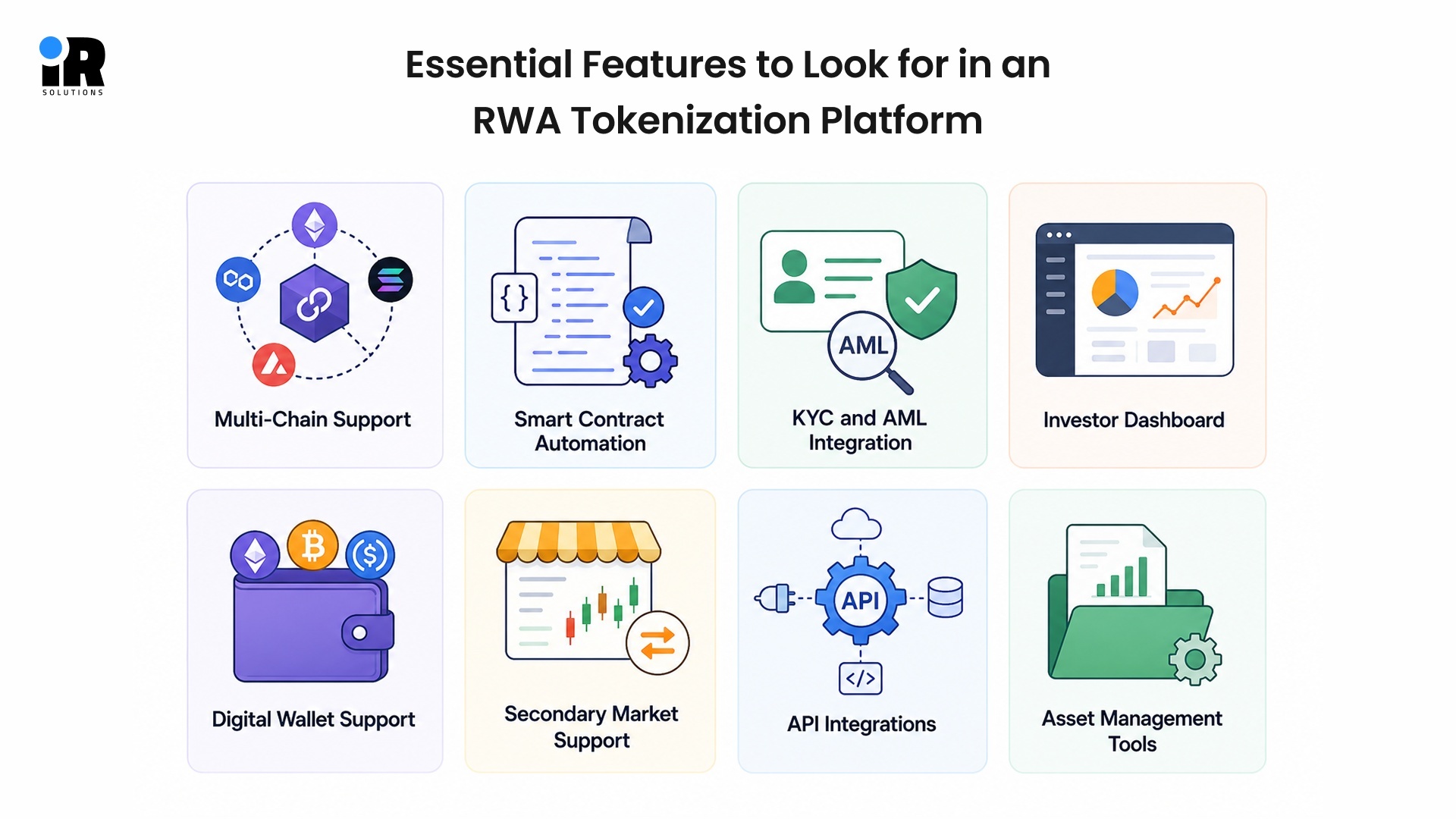
Multi-Chain Support
Single-chain platforms limit investor access and create future migration risk if the chosen network faces scalability or regulatory challenges after the project is already live with investor capital committed.
Smart Contract Automation
Automated income distribution, transfer restriction enforcement, and governance logic should be handled by the smart contract rather than by manual processes that introduce operational risk and human error at each event trigger throughout the asset's life.
KYC and AML Integration
Identity verification should be embedded in the investor onboarding process with verification status readable within the smart contract. External compliance processes that are not connected to the token transfer logic create enforcement gaps that regulators notice.
Investor Dashboard
A functional interface for investors to view their holdings, track distributions, access documents, and participate in governance is not a luxury feature. It determines how much ongoing support the issuer needs to provide manually and affects investor satisfaction across the full holding period.
Digital Wallet Support
Compatibility with wallets that the target investor audience already uses reduces onboarding friction and the education overhead that unfamiliar wallet infrastructure creates for investors who are new to blockchain-based asset ownership.
Secondary Market Support
The availability of a secondary market pathway is one of the most significant factors in the attractiveness of the initial offering. Platforms that cannot offer this, or offer it through underdeveloped modules, are asking investors to accept illiquidity that better-resourced alternatives do not require.
API Integrations
The platform must integrate with external systems the issuer uses for custody, reporting, compliance, and investor communication. A closed platform that requires the issuer to manage everything internally is a practical limitation that becomes more expensive as the project scales.
Asset Management Tools
Reporting, compliance monitoring, investor communication, and governance process management should be included in the platform. Assembling these from third-party solutions for each function separately adds cost and creates integration complexity that grows with the portfolio.
Build vs Buy: Should You Develop Your Own RWA Platform?
This is a question that gets asked more as project complexity and budget increase. The honest answer is that existing platforms are the right starting point for most projects and custom development is justified in a smaller number of specific situations.
When an Existing Platform Makes Sense
An existing platform makes sense when the project fits within the asset classes, regulatory environments, and investor audiences the platform was built to serve and when the project does not require capabilities that the platform cannot accommodate without significant customisation that negates the cost advantage of using an existing solution.
When Custom Development Is the Better Choice
Custom development is justified when no existing platform provides the specific capabilities the project requires, when the issuer wants to operate their own infrastructure without long-term dependency on a third-party provider, or when projected transaction volume and asset portfolio size make the economics of ongoing platform fees unfavourable compared to building and maintaining a proprietary system over a ten-year horizon. Businesses that require complete control over token standards, compliance workflows, investor management systems, and blockchain infrastructure can explore RWA tokenization services designed for custom asset tokenization requirements.
Long-Term Scalability
Custom development provides the most flexibility for long-term scalability because the system can be extended and modified without dependence on a third-party platform's development roadmap or pricing decisions that may change after the project is already committed to the infrastructure.
RWA Tokenization Platform Development Cost
The cost of developing an RWA tokenization platform depends on the level of customization, the asset types supported, the compliance requirements, the blockchain infrastructure, and the investor management features included in the system. A simple tokenization solution with basic issuance functionality requires significantly less investment than an enterprise-grade platform designed for institutional investors and multiple asset classes.
For businesses using existing tokenization platforms, costs usually start with setup fees and ongoing platform charges. These solutions are often suitable for projects that need faster deployment and can work within the platform’s existing compliance framework, blockchain options, and available features.
Custom RWA tokenization platform development requires a larger investment because the business owns the entire infrastructure and can customize every component. Development costs vary widely depending on the complexity of the platform, the number of supported asset classes, and the depth of compliance infrastructure required. A detailed scoping conversation is more useful than a flat estimate at this stage.
Developing these platforms requires expertise across blockchain architecture, smart contracts, security auditing, and decentralized application development. Organizations building custom RWA solutions often need specialized blockchain capabilities to ensure the platform can support compliance requirements, investor management, and future scalability.
Factors That Influence RWA Platform Development Costs
1- Smart Contract Development and Auditing
The complexity of token contracts, ownership logic, transfer restrictions, automated distributions, and security auditing directly impacts development costs. Financial applications require extensive testing because vulnerabilities can affect investor assets and regulatory compliance.
2- Compliance and Identity Verification Systems
Platforms designed for regulated assets require KYC, AML checks, investor accreditation verification, and transfer restriction mechanisms. These compliance layers increase development requirements but are essential for institutional adoption.
3- Blockchain Infrastructure
The selected blockchain network affects development complexity, transaction costs, scalability, and integration requirements. Supporting multiple networks can increase both initial development and long-term maintenance costs.
4- Investor Management Features
Advanced platforms often include investor dashboards, portfolio tracking, reporting tools, document management, and automated distribution systems. These features improve the investor experience but require additional development effort.
5- Secondary Market and Trading Features
Building marketplace functionality, liquidity solutions, or peer-to-peer trading capabilities requires additional smart contract development, security testing, and regulatory consideration.
For businesses planning long-term tokenization strategies, custom platform development can provide greater flexibility, ownership, and scalability compared with relying completely on third-party solutions. The right approach depends on asset type, regulatory requirements, investor expectations, and future growth plans.
Key Risks to Evaluate in RWA Platform Selection
These challenges come up consistently across platform selection processes and are worth understanding before the evaluation begins rather than after a commitment has been made.
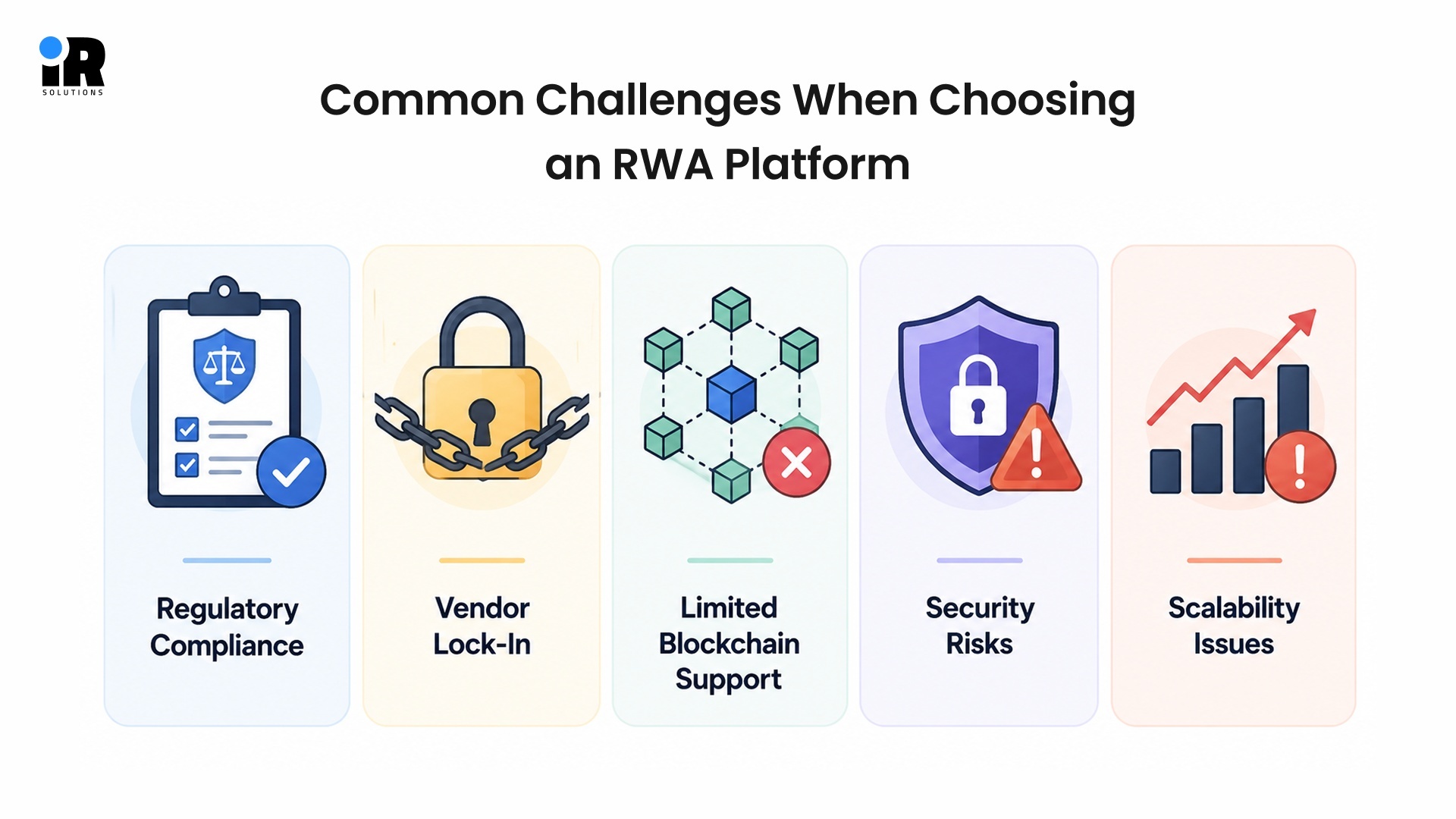
Regulatory Compliance
Platforms that appear compliant in one jurisdiction may require significant additional legal structuring to operate in others. Evaluating the platform's regulatory coverage against the specific jurisdictions where the offering will be distributed is essential before any platform commitment is made.
Vendor Lock-In
Platforms that use proprietary token standards or store investor data in formats that are not portable create dependency risks that affect the project's ability to migrate if the platform changes its pricing, its terms, or its operational model after the project is already live.
Limited Blockchain Support
Single-chain platforms restrict the investor base to participants comfortable with that specific network and create migration risk if the chosen blockchain faces regulatory challenges or technical limitations after deployment.
Security Risks
Platforms without independently audited smart contract infrastructure introduce security risk that the project cannot fully control after the contract is deployed. The audit record of the platform's core infrastructure should be part of every evaluation rather than an afterthought.
Scalability Issues
Platforms that perform well at small investor counts may struggle to maintain performance as the project scales. Testing platform performance at projected future load rather than only current capacity is a step that most first-time platform evaluators skip because the current state feels manageable.
Future Trends in RWA Tokenization Platforms
The direction platform development is taking in 2026 reflects institutional participation and regulatory maturation more than any previous phase of this market's development.
Institutional Adoption
Major asset managers and banks are moving from evaluation to active deployment, which is pushing platform development toward more sophisticated compliance infrastructure, better integration with traditional financial systems, and clearer regulatory standing in multiple jurisdictions simultaneously rather than in the single jurisdiction each platform originally focused on.
AI-Powered Compliance
AI systems that monitor token transfers for compliance anomalies, flag suspicious activity for review, and automate regulatory reporting are beginning to appear in more advanced platforms and are likely to become a standard feature expectation within the next two to three years as the cost of building them falls.
Want a closer look at this shift? See how AI is improving RWA tokenization and asset management.
Cross-Chain Tokenization
The ability to deploy tokens across multiple blockchain networks simultaneously and maintain consistent ownership records and transfer restrictions across all of them is moving from an experimental capability to a production requirement for platforms targeting institutional issuers with global investor bases.
Tokenized Funds
Fund structures that issue tokens rather than traditional limited partnership interests are gaining momentum as regulatory clarity improves, and platforms that can support the specific requirements of tokenized fund administration are well-positioned for growth in this category as the regulatory picture firms up.
Programmable Finance
Smart contracts that automatically adjust distribution logic, reinvestment rules, and governance parameters based on predefined conditions are enabling more sophisticated financial products than static token structures can support. The platforms building this infrastructure are likely to attract the most complex projects as the market matures.
Ready to bring your asset tokenization project to life? Get in touch to see how we can help.
Conclusion
The RWA tokenization platform market in 2026 has enough mature, production-tested options that most projects can find a suitable existing platform without building from scratch. What changed is that the choice between platforms now has real consequences because the projects are real, the investor capital is real, and the regulatory scrutiny is increasing. Using the evaluation criteria and platform reviews in this guide provides a structured basis for making that decision based on what the project actually needs rather than which platform has the most compelling marketing or the most recognisable institutional clients on its homepage. Those factors are useful context. They are not a substitute for matching the platform's actual capabilities to the specific requirements the project will need it to meet from day one through to the final investor exit.
Frequently Asked Questions
What is the best RWA tokenization platform?
There is no universal answer. Securitize leads for US institutional issuance. Tokeny leads for EU regulated securities. Ondo Finance leads for tokenized Treasuries. DigiShares leads for real estate white-label platforms. The right choice depends on the specific asset class, regulatory environment, and investor audience rather than platform reputation alone.
Which platform is best for real estate tokenization?
DigiShares and Brickken are the strongest options for real estate, with DigiShares offering the most developed white-label infrastructure and Brickken offering the most accessible entry point for first-time issuers working with limited technical resources and tighter budgets.
Which blockchain do most platforms use?
Ethereum is the most widely used across the platforms in this comparison, followed by Polygon for lower-cost transactions. Polymesh operates on its own purpose-built blockchain and Centrifuge uses Centrifuge Chain built on Polkadot for cross-chain capability.
Are RWA platforms regulated?
Regulatory status varies significantly. Securitize is the only platform here with US SEC-registered transfer agent status. Tokeny aligns with EU MiCA framework requirements. Most other platforms operate within existing regulatory structures but do not hold direct regulatory licences, which means the issuer rather than the platform carries primary regulatory responsibility for the offering in most cases.
Can I build my own RWA tokenization platform?
Yes, and it is the right choice for issuers who need capabilities that existing platforms cannot provide, who want full control over their infrastructure without third-party dependency, or whose projected transaction volume makes the economics of custom development favourable over long-term platform fees. It is not the right choice for most first-time projects where an existing platform can cover the requirements without the development overhead.
How much does an RWA platform cost?
Costs vary based on whether you use an existing platform (lower upfront cost, ongoing fees) or build custom infrastructure (higher upfront investment, no recurring platform fees). The right comparison is total cost of ownership over the project's life, not the upfront number alone.
Which platform supports institutional investors?
Securitize, Tokeny, Ondo Finance, and Polymesh all have established institutional investor bases and the compliance infrastructure that institutional capital requires. Centrifuge serves DeFi-native institutional participants rather than traditional regulated institutions, which is a meaningful distinction when the target investor audience is being evaluated.
How do I choose the right tokenization platform?
Start by defining the asset class, the regulatory environment, and the investor audience the project targets. Evaluate platforms against those specific requirements rather than a generic feature checklist. The platform that fits the three criteria most relevant to the specific project is usually the right choice regardless of how it ranks on criteria that do not apply to the project at all.