




Blockchain technology has changed how businesses build and scale digital operations, but not every blockchain is equal for enterprise use. Ethereum is the most-deployed smart contract platform in the world, not because it was first, but because it has held up under real production conditions better than anything else. Its programmability, security model, and deep developer ecosystem give businesses and every Ethereum developer the capabilities that newer chains are still working to match. Its transition to Proof of Stake also made it significantly more energy-efficient, addressing sustainability concerns previously raised by enterprises.
What truly sets Ethereum apart is the maturity of its infrastructure, proven tooling, audited smart contract standards, and broad Layer 2 compatibility, which costs without compromising security. For any business evaluating blockchain development as part of a growth strategy, Ethereum is the natural starting point.
The Core Reasons Ethereum Drives Enterprise Blockchain Adoption
The design decisions made early on, and the upgrades made since, have produced a platform that competing chains have spent years trying to replicate without fully succeeding.
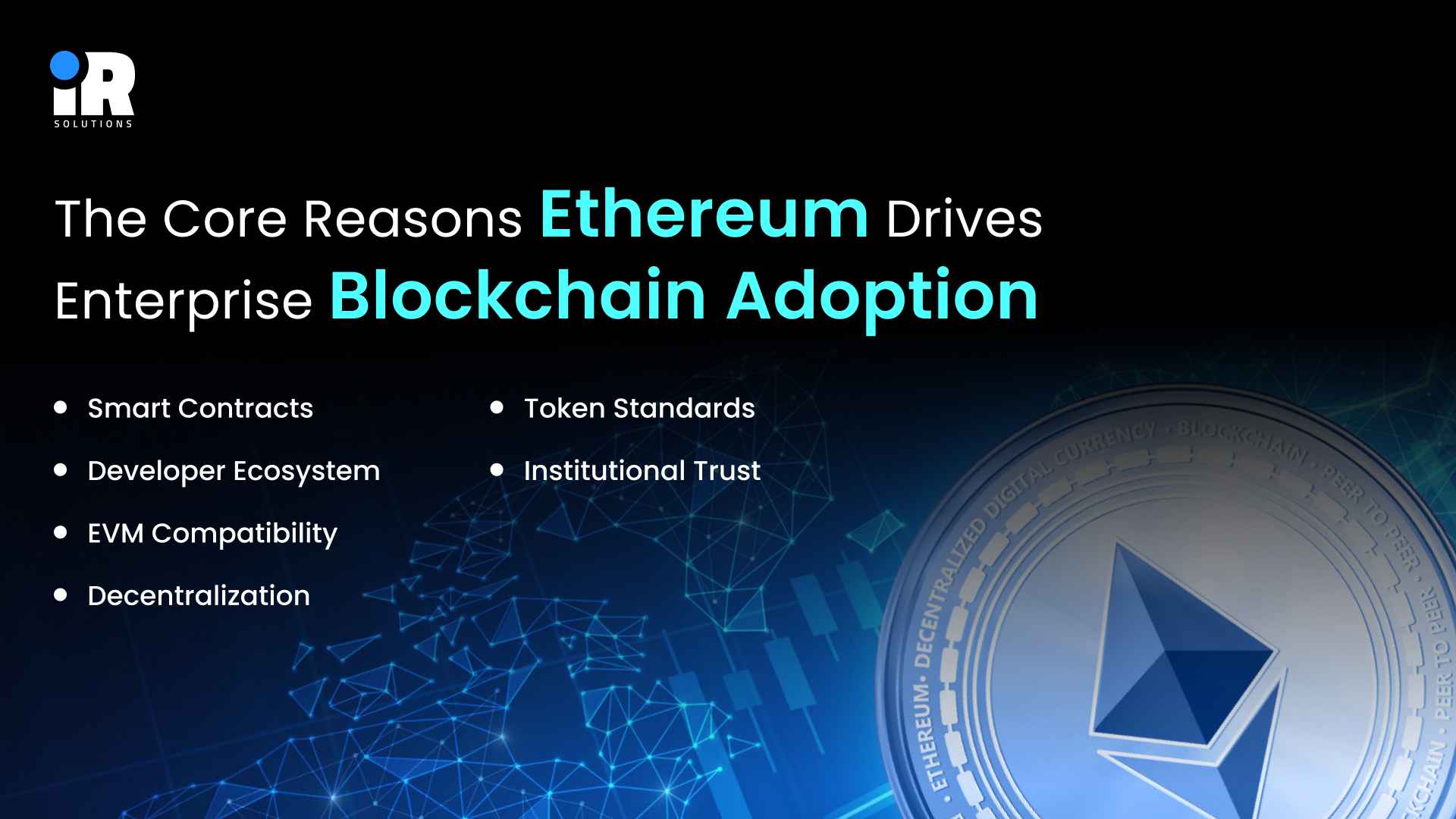
- Smart Contracts: Self-executing contracts that automate agreements without intermediaries, cutting manual processing costs and the errors that accumulate in human-dependent workflows.
- Developer Ecosystem: The largest active developer community of any blockchain platform, with more tools, audited libraries, and available talent than anywhere else in the space.
- EVM Compatibility: The Ethereum Virtual Machine is the standard execution environment. Most Layer 2 networks and competing chains are built to be compatible with it.
- Decentralisation: Ethereum runs on thousands of independent nodes globally, making it genuinely resistant to censorship and more resilient than private or permissioned alternatives.
- Token Standards: ERC-20 and ERC-721 are the globally adopted standards for fungible tokens and NFTs. They work with every major exchange, wallet, and DeFi protocol without requiring custom integration work.
- Institutional Trust: Major banks, investment firms, and enterprises have deployed Ethereum-based systems. That creates regulatory familiarity and institutional credibility that newer chains have not had time to build.
How Ethereum Compares to Other Blockchain Platforms
Businesses evaluating blockchain regularly ask whether Solana, Binance Smart Chain, Avalanche, or Hyperledger might be a better fit. The honest answer depends on what you are actually optimising for.
Solana processes transactions faster than Ethereum's base layer, but it has experienced several network outages, the kind that would be unacceptable for enterprise operations where downtime has real financial consequences. Binance Smart Chain keeps fees low by sacrificing decentralisation, which creates centralisation risks that regulators and institutional partners are scrutinising more carefully. Hyperledger works well for private consortium use cases but lacks the composability, open ecosystem, and liquidity that public Ethereum provides. Ethereum, through Layer 2 networks like Arbitrum, Optimism, and zkSync, now handles thousands of transactions per second at a fraction of a cent while preserving base-layer security guarantees. For DeFi products, tokenised assets, supply chain systems, or decentralised identity infrastructure, Ethereum holds up better across every dimension when you look past the headline fee comparisons.
Primary Ethereum Use Cases Driving Enterprise Adoption
Ethereum's programmability makes it suitable for a genuinely wide range of business applications, across sectors that have very different operational requirements.
- DeFi protocols for lending, borrowing, and automated market making without traditional financial intermediaries.
- Real-world asset (RWA) tokenisation converts physical assets like real estate, commodities, and private equity into tradable on-chain tokens. Supply chain transparency systems that record provenance, transfers, and quality verifications immutably across multi-party logistics networks.
- Decentralised identity and credential verification, where individuals control their own verified data rather than trusting a central database.
- Cross-border payment infrastructure that settles international transactions in minutes at a fraction of traditional wire transfer cost.
- NFT marketplaces and digital ownership platforms for gaming, media, and creator economy applications.
- DAO governance systems where stakeholders vote on protocol changes through on-chain token mechanics.
Each of these use cases draws directly on Ethereum's security model, composability with existing DeFi infrastructure, and the credibility that institutional adoption brings to the network.
Businesses moving into tokenized assets can benefit from the insights shared in How Blockchain Enables Real-World Asset Tokenization.
Why Smart Contracts on Ethereum Change How Businesses Operate
A smart contract is code that lives permanently on the Ethereum blockchain and executes automatically when predefined conditions are met, no human approval required, no intermediary, no delay while someone reviews a document. For businesses, that means contracts, payments, and compliance workflows run with a level of transparency and certainty that traditional systems cannot match.
The practical implications are concrete a supply chain business can automate supplier payments the moment delivery is verified, removing disputes, delays, and manual invoice processing from the settlement process. A DeFi startup can deploy lending protocols that automatically liquidate collateral when prices fall below a threshold, removing counterparty risk without requiring participants to trust each other personally. An enterprise can encode compliance rules directly into token contracts so assets can only transfer between verified, eligible parties with no manual legal review required per transaction.
On Ethereum, deployed code is permanent, vulnerabilities cannot be quietly patched the way a web application can be updated overnight. That is why every contract we build goes through security auditing before mainnet deployment.
To see how this technology performs across real business contexts, read our blog on Building Trust and Transparency Through Blockchain in Business.
Ethereum's Scalability Evolution - From a Bottleneck to a Business-Ready Platform
The concern about Ethereum's gas fees and slow throughput was legitimate a few years ago. The criticism made sense in 2021, but it does not hold up the same way today.
The Merge in 2022 moved Ethereum from Proof of Work to Proof of Stake, cutting energy consumption by over 99%, which resolved the ESG objections that enterprises and institutional investors were raising. Layer 2 networks like Arbitrum and Optimism now handle thousands of transactions per second at fees measured in fractions of a cent, while inheriting Ethereum's base-layer security. The Dencun upgrade in 2024 pushed Layer 2 fees lower still through proto-danksharding, making Ethereum-based applications cost-competitive with any alternative chain for high-volume business applications.
Businesses evaluating Ethereum now are looking at a different network than the one that earned the gas fee reputation. The scalability problems have been worked through. The security model and ecosystem depth that made it the default choice in the first place are still intact.
If you want to build on Ethereum with people who do, schedule a free call with our experts, and we will map out the right architecture for your situation.
The Real Cost of Getting Your Ethereum Development Wrong and How to Avoid It
Most businesses focus on development cost, but the real risk lies in what happens after deployment. On Ethereum, mistakes are permanent and can lead to irreversible financial losses with no rollback or easy fix.
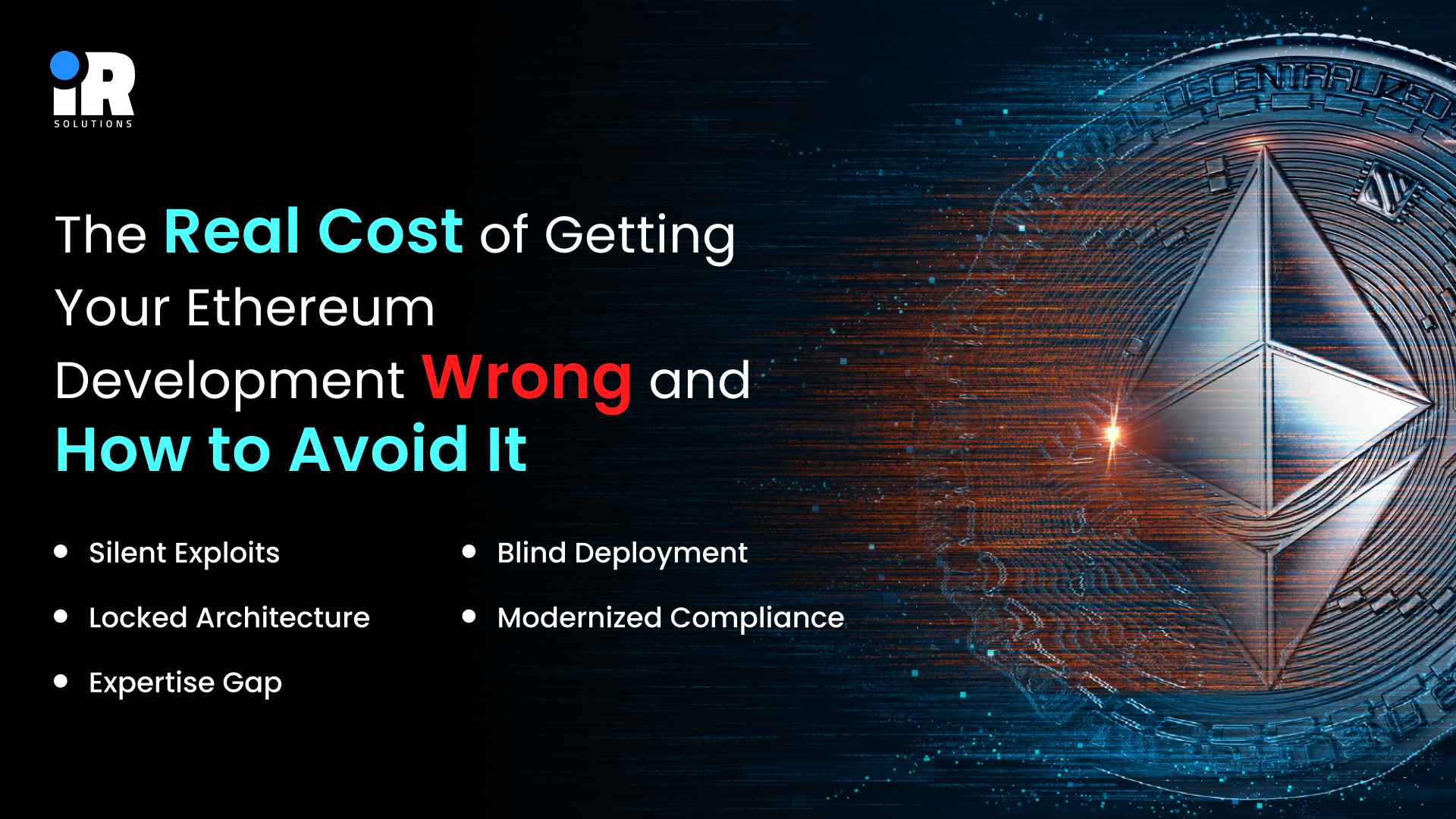
- Silent Exploits: Reentrancy attacks and access control failures have drained billions from projects that skipped proper security auditing. These vulnerabilities are invisible until an attacker finds them, and there is no recovery path once the funds are gone.
- Locked Architecture: Deploying on mainnet without Layer 2 consideration can trap a business in fee structures that make the product economically unworkable at scale. Without upgrade mechanisms built in, responding to regulatory changes or fixing bugs means migrating user funds is expensive, risky, and trust-damaging.
- Expertise Gap: Ethereum-specific development has real technical depth. Developers without Solidity experience make mistakes that experienced blockchain developers catch immediately. Hiring on an hourly rate rather than verifiable production experience is where most project failures actually start.
- Blind Deployment: Internal code review is not the same as an independent audit. Auditors approach contracts with an adversarial mindset specifically designed to surface what developers miss when they are too familiar with their own code.
- Modernized Compliance: Adding KYC logic, transfer restrictions, and reporting capabilities after deployment costs far more than building them in from the start. Businesses in fintech, real estate, and supply chain cannot treat compliance as something to handle after launch.
Ethereum Trends Shaping the Next Wave of Enterprise Adoption
The Ethereum ecosystem has kept moving while the technology has matured. Several developments are creating real business opportunities right now for companies paying attention.
- Real-world asset tokenisation is accelerating traditional financial institutions are tokenising bonds, funds, and commodities on Ethereum's public chain for around-the-clock settlement
- Institutional DeFi is taking shape as regulated entities deploy permissioned DeFi protocols, combining on-chain efficiency with the compliance controls that financial regulation requires
- Account abstraction (ERC-4337) is making user onboarding significantly less difficult with smart contract wallets that support gasless transactions, social recovery, and business-friendly permission structures
- Ethereum-based identity standards are gaining traction in supply chain, healthcare, and government applications, where verifiable credential management is a regulatory requirement
- AI and Ethereum integration is producing new use cases in decentralised AI model marketplaces, verifiable computation, and on-chain data oracle networks
Businesses that start building now are working with these developments rather than waiting to react to them when the timing has already shifted.
For a broader breakdown of blockchain technologies, infrastructure, development costs, and implementation strategies, read our Blockchain Development Guide 2026: Use Cases, Costs, Technologies & How to Get Started.
From Smart Contract to Scalable dApp: A Technical Roadmap for Ethereum development services Builds
Every serious Ethereum build starts with an architecture decision, not a coding decision. Choosing between mainnet for security and a Layer 2 like Arbitrum for cost-efficient high-volume execution shapes every downstream choice, tooling, wallet integration, upgrade strategy, and operational costs at scale. Get that layer decision wrong, and the rework is expensive.
Smart contract development also demands a level of rigour that standard software development does not require. Deployed contracts are permanent. A flaw in the contract logic is not a bug report, it is a financial liability that cannot be patched without significant disruption. Testing across edge cases and independent auditing before deployment is not optional for production systems.
Connecting contracts to real users through a dApp frontend is where many Ethereum projects underestimate the actual scope. Managing wallet connections, transaction signing, live blockchain state, and failed transaction handling while keeping the interface usable for people unfamiliar with crypto wallets is its own discipline. Upgrade mechanisms, monitoring, and user experience design need to be part of the plan from the start, not problems addressed after the first round of user complaints.
Conclusion
Ethereum is not the most-used blockchain platform because of marketing. It held up under real production conditions, attracted the deepest developer talent, and earned institutional trust that newer chains are still building toward. The scalability objections that were reasonable a few years ago have been worked through. The security model and ecosystem depth are still there.
What determines whether an Ethereum project succeeds has nothing to do with the network itself. It comes down to the architecture decisions, the discipline of the security process, and whether the development team actually understands what they are building. IR Solutions helps businesses build secure, scalable, and production-ready Ethereum solutions designed for real operational use, not just proof-of-concept launches.
Frequently Asked Questions
Why do enterprises prefer Ethereum over other blockchain platforms?
Ethereum has the largest developer ecosystem, the most audited smart contract standards, and an institutional track record that newer chains have not had time to build.
What is the use of smart contracts in business today?
They automatically process agreements and payments without the need for intermediaries and reduce costs in your operations by eliminating the points of human error in the manual process.
Has Ethereum solved its high gas fee problem for businesses?
Layer 2 networks like Arbitrum and Optimism handle thousands of transactions per second at fractions of a cent, while inheriting Ethereum's base-layer security.
Which industries benefit most from building on Ethereum currently?
Fintech, real estate tokenisation, supply chain, healthcare identity, and decentralised governance, particularly where compliance and multi-party workflows intersect.
What is the biggest risk in Ethereum smart contract development?
Deploying without an independent security audit. Vulnerabilities like reentrancy attacks are invisible until someone exploits them, and there is no recovery after funds are gone.


