



AI products are no longer experimental side projects, they are becoming core to how modern businesses operate, compete, and serve customers. But turning an AI idea into something that works in real environments is rarely straightforward. What looks simple in a demo often becomes complex once data, infrastructure, and real user behavior enter the picture. For startups, the challenge is choosing the right problem to solve before resources run thin. For enterprises, it is making AI work inside systems that were never designed for it in the first place.
Between those two realities sits a long list of technical and strategic decisions that determine whether an AI product succeeds or slows down. Understanding how these systems are actually built, scaled, and maintained is what separates experiments from production-ready products that deliver consistent value. Many organizations accelerate this process by partnering with teams that bring end-to-end AI product development expertise, helping reduce risk across strategy, development, deployment, and scaling.
A broader perspective on adoption, automation, and implementation priorities is covered in AI for Business in 2026, helping organizations align AI investments with measurable business outcomes.
Types of AI Products Companies Actually Build
There's a wide range of what companies ship under the "AI product" label. Understanding the categories helps you scope your own project more accurately and avoid treating different problems like they have the same solution.
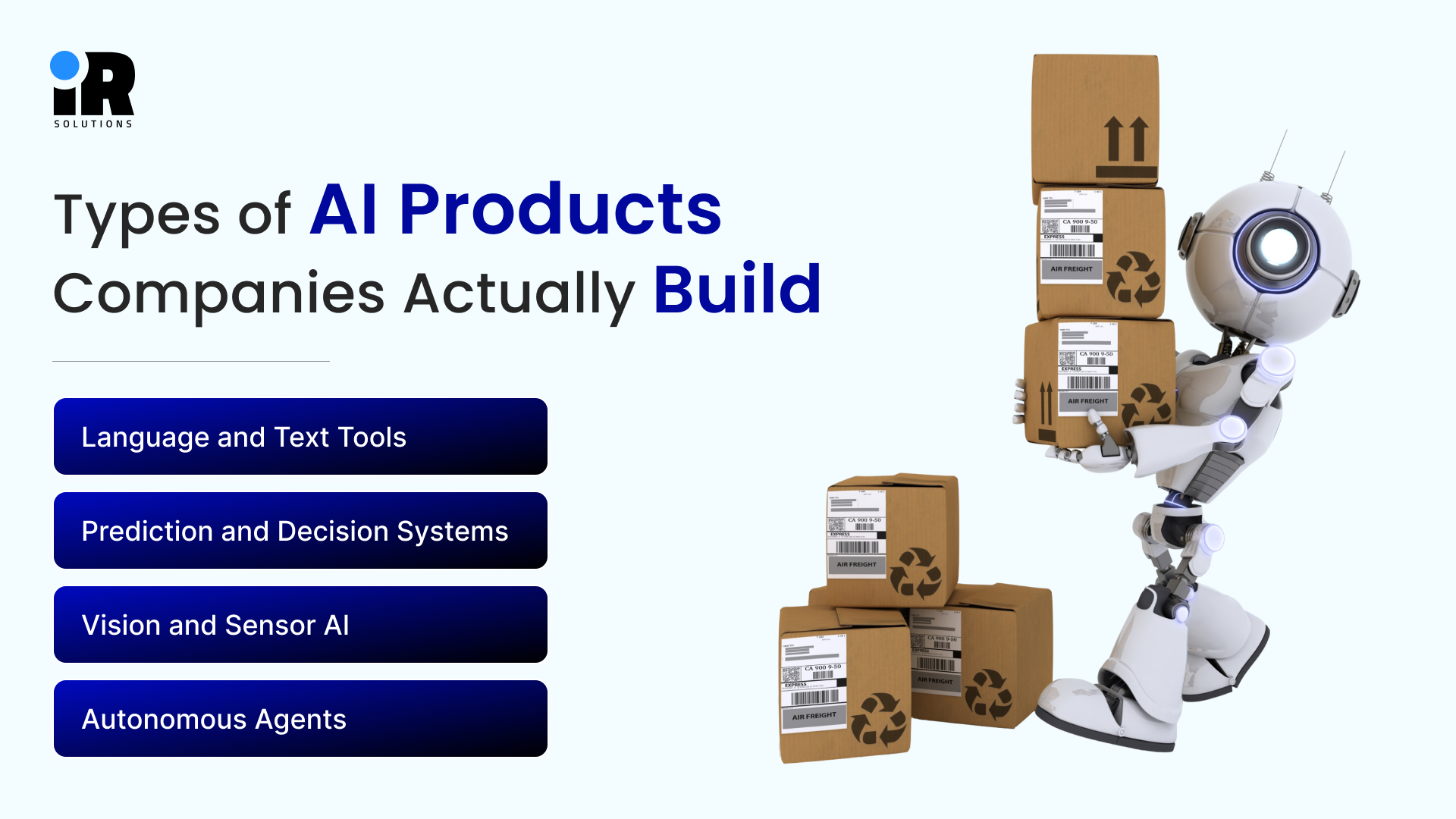
Language and Text Tools
These are built on large language models and natural language processing. Chatbots and virtual assistants handle customer queries, HR requests, or lead qualification without human involvement. For customer-facing implementations, many companies prefer to hire NLP engineers to design conversational systems that align with business objectives and user expectations. Document processing tools extract and summarize content from contracts, invoices, or support tickets. Content generation systems produce first drafts of marketing copy or internal reports. Semantic search lets users find information by meaning rather than exact keywords, using vector databases underneath.
Prediction and Decision Systems
These systems analyze historical patterns in your data to support faster, better decisions. Churn prediction models flag at-risk customers before they leave. Demand forecasting tools predict inventory needs across locations and seasons. Credit scoring and risk models evaluate financial risk using more signals than traditional methods. Predictive maintenance systems catch equipment issues before they cause downtime.
Vision and Sensor AI
These products work on images, video, or sensor data, defect detection tools flag production line errors faster than manual inspection. Object recognition systems track goods through warehouses or monitor safety compliance. OCR and document scanning tools convert physical documents into structured digital records that other systems can use.
Autonomous Agents
This is the newer category of AI that doesn't just answer questions but actually takes action. Sales agents draft outreach emails, update CRM records, and schedule follow-ups. Operations agents monitor systems, trigger alerts, and route tasks based on defined conditions. Inventory agents track stock levels and reorder from suppliers when thresholds are hit. These systems are moving fast, and the practical applications are genuinely high-value.
The operational impact of autonomous systems is explored further in how agentic AI is changing business operations, including practical examples of AI-driven workflows and decision-making.
How AI Products Are Built From Start to Scale
No two AI projects follow the same path, but most move through the same core phases. Understanding what happens at each stage helps you plan time and budget with more accuracy and fewer surprises.
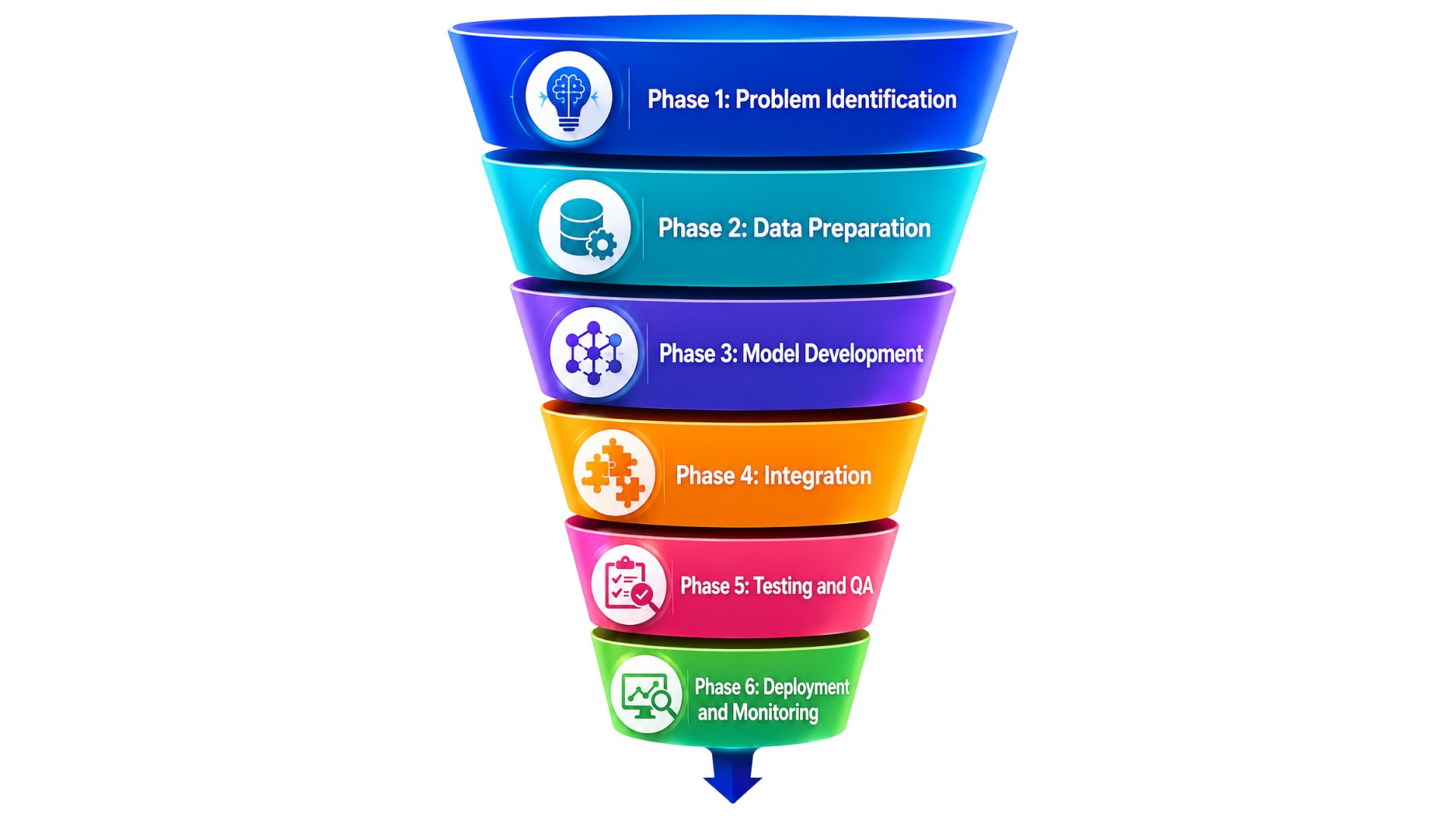
Phase 1: Problem Identification
- Teams often jump straight into building before checking if AI actually fits the problem at all.
- Discovery means mapping the workflow, checking what data you have, and setting real success metrics.
- Skipping this step feels faster at first but usually costs way more time later on.
Phase 2: Data Preparation
- Good models start with clean data, not fancy algorithms or the latest AI techniques out there.
- This phase covers pulling records from systems, removing duplicates, and labeling examples for the model to learn.
- Most teams underestimate how long this takes, sometimes eating up more than half the timeline.
Phase 3: Model Development
- Engineers usually pick between tuning an existing model or building something custom from scratch entirely.
- Some projects blend a foundation model with retrieval methods to pull in accurate outside knowledge.
- Training and data work often go back and forth as new gaps in the data show up.
Phase 4: Integration
- A model sitting in a notebook does nothing until it connects to actual business systems.
- This step links the model to APIs, batch jobs, or platforms like CRM and ERP tools.
- Older systems tend to cause unexpected snags, so leave extra room in your timeline here.
Phase 5: Testing and QA
- Testing AI tools looks nothing like testing regular software, since outputs aren't always predictable or fixed.
- Teams check accuracy across varied inputs and see how the system handles messy or incomplete data.
- Bias checks matter too, since skewed errors can create real compliance or fairness problems later.
Phase 6: Deployment and Monitoring
Launching the system is just the beginning, not the finish line everyone hopes it would be.
Real-world data shifts over time, so models need regular checks to catch quiet drift.
Teams that stop watching after launch often discover a broken system months down the road.
At this stage, many teams choose to hire AI ML developers to speed up model tuning, reduce experimentation cycles, and improve production readiness. More details are available here
A deeper implementation framework is explained in AI integration in business from strategy to execution, connecting AI planning, deployment, and long-term adoption strategies.
What Actually Shapes the Cost of Building AI Systems
There's no fixed price tag for an AI product, since costs swing wildly based on scope. A narrow MVP built for one specific use case costs far less than a large-scale enterprise platform. Data readiness matters just as much, since clean and labeled data speeds everything up considerably. Unstructured or unlabeled data adds weeks of cleanup work before any actual modeling can begin.
Model choice also shapes the budget, since fine-tuning an existing model beats building one from zero. Large training runs and high-volume inference both push cloud compute costs higher as usage grows. Regulated industries like healthcare and finance bring extra documentation, security, and audit work into play. Integration adds another layer, since connecting to a modern API is easier than wiring into old legacy systems. Where the model needs to run changes things too, since on-device deployment costs more than simple API access.
Most companies do best by starting with a small pilot that runs about six to ten weeks. Proving value on one narrow use case first lets you expand later with real evidence behind you. This approach lowers the risk of the bigger investment and gives you actual data for your next move.
How Businesses Can Reduce AI Failures After Deployment
Most avoidable failures share the same root causes, Businesses that know these in advance make better decisions.
- Tech First: Choosing a tool before defining the actual problem often creates a solution looking for a use case. Start with a specific business problem you can measure, then ask if AI even fits. Sometimes the honest answer is that AI isn't the right fit for that problem at all.
- Data Work: Data prep isn't some small cleanup task you rush through before the real work starts. Teams that plan to spend most of their time modeling often end up flipping that ratio entirely. A model can only be as strong as the data you actually feed into it.
- No Metrics: Saying that the model should simply perform well isn't a real measurable goal for anyone. Set clear targets before development begins, like ninety percent accuracy or a fifteen percent drop in churn. Without real numbers attached, there's no way to know when the work is actually done.
- Integration Gaps: A model that scores well in testing can still fail once it meets real systems. Bringing engineers in early and testing the full pipeline before launch avoids painful surprises later.
- After Launch: AI systems quietly degrade over time as the real-world data drifts from training conditions. Companies that skip monitoring and retraining build up costly technical debt without even noticing it.
The Real Challenges of Enterprise AI Adoption
There are other constraints that exist for enterprises as compared to startups. Smaller teams don't have to deal with the scale, organization, or infrastructure.
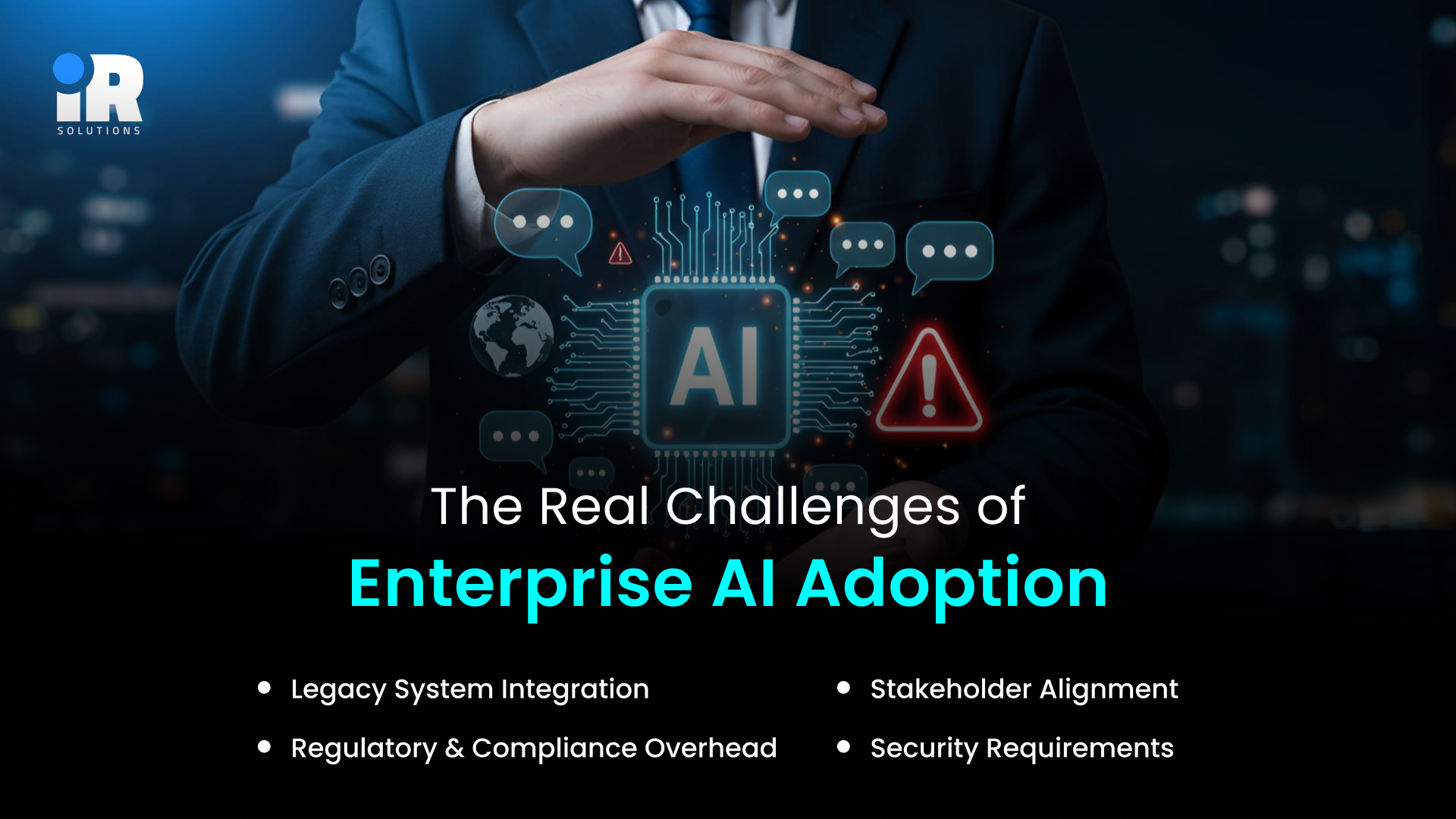
Legacy System Integration
Most large organizations run AI alongside systems built decades ago. These systems weren't designed for real-time API calls or modern data formats. Integration requires custom middleware, extensive testing, and often partial refactoring of adjacent systems just to make the handoff work.
Stakeholder Alignment
Enterprise AI projects involve more decision-makers, such as IT, legal, compliance, operations, and leadership. Misalignment between any of these groups can stall or kill a project even when technical execution is solid. Buy-in from the right people, established early, is not optional.
Regulatory and Compliance Overhead
Regulated industries require additional work at every phase. Data handling must comply with GDPR, HIPAA, or CCPA, depending on the region and sector. Model decisions may need to be auditable and explainable. Deployment might require internal security reviews or external audits before go-live. These requirements don't go away, and ignoring them until the end creates the most expensive kind of rework.
Security Requirements
Enterprise AI systems process sensitive business data. Encryption in transit and at rest is required. Role-based access controls on model APIs limit exposure. Audit logs for model inputs and outputs create accountability. Secure model storage and version control prevent unauthorized changes from making it to production.
Emerging Trends Reshaping AI Development
A few shifts are actively changing how AI products get built right now. These aren't distant future concepts teams are shipping products using each of these today.
Agentic AI
AI agents plan and execute multi-step tasks with minimal human direction. Instead of answering one question, an agent takes a goal, breaks it into steps, uses tools to complete those steps, and reports back. Practical applications in customer service, internal operations, and supply chain are already delivering results. The challenge is building agents that are reliable and auditable, not just capable. Businesses often hire AI agentic app developers to design and implement these systems in real-world environments.
Multimodal Models
The newest generation of AI handles text, images, audio, and video in a single system. This unlocks products that weren't possible before, such as a support tool that processes screenshots alongside voice messages in the same workflow, for example. Multimodal capability is becoming a baseline expectation for new enterprise AI products.
Retrieval-Augmented Generation
RAG connects an LLM to a custom knowledge base, instead of relying only on what the model learned during training, it retrieves relevant documents at query time and uses them to generate a more accurate, grounded answer. This is now the standard approach for enterprise AI assistants, internal documentation tools, and any application where factual accuracy matters.
Federated Learning
For organizations with strict data privacy requirements, federated learning trains models across decentralized data sources without centralizing the raw data. Healthcare providers and financial institutions are the primary early adopters. As privacy regulations tighten globally, this approach will become more relevant across sectors.
Key Metrics for Measuring AI Product Success
Knowing whether an AI product actually works comes down to tracking the right numbers consistently. The exact metrics shift with each use case, but a few core categories apply almost everywhere.
- Accuracy, precision, and recall show how often the model gets predictions right or completely wrong.
- Overall model quality across different decision thresholds shows how consistently it performs.
- Cost per prediction and time saved show whether the AI is worth running at scale.
- Revenue attributed and error reduction rates connect AI decisions directly to real measurable financial outcomes.
- Delay, uptime, and data drift scores track whether the system stays healthy and reliable in production.
How to Build Internal Ownership of AI Systems
Hiring an AI development partner doesn't mean staying dependent on them indefinitely. The best engagements build your team's capability alongside the product, so you're not paying someone else to maintain a system your own people don't understand.
Request documentation on everything every model, pipeline, and integration should be written up in a way your team can follow and maintain. Involve your engineers throughout the engagement, not just at handover. If your engineers don't understand what was built, you're not in a good position when something breaks or needs to change.
Plan for knowledge transfer before the engagement ends, the external team should walk your people through the architecture, the model logic, and the monitoring setup in enough detail that your team could take over. Build the engagement in phases so that each one leaves your team more capable than the last, not more dependent on the vendor.
The goal is a team that can eventually own and evolve the AI product on its own. A partner who designs toward that outcome is more valuable than one who quietly builds toward renewal contracts.
If you're ready to start that kind of engagement, schedule a call, and we'll work through where you are and what the right first step looks like.
Conclusion
Building an AI product isn't a single event, it's an ongoing process that keeps evolving. The teams that succeed treat discovery, data, and integration as equally important from day one. They define real success metrics early, instead of waiting until launch to figure things out. Monitoring and retraining after launch matter every bit as much as the initial build itself. Enterprises carry extra weight too, since legacy systems and compliance rules slow most projects down. None of this works without the right partner guiding you through each phase carefully. A good partner builds your team's capability, too, not just dependence on their own work. Working with the right AI custom software development partner can simplify complex AI initiatives, shorten development cycles, and create a stronger foundation for long-term innovation.
Frequently Asked Questions
What does AI product development actually involve?
It's the full cycle of work, from picking the right problem to gathering data, building the model, plugging it into real systems, and keeping it healthy long after launch.
How long does an AI project usually take?
Timelines vary quite a bit depending on scope and data, but most teams start with a focused pilot that runs roughly six to ten weeks before scaling further.
What does an AI product typically cost?
Costs swing wildly from project to project, since scope, data readiness, model choice, and integration complexity all push the final number up or down.
What's the most overlooked phase in AI projects?
Data preparation gets rushed more than any other phase, even though it often ends up consuming more than half of the entire project timeline.
How is enterprise AI different from startup AI?
Enterprises carry more weight overall, legacy systems, compliance requirements, and a longer list of stakeholders all slow decisions down compared to a small startup team.
Does the work stop once we launch?
No, because real-world data continually change after deployment, models must continue to be observed and retrained to remain accurate and subtly degrade over time without notice.