


Key Takeaways
- An equity tokenization platform allows companies to issue, manage, and transfer ownership of equity as digital tokens on a blockchain with automated compliance and reporting.
- Smart contracts automate token issuance, transfer restrictions, dividend distributions, voting rights, vesting schedules, and investor eligibility checks without manual intermediary involvement.
- ERC-1400, ERC-1404, and ERC-3643 are the three token standards most commonly used for equity tokenization because they support compliance logic natively within the token transfer mechanism.
- The platform architecture spans five layers: frontend, application, compliance, blockchain, and data integration, each handling a distinct set of functions across the full equity lifecycle.
- Building an equity tokenization platform typically costs between $80,000 and $400,000 depending on feature depth, compliance requirements, blockchain selection, and the number of jurisdictions the platform needs to support.
Private company equity has always been one of the most inaccessible asset classes for the investors who would benefit most from exposure to it. A startup that raises a Series A round issues shares to a small number of institutional investors through a paper-based process that involves legal documentation, manual cap table updates, transfer agent oversight, and settlement timelines measured in days. When a shareholder wants to exit that position before an IPO or acquisition, the process of finding a buyer, completing due diligence, and transferring ownership takes weeks and costs a meaningful percentage of the transaction value in legal and administrative fees. The company's equity is genuinely valuable, but the infrastructure surrounding it makes it slow, expensive, and inaccessible to most of the people who might want to own it.
Equity tokenization is gaining attention from both regulators and traditional financial institutions. In 2026, the SEC addressed how tokenized securities can work within existing securities laws. DTCC, an organization that helps process and settle securities transactions in the U.S., is also working on infrastructure for tokenized securities. Together, these developments show that equity tokenization is gradually moving from an experimental blockchain idea toward use in regulated financial markets.
The broader asset tokenization market reflects this shift at scale, with total value projected to grow from roughly $1.76 trillion in 2025 to over $24.4 trillion by 2033. The result is equity that settles faster, can be held fractionally, and is managed with a level of transparency and automation that traditional equity management systems have never been able to provide at a comparable cost.
What Is an Equity Tokenization Platform?
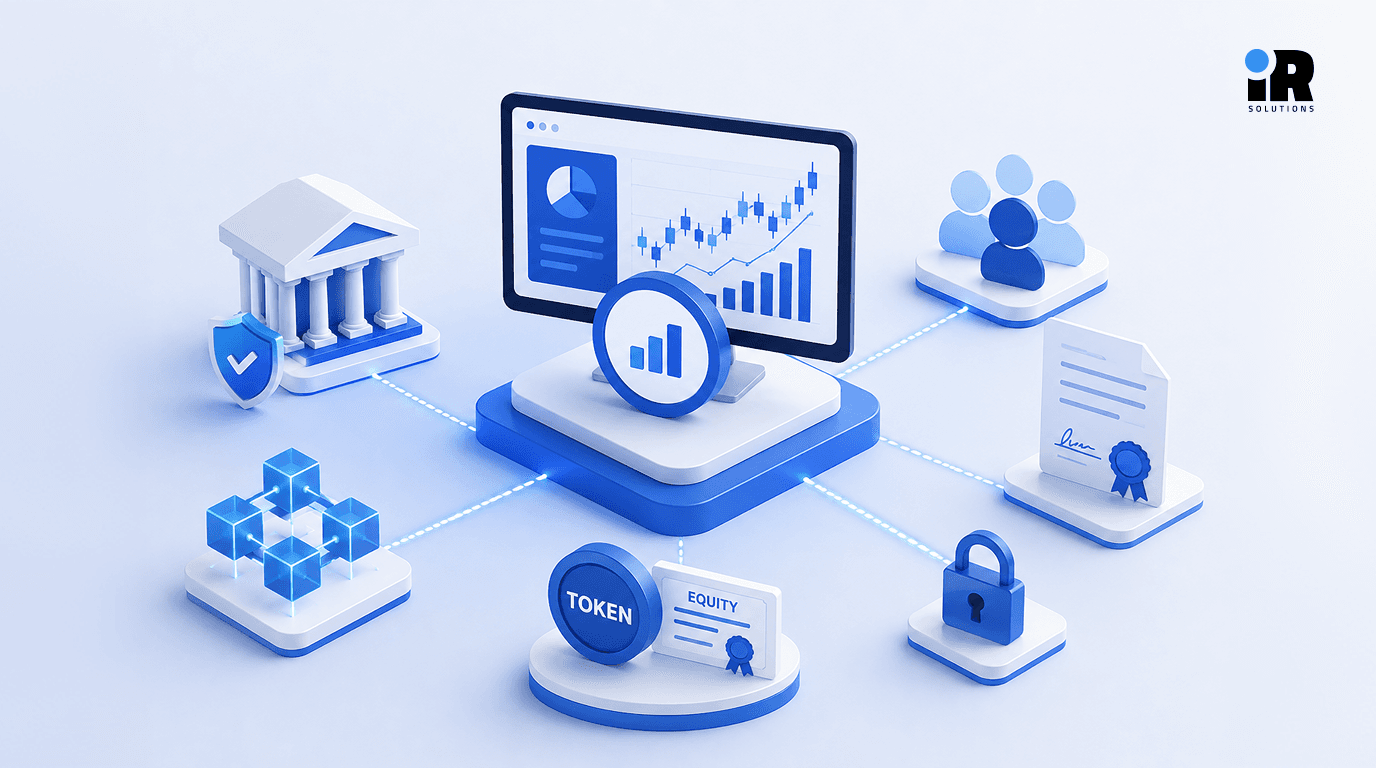
An equity tokenization platform is a software system that allows companies to issue, manage, and transfer equity as blockchain-based digital tokens. It replaces many manual processes involved in traditional equity management while providing a secure and transparent way to track ownership.
The platform supports the full equity lifecycle, including token issuance, investor onboarding, ownership management, compliance checks, and token transfers. It maintains an up-to-date cap table by automatically recording ownership changes on the blockchain and ensures that transfers meet the issuer’s eligibility and regulatory requirements.
Smart contracts can also automate corporate actions such as dividend distributions, rights offerings, and stock splits. Investors can access real-time information about their holdings, transactions, income, and governance participation through an investor dashboard connected to the blockchain.
Does a Token Represent Legal Equity Ownership?
A token does not automatically create legal ownership of company equity simply because it exists on a blockchain. The legal structure of the offering must define what the token represents, what rights the holder receives, how ownership is recorded, and how the token connects to the underlying shares or other securities.
In an issuer-sponsored model, the issuer or its authorized agent creates the token as part of the securities infrastructure and establishes the relationship between the token and the underlying security. Other structures may involve a third party creating a token that represents an interest or entitlement connected to an underlying security. The distinction can affect custody, investor rights, disclosures, transfer restrictions, and compliance requirements.
For an equity tokenization platform, legal structuring therefore needs to happen before token creation. The technology should implement the rights and restrictions established by the legal framework rather than attempting to define those rights through smart contract code alone.
How Does an Equity Tokenization Platform Work?
An equity tokenization platform follows a structured workflow that moves from selecting the equity to issuing, managing, transferring, and trading tokenized ownership.
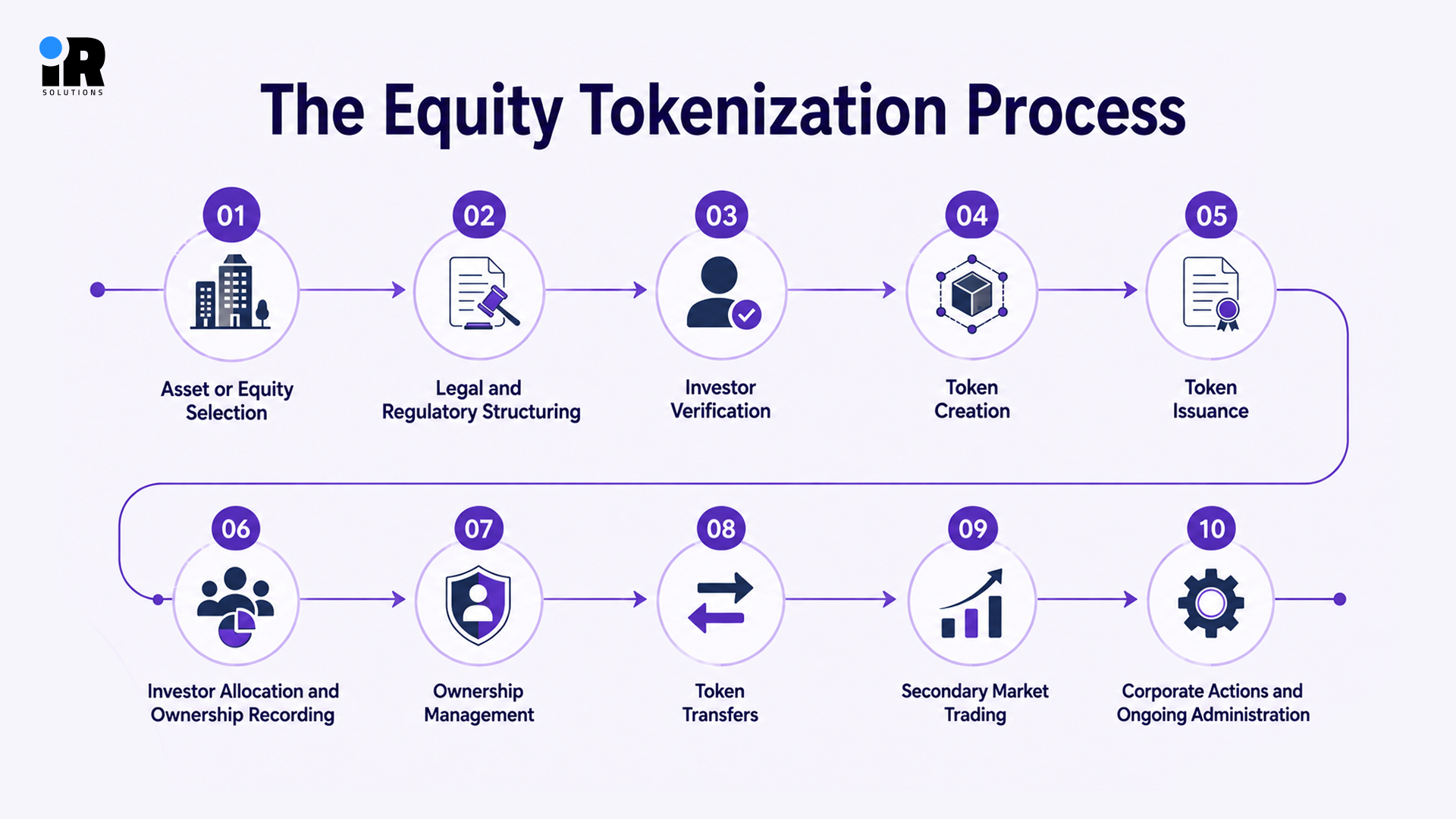
- Asset or Equity Selection: Identify the shares or equity class to be tokenized and define its ownership rights.
- Legal and Regulatory Structuring: Establish the legal framework and confirm applicable securities and compliance requirements.
- Investor Verification: Verify investor identity, residency, and eligibility through KYC and AML checks.
- Token Creation: Define the token supply, ownership rights, and transfer restrictions through smart contracts.
- Token Issuance: Issue the tokens and distribute them to verified investor wallets.
- Investor Allocation and Ownership Recording: Record each investor’s token holdings and provide access through the platform.
- Ownership Management: Keep the cap table and ownership records updated as transactions occur.
- Token Transfers: Process ownership transfers while checking eligibility and compliance requirements.
- Secondary Market Trading: Enable eligible investors to buy and sell tokenized equity within the platform’s compliance framework.
- Corporate Actions and Ongoing Administration: Manage dividends, voting, vesting, redemptions, share-class changes, reporting, and other activities throughout the equity lifecycle.
Key Features of an Equity Tokenization Platform
The feature set of the platform determines whether it can handle the full complexity of equity management or only a subset of what issuers and investors actually need from a production system.
Equity Token Issuance
The token issuance module manages the creation of equity tokens on the chosen blockchain, defining total supply, per-token rights, and the compliance parameters that govern how tokens can be distributed and transferred from the point of creation through the full ownership lifecycle.
Smart Contract Management
Smart contract management tools allow issuers to configure, deploy, and monitor the contracts that govern token behaviour without requiring direct interaction with raw contract code for every operational decision the platform needs to support after the initial deployment.
Investor Onboarding
A structured onboarding workflow guides new investors through identity verification, eligibility confirmation, and wallet setup before they are approved to receive or transfer tokens on the platform for any equity class the issuer has made available to them.
KYC and AML Integration
Native integration with identity verification and AML screening providers connects investor data to the compliance layer of the platform so that verification status is current and readable by the smart contract at every transfer attempt rather than requiring manual compliance review for each transaction.
Investor and Portfolio Management
Tools for managing investor relationships, tracking holdings across multiple equity classes, and maintaining communication records give issuers a complete operational view of their shareholder base without requiring separate CRM systems that do not share data with the cap table.
Cap Table Management
A real-time cap table that updates automatically with every token transfer, corporate action, and new issuance event replaces the manually maintained spreadsheets and third-party cap table services that create reconciliation gaps between the official ownership record and the actual current state of the equity structure.
Custody and Wallet Management
A tokenized equity platform needs secure wallet and custody infrastructure to protect investor holdings and control how tokens can be received, transferred, recovered, or restricted. Depending on the platform model, this can include custodial wallets, non-custodial wallets, institutional custody integrations, wallet whitelisting, key-management controls, and recovery processes.
Corporate Action Management
Corporate action management allows issuers to administer events such as dividends, voting, stock splits, redemptions, buybacks, rights offerings, and vesting through a centralized platform. Connecting these events with token balances can reduce manual calculations and keep investor records synchronized with changes affecting the underlying equity.
Document and Disclosure Management
A regulated equity platform may also need to manage offering documents, investor agreements, disclosures, subscription records, and other documents associated with an equity offering. Integrating document management with investor and compliance workflows helps maintain a consistent record of the information associated with each investor and security.
Token Transfer Management
Transfer management tools handle the workflow for requested ownership changes, applying compliance checks, confirming counterparty eligibility, and executing the transfer on-chain within the restrictions the issuer has defined for the specific equity class being moved.
Dividend and Distribution Management
Automated distribution logic calculates each holder's proportional entitlement when a dividend or income distribution is declared and executes payment to all eligible wallets simultaneously through the smart contract without manual calculation or individual payment processing for each shareholder.
Voting and Governance
On-chain voting tools allow token holders to participate in governance decisions according to the voting rights attached to their tokens, with results recorded permanently on the blockchain rather than through manual ballot collection and counting processes that are slower and less transparent.
Issuer Dashboard
An issuer-facing interface provides real-time visibility into the cap table, outstanding token supply, pending transfers, upcoming corporate actions, and compliance status across all active equity classes the company has issued through the platform.
Investor Dashboard
An investor-facing interface shows each holder their current token balance, income history, transaction record, governance participation, and the documents relevant to their holding without requiring them to contact the issuer or an administrator for routine information requests.
Admin and Compliance Dashboard
An administrative interface gives the platform operator visibility into all platform activity, pending compliance items, flagged transactions, and regulatory reporting requirements across all issuers and equity classes managed within the system.
Reporting and Analytics
Automated reporting tools generate ownership summaries, transfer histories, distribution records, and regulatory filings from the on-chain data without requiring manual data extraction and formatting for each reporting cycle or regulatory submission the issuer is obligated to complete.
How Blockchain Enables Equity Tokenization
Blockchain supports equity tokenization by replacing manually maintained systems with a shared, tamper-resistant ledger that all authorised parties can read and verify simultaneously. Digital ownership records are permanent and independently verifiable without a centralised administrator confirming the cap table state. Programmable transactions carry embedded logic that executes automatically when conditions are met, automating dividend distributions, vesting releases, and rights adjustments that currently require manual execution.
Automated compliance encodes transfer restrictions and eligibility rules directly into the token transfer logic, rejecting non-compliant transactions automatically without manual review introducing delay. Transparent transaction history gives regulators, auditors, and investors a complete on-chain record of every ownership change and distribution event without requiring the issuer to produce it from internal systems. Faster settlement replaces multi-day windows with atomic on-chain completion in minutes, removing counterparty risk entirely from the settlement period.
Fractional ownership divides equity into units accessible at investment levels that standard share classes cannot support, expanding the investor base beyond participants that minimum requirements have historically excluded. Peer-to-peer transfers move ownership directly between verified wallets without a transfer agent processing each change, reducing both the cost and time of every transfer the platform handles. For a closer look at these mechanics across asset types more broadly, see how blockchain enables real-world asset tokenization.
Smart Contracts for Equity Tokenization
Smart contracts automate the functions that make equity tokenization operationally viable. Token issuance contracts mint and distribute tokens to verified wallets automatically upon investment completion. Ownership rules define who can hold tokens under what conditions, while transfer restrictions block unverified wallets, ineligible investors, and excluded jurisdictions on every attempt. If you are weighing how much logic to build versus adapt, see why smart contracts are essential across RWA tokenization for a practical breakdown.
Investor eligibility checks confirm both sender and receiver meet current criteria before every transfer executes rather than after. Dividend distributions flow automatically from the treasury contract to each eligible holder proportional to their token balance when a distribution event triggers. Voting rights are exercised through governance contracts that record and count each holder's vote on-chain without any manual ballot management.
Vesting schedules release token allocations according to predefined timelines without manual transfers or registry updates at each event. Redemptions return capital to token holders and burn the redeemed tokens atomically in a single on-chain transaction that completes both sides simultaneously.
Token Standards for Equity Tokenization
The token standard determines whether the platform can enforce the compliance logic that equity tokenization requires or is structurally limited to permissionless transfers that do not meet securities law requirements in most jurisdictions.
ERC-1400
ERC-1400 is an earlier security token standard that introduces partitioned token structures and transfer restriction capabilities to the basic ERC-20 framework. It remains in use for tranched structures such as senior and junior bond classes or multi-class fund tokens, but adoption has slowed as issuers increasingly favor ERC-3643 for new deployments.
ERC-1404
ERC-1404 extends ERC-20 with a simple transfer restriction mechanism that allows issuers to define the conditions under which transfers can be rejected and the reason codes associated with each rejection type. It is less sophisticated than ERC-3643 but provides a lightweight compliance layer for equity tokenization platforms with less complex restriction requirements.
ERC-3643
ERC-3643 is the most widely adopted standard for institutional-grade regulated token issuance in 2026, having been used to tokenize over $32 billion in real-world assets across more than 180 jurisdictions, with adopters including DTCC, Franklin Templeton, and Invesco. It incorporates a dynamic identity registry that links wallet addresses to verified investor profiles and enforces compliance checks on every transfer against that registry in real time. Changes to an investor's eligibility status propagate to transfer restrictions automatically without requiring a contract upgrade, which makes it the most operationally robust standard for equity tokenization platforms that need to respond to changing regulatory requirements over the lifetime of the equity offering.
ERC-1400 vs ERC-1404 vs ERC-3643
Each standard takes a different approach to enforcing compliance at the token level, and the right one depends on how complex the equity structure and restrictions need to be.
Standard | Main Focus | Compliance Approach | Suitable For |
ERC-1400 | Security-token framework | Advanced transfer controls | Complex security structures |
ERC-1404 | Transfer restrictions | Basic restriction logic | Simpler regulated tokens |
ERC-3643 | Identity and compliance | Identity-based eligibility and permissioned transfers | Institutional tokenization |
The right token standard depends on the equity structure, compliance requirements, transfer model, jurisdiction, and blockchain architecture. There is no single token standard that is appropriate for every equity tokenization project.
Compliance Requirements for an Equity Tokenization Platform
Compliance is not a feature that can be added to a tokenization platform after the technical build is complete. It needs to be embedded in the architecture from the first design decision through to the ongoing operation of the platform in production.
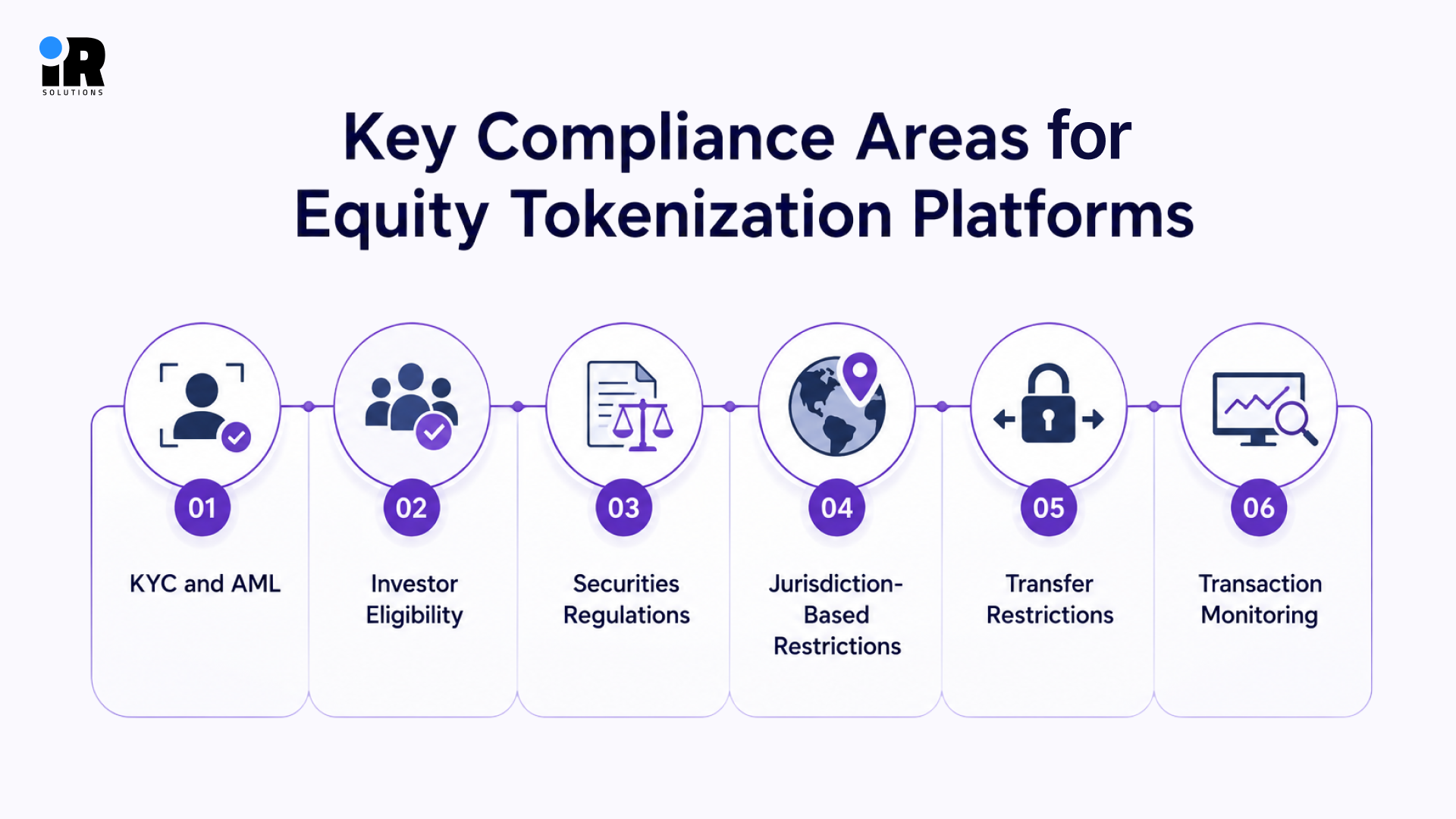
KYC and AML
Every investor who receives or transfers equity tokens must be verified through a KYC process that confirms their identity and an AML screening that confirms they do not appear on relevant watchlists or sanctions lists. That verification status must be maintained and updated in the identity registry as circumstances change, rather than being treated as a one-time check at the point of initial onboarding.
Investor Eligibility
Equity tokens representing securities are subject to investor eligibility requirements in most jurisdictions, including accreditation standards in the United States and equivalent qualified investor standards in the EU and other regulated markets. The platform must confirm eligibility before any token is issued or transferred to a specific investor and must update eligibility status in the compliance layer when investor circumstances change.
Securities Regulations
The offering structure must comply with the securities laws of each jurisdiction where tokens will be issued or transferred, including disclosure requirements, registration or exemption filing obligations, and the specific conditions attached to any exemption the issuer relies on to distribute tokens without full public registration.
Jurisdiction-Based Restrictions
Transfer restrictions that prevent tokens from moving to investors located in jurisdictions where the offering is not legally compliant must be enforced at the smart contract level rather than through manual review, which requires accurate jurisdiction mapping for every wallet in the identity registry.
Transfer Restrictions
Lock-up periods, holding period requirements, volume limits, and counterparty eligibility restrictions all need to be encoded in the smart contract and enforced automatically on every transfer request rather than applied selectively through post-hoc review that introduces both delay and compliance risk.
Transaction Monitoring
Ongoing monitoring of token transactions for patterns that indicate potential regulatory violations, market manipulation, or suspicious activity is required in most regulated markets and must be built into the platform's compliance infrastructure as an ongoing operational function rather than a one-time setup.
Equity Tokenization Platform Architecture
The architecture of the platform determines how reliably and scalably it can perform all of the functions above in a production environment with real investor capital and real regulatory obligations.
Frontend Layer
The frontend layer provides the investor, issuer, and admin interfaces through which all platform participants interact with the system. Investor portals display holdings, transaction history, income records, and governance participation. Issuer interfaces provide cap table management, corporate action execution, and compliance monitoring. Admin interfaces give the platform operator visibility into all activity, pending compliance items, and system health across the full platform.
Application Layer
The application layer handles user management, portfolio tracking, transaction processing, reporting generation, and the core business logic that coordinates activity between the frontend interfaces and the underlying blockchain and data systems. This layer is where the platform's rules about who can do what and under what conditions are implemented as operational software rather than smart contract code.
Compliance Layer
The compliance layer integrates with KYC providers, AML screening services, investor eligibility verification tools, and transfer restriction enforcement systems. It serves as the bridge between the identity registry maintained in the blockchain layer and the business rules maintained in the application layer, ensuring that every action taken on the platform has been validated against the current compliance state before execution.
Blockchain Layer
The blockchain layer contains the smart contracts, token contracts, wallet infrastructure, and on-chain transaction processing that constitute the core technical innovation of the tokenization platform. Everything that happens in the upper layers ultimately results in a transaction or state change in this layer that is recorded permanently on the chosen blockchain network.
Data and Integration Layer
The data and integration layer manages the connections between the platform and external systems, including custody providers, accounting systems, payment processors, regulatory reporting infrastructure, and third-party services that the platform depends on for specific functions. APIs, databases, and integration middleware sit in this layer and determine how well the platform connects to the broader financial and legal infrastructure that equity management operates within.
Blockchain Networks for Equity Tokenization
Choosing a blockchain for equity tokenization starts with security and scalability. The network should protect investor assets, process transactions reliably, and handle increasing users and transaction volumes as the platform grows. A well-established network can also reduce the risk of downtime and technical issues.
Transaction costs and smart contract capabilities are also important. The blockchain should keep fees manageable while supporting smart contracts for token transfers, investor eligibility, vesting, dividends, and governance. Lower and predictable costs can also make the platform more practical for long-term use.
Finally, consider compliance, interoperability, and ecosystem support. The network should meet relevant regulatory requirements, connect with other blockchains and traditional financial systems, and offer reliable developer tools, custody solutions, security providers, and institutional support. This makes it easier to build, operate, and scale the platform over time.
How to Choose a Blockchain for Equity Tokenization
Selecting a blockchain means weighing several factors together rather than picking the most popular option, since security, compliance, and cost all affect how the platform performs
Factor | Why It Matters |
Security | Protects ownership records and transactions |
Finality | Determines how quickly transactions become irreversible |
Transaction Costs | Affects the platform's operating economics |
Smart Contract Support | Enables token and compliance logic |
Compliance Infrastructure | Supports regulated transfers |
Custody Support | Important for institutional investors |
Interoperability | Enables connections with other networks |
Ecosystem | Provides developers, auditors, custodians, and integrations |
Ethereum, Polygon, Avalanche, and other blockchain networks can support different tokenization requirements. The appropriate network should be selected based on the platform's security, compliance, scalability, custody, interoperability, and cost requirements rather than simply choosing the most popular blockchain.
Equity Tokenization Platform Development Process
The development process for an equity tokenization platform follows a defined sequence where the decisions made in each stage determine the feasibility and quality of the stages that follow.
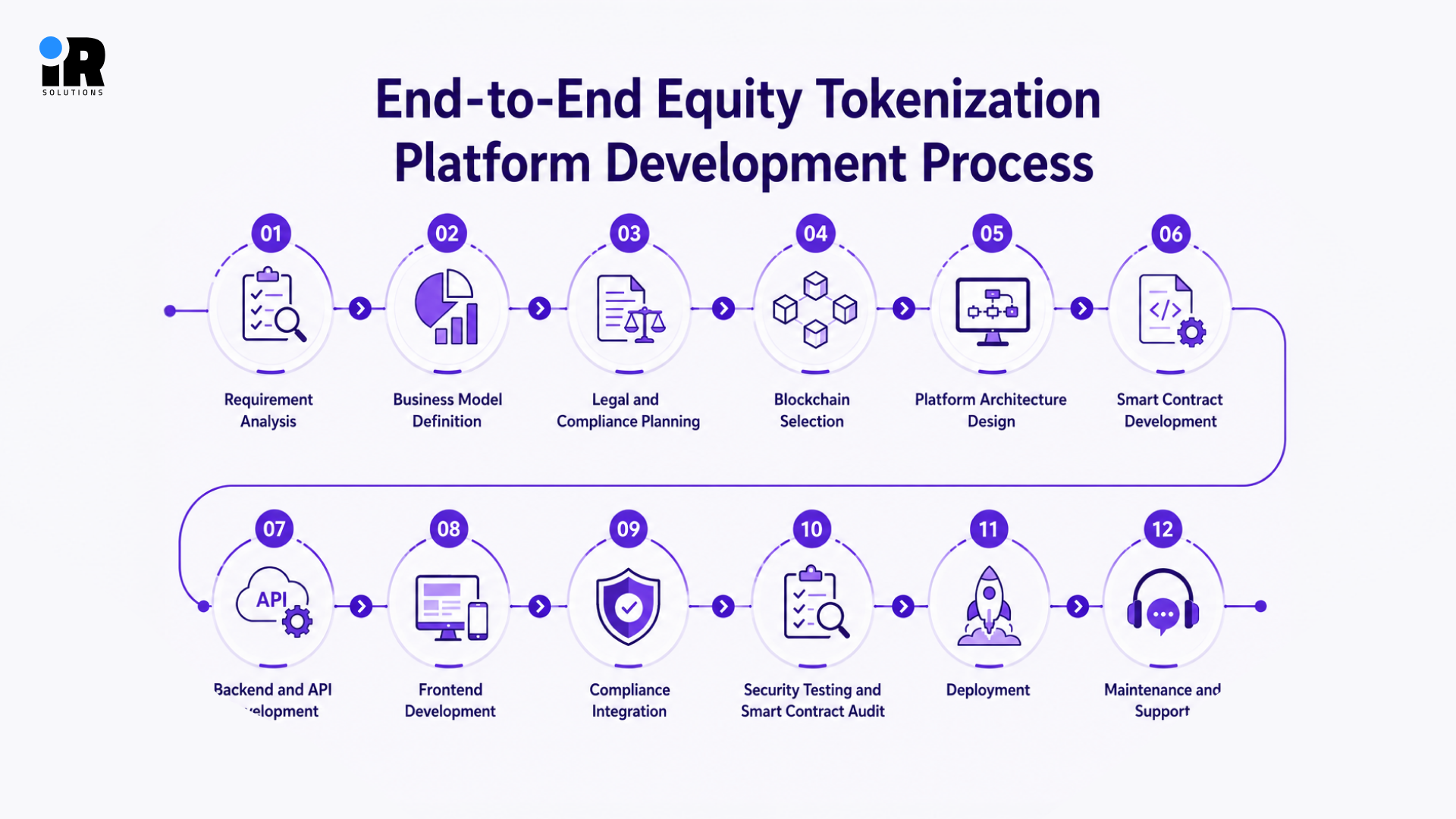
Requirement Analysis
Defining the specific equity classes, investor types, jurisdictions, compliance requirements, and feature scope of the platform before any design or development work begins prevents the scope changes that consistently extend timelines and budgets beyond initial estimates.
Business Model Definition
Before architecture and development begin, the platform's business model should be defined. This includes determining who will issue the equity, who can invest, whether the platform will support primary issuance or secondary trading, which custody model will be used, how the platform will generate revenue, and which jurisdictions will be supported.
Legal and Compliance Planning
Legal counsel with specific digital securities experience reviews the offering structure, confirms compliance requirements in each target jurisdiction, and defines the transfer restriction logic that the smart contract development team will implement in the blockchain layer.
Blockchain Selection
The network is selected based on the security, scalability, compliance compatibility, and ecosystem support requirements defined during the requirement analysis and legal planning stages rather than on generic market preference.
Platform Architecture Design
The five-layer architecture is designed to define how the frontend, application, compliance, blockchain, and data integration layers will interact with each other and with the external systems the platform depends on for specific functions.
Smart Contract Development
Equity token contracts, compliance enforcement logic, distribution contracts, governance contracts, and upgrade proxy patterns are written, tested, and prepared for independent security audit before any investor capital is exposed to them in a production environment.
Backend and API Development
The application layer is built to handle user management, portfolio tracking, transaction processing, corporate action execution, and the API connections to external systems that the platform's compliance and data integration layers require.
Frontend Development
Investor, issuer, and admin interfaces are built to provide each participant category with the information and tools they need without exposing them to the complexity of the underlying blockchain and compliance systems they are interacting with through the interface.
Compliance Integration
KYC providers, AML screening services, investor eligibility verification systems, and transfer restriction enforcement infrastructure are integrated and tested to confirm that the compliance layer functions correctly across all investor types and jurisdictions the platform supports.
Security Testing and Smart Contract Audit
Independent security testing of the platform infrastructure and a third-party smart contract audit from a firm with specific equity tokenization experience are conducted before any deployment to a production environment with real investor capital.
Deployment
Contracts are deployed to the chosen blockchain network, production infrastructure is configured and load tested, and final validation confirms that all compliance, distribution, and governance functions operate correctly under realistic production conditions.
Maintenance and Support
Post-launch maintenance covers smart contract updates as regulations evolve, platform feature additions based on operational experience, security monitoring, and investor and issuer support throughout the operational life of the platform.
How Long Does It Take to Build an Equity Tokenization Platform?
The development timeline depends on the platform's feature scope, legal structure, compliance requirements, number of supported jurisdictions, blockchain architecture, custody integrations, and security requirements. A basic MVP can require substantially less development work than an enterprise platform supporting multiple jurisdictions, complex equity structures, institutional custody, and secondary trading.
The major stages typically include discovery and legal planning, architecture, smart contract development, backend and frontend development, compliance integrations, security testing, audit, deployment, and post-launch support. Projects with complex regulatory requirements can take longer because legal preparation, compliance validation, and security audits must be completed before production deployment.
Benefits of an Equity Tokenization Platform
An equity tokenization platform can make the process of issuing and managing shares more efficient. Faster settlement allows transactions to be completed more quickly, while blockchain records provide better ownership transparency and tracking, making it easier to verify who owns specific shares.
Tokenization can also support automated compliance through smart contracts, helping enforce rules such as investor eligibility and transfer restrictions. This can reduce administrative work by automating tasks that would otherwise require manual recordkeeping and processing.
Another key benefit is fractional ownership, which can lower the entry barrier for investors and improve investor access. Equity can also become programmable, allowing features such as voting, dividends, and transfer rules to be built into the token. With the right regulatory and market infrastructure, tokenized equity may also create opportunities for secondary market liquidity, allowing eligible investors to trade their holdings more easily.
Challenges in Equity Tokenization Platform Development
Regulatory complexity is the starting point for most challenges. Every jurisdiction where tokens are issued or transferred has its own securities law, which must shape the legal structure and compliance layer beforehand. Cross-border platforms need jurisdiction-specific transfer restriction logic, not one global rule set. Investor verification adds to this — KYC and AML checks must scale without creating onboarding bottlenecks that delay issuance and hurt trust.
Security and access carry the highest stakes. Smart contract vulnerabilities are hard to fix once deployed and can put investor capital at irreversible risk. Wallet security matters just as much, since most investors aren't used to self-custody and need education, key management, and recovery options. Custody adds further weight for institutional investors, who bring legal obligations around safeguarding digital assets that early-stage teams often underestimate.
Market and system factors decide whether a platform actually works. Liquidity for tokenized equity stays far lower than public markets, so platforms need a real secondary market strategy. Blockchain interoperability adds friction across networks and jurisdictions, while data privacy laws like GDPR shape how identity data connects to on-chain records. Integration with traditional financial systems then extends timelines and demands specialized expertise.
Equity Tokenization Platform vs Traditional Equity Management
Comparing the two models side by side shows where tokenization actually changes the mechanics of equity management, from settlement speed to how transfers are verified and recorded.
Dimension | Equity Tokenization Platform | Traditional Equity Management |
Ownership records | Immutable on-chain ledger | Paper or centralised digital records |
Issuance | Smart contract token creation | Manual share certificate issuance |
Transfers | Automated, compliance-checked on-chain | Manual legal documentation process |
Settlement | Minutes | Days to weeks |
Compliance | Automated enforcement on every transfer | Manual review per transaction |
Fractional ownership | Supported natively | Not supported in standard share structures |
Transparency | Real-time on-chain visibility | Periodic administrator reporting |
Investor access | Global, eligible investors only | Local, large minimum commitments |
Use Cases of Equity Tokenization
The use cases below represent current production deployments rather than theoretical future applications of the technology.
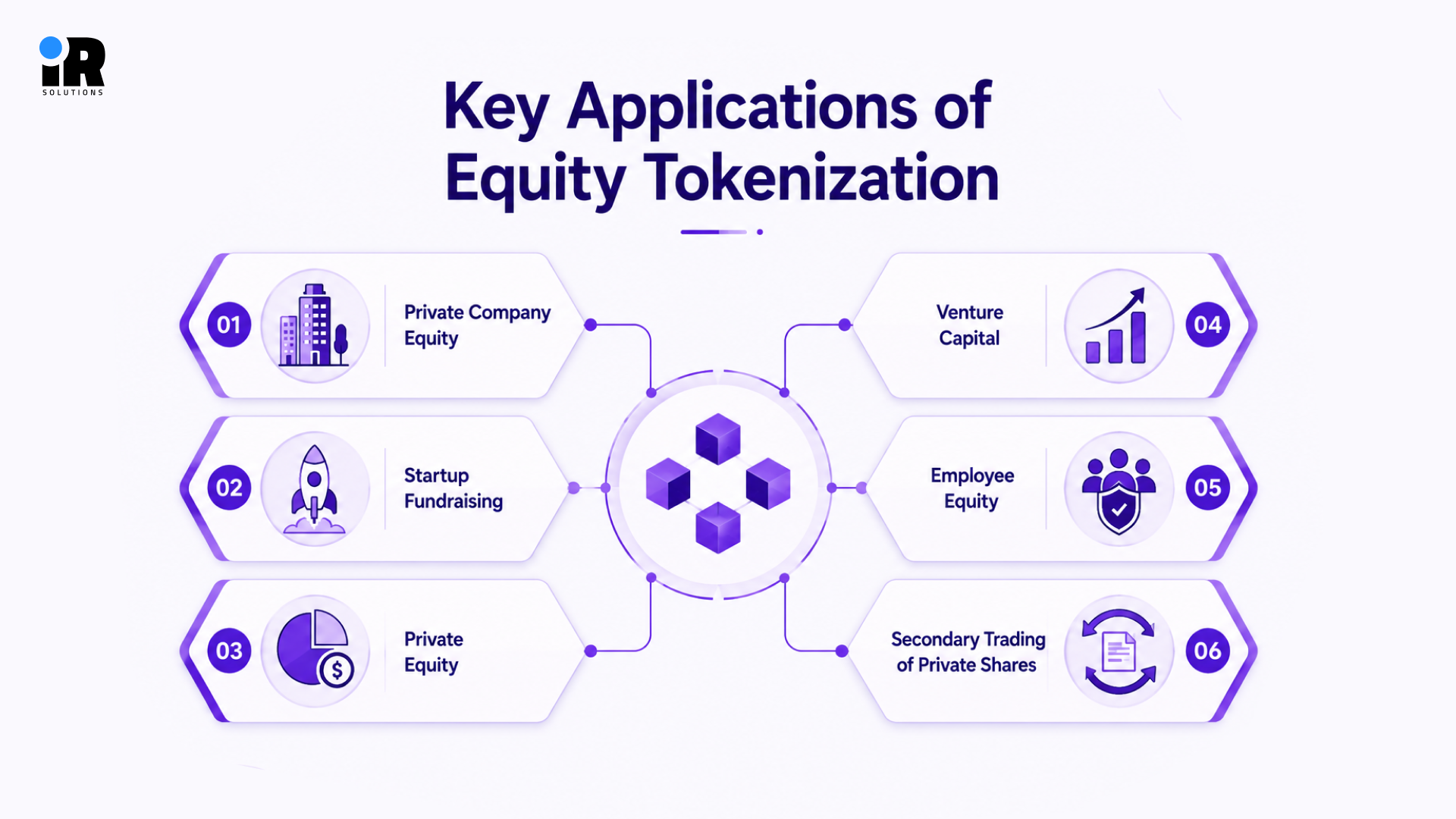
Private Company Equity
Private companies can issue tokenized equity to cap table investors, automate vesting for employees and founders, and provide investor reporting without maintaining separate cap table management systems alongside the blockchain ownership record.
Startup Fundraising
Early-stage companies can raise capital from a broader pool of accredited or qualified investors by issuing tokenized equity through a platform that handles compliance, distribution, and investor management without requiring the full legal overhead of a traditional venture financing round.
Private Equity
Private equity firms can tokenize fund interests to offer improved secondary market liquidity to limited partners who currently have no practical exit pathway before the fund reaches its planned realisation horizon through portfolio company exits.
Venture Capital
Venture capital funds can issue tokenized LP interests that provide quarterly income distributions, governance participation, and secondary market liquidity through a single platform that replaces the manual administration of traditional LP management operations.
Employee Equity
Employee stock ownership plans and individual employee equity grants can be managed through tokenization platforms that automate vesting schedules, simplify exercise and transfer processes, and provide employees with real-time visibility into their equity position and its current value.
Secondary Trading of Private Shares
Tokenized equity platforms with integrated secondary marketplace infrastructure allow early investors and employees to sell their positions to eligible buyers without requiring a company-led liquidity event or the expensive and slow legal process that traditional private share transfers involve.
How Much Does It Cost to Build an Equity Tokenization Platform?
Total development cost depends on how each major cost driver is scoped. Platform complexity sets the baseline more features mean more frontend, application-layer, and compliance integration work, while blockchain selection affects both smart contract development and ongoing transaction costs. For a full breakdown of what moves the number up or down, see what it costs to launch an RWA tokenization platform before scoping your budget.
Smart contract complexity is one of the biggest individual drivers, since conditional logic for vesting, governance, multi-class equity, and distribution rules takes far more development and audit time than a simple issuance contract. Compliance integrations KYC, AML, jurisdiction-specific reporting add both build cost and ongoing licensing fees, and wallet or custody integrations scale with how many providers the platform supports.
Security work, including audits, penetration testing, and monitoring, scales with the value and complexity of the equity involved rather than sitting at a fixed cost. Supported jurisdictions multiply compliance scope, since each one adds its own transfer restrictions and reporting obligations, while the choice between in-house, dedicated, or staff-augmented development teams affects both cost and timeline. Ongoing maintenance is a recurring cost most first-time projects underbudget for.
Most platforms land between $80,000 and $400,000 for the initial build. Enterprise-grade platforms across multiple jurisdictions can exceed this, with full-scale builds including legal, compliance, and audit costs sometimes reaching $500,000 or more.
What Determines the Cost of an Equity Tokenization Platform?
Development cost is shaped by several factors working together, and understanding how each one affects scope helps issuers budget realistically before committing to a specific build.
Cost Factor | Impact |
Platform Features | More workflows increase development effort |
Smart Contracts | Complex token logic requires more development and auditing |
Compliance | KYC, AML and eligibility integrations add complexity |
Jurisdictions | More jurisdictions require more legal and technical rules |
Blockchain | Network and infrastructure choices affect cost |
Custody | Institutional custody integrations increase complexity |
Security | Audits and testing add development cost |
Integrations | Banking, accounting and payment integrations increase scope |
Secondary Trading | Marketplace functionality requires additional infrastructure |
Why Choose IR Solutions for Equity Tokenization Platform Development
IR Solutions offers end-to-end equity tokenization platform development, combining blockchain expertise with compliance-focused solutions. Platforms can be customized around the issuer’s equity structure, investor requirements, and business goals instead of using a generic approach. The team can work with networks such as Ethereum, Polygon, Avalanche, and other suitable enterprise blockchains based on project needs.
Development can cover smart contracts, token issuance, investor onboarding, compliance, distributions, governance, and vesting. The platform can also integrate KYC/AML providers, custody services, payment systems, accounting tools, and other third-party solutions. Investor and issuer dashboards can be designed to support their specific workflows, while security measures such as smart contract audits and testing help protect platform operations.
IR Solutions also provides ongoing maintenance and support after launch. This includes platform updates, security monitoring, regulatory changes, and new feature development as requirements evolve. This approach helps businesses build a secure, scalable, and practical equity tokenization platform.
Conclusion
An equity tokenization platform replaces the manual, slow, and expensive processes of traditional equity management with automated, compliant, and transparent blockchain-based infrastructure that serves both issuers and investors better than any comparable traditional system. The technical foundation of smart contracts, compliance-aware token standards, and multi-layer platform architecture makes the operational improvements achievable rather than theoretical. The development investment required to build a production-ready platform is significant, but so are the operational savings, investor access improvements, and market differentiation advantages that a well-built equity tokenization platform delivers to the companies and investors that use it. Getting the legal structure, blockchain selection, smart contract design, and compliance integration right before any investor capital is committed is what determines whether the platform delivers on its potential or requires expensive remediation after the fact.
Frequently Asked Questions
What is an equity tokenization platform?
An equity tokenization platform is a software system that allows companies to issue, manage, and transfer ownership of equity as blockchain-based digital tokens with automated compliance, distribution, and reporting functions built into the platform architecture.
How does equity tokenization work?
Equity is legally structured within an appropriate entity, converted into digital tokens on a blockchain through smart contracts, distributed to verified investors, and managed through automated compliance, distribution, and governance logic throughout the full ownership lifecycle.
How do you build an equity tokenization platform?
Building an equity tokenization platform requires requirement analysis, legal and compliance planning, blockchain selection, architecture design, smart contract development, backend and API development, frontend development, compliance integration, security auditing, deployment, and ongoing maintenance and support.
Which blockchain is best for equity tokenization?
Ethereum is the most widely used for institutional-grade equity tokenization. Polygon offers lower transaction costs with Ethereum compatibility. The right choice depends on the specific security, scalability, compliance, and ecosystem requirements of the individual platform rather than a universal recommendation.
What token standards are used for tokenized equity?
ERC-1400, ERC-1404, and ERC-3643 are the most commonly used standards for equity tokenization because they support compliance logic, transfer restrictions, and investor eligibility enforcement natively within the token transfer mechanism rather than through external systems.
Is tokenized equity legally compliant?
Tokenized equity can be legally compliant when properly structured under applicable securities laws in each jurisdiction where tokens are issued or transferred. Frameworks including Reg D and Reg A+ in the US, MiCA in the EU, and equivalent regulations in other markets provide established compliance pathways.
How much does it cost to build an equity tokenization platform?
Most equity tokenization platforms cost between $80,000 and $400,000 to build, depending on feature complexity, compliance requirements, blockchain selection, number of supported jurisdictions, and the depth of custody and third-party integrations required.
How long does equity tokenization platform development take?
Development timelines typically range from four to twelve months depending on platform complexity, compliance scope, and the number of jurisdictions the platform needs to support at launch. Legal preparation and smart contract auditing are usually the longest individual stages in the process.
Can an equity tokenization platform support secondary trading?
Yes. Equity tokenization platforms with integrated secondary marketplace infrastructure allow eligible investors to buy and sell token positions within the compliance framework the issuer has established, providing liquidity pathways that traditional private equity structures do not offer outside of company-led liquidity events.
What is the difference between equity tokens and security tokens?
Equity tokens are a specific category of security token that represent ownership rights in a company, including potential dividend entitlements and voting rights. Security tokens is the broader category that includes equity tokens, debt tokens, revenue-sharing tokens, and other instruments representing regulated financial rights on a blockchain.