


Key Takeaways
- Klaviyo is better for advanced segmentation, predictive analytics, and complex ecommerce automation.
- Omnisend is easier to use and better suited to smaller teams that want faster setup.
- Klaviyo offers deeper customer data, reporting, integrations, and personalization options.
- Omnisend has an advantage for multichannel marketing with email, SMS, and web push.
- Omnisend generally costs less, while Klaviyo offers more advanced tools for growing brands.
- The right choice depends on your store size, marketing needs, budget, and team capacity.
Your email marketing platform can have a direct effect on how well your store keeps customers coming back.
Klaviyo and Omnisend are both built for ecommerce, but they take different approaches. Klaviyo is a stronger fit for brands that need detailed customer data, advanced segmentation, predictive insights, and more complex customer journeys. Omnisend is often a better fit for smaller teams that want quick setup, email, SMS, and web push workflows without adding too much complexity.
The better option depends on more than the number of features each platform offers. Your contact list size, email sending volume, SMS needs, ecommerce platform, growth plans, and the amount of time your team can spend managing the platform all matter.
In this comparison, we look at both platforms based on the features and tools that can affect ecommerce sales and customer retention, rather than simply repeating their advertised features. We will compare pricing, automation, segmentation, SMS, integrations, deliverability, and support to help you decide which one fits your store.
Klaviyo vs Omnisend: Main Differences
Klaviyo stores every customer action every purchase, browse, and click and turns that into usable data for targeting. It is built for teams that want to get granular with segmentation and automation. The tradeoff is that it takes time to learn and set up properly.
Omnisend is built for speed. You get email, SMS, and web push in one place, with prebuilt flows that work out of the box. It is a better fit for lean teams that want results without a long setup phase.
Klaviyo vs Omnisend: Quick Comparison
This table covers the features that matter most to ecommerce stores making a final decision.
Feature | Klaviyo | Omnisend |
Best for | Data-driven brands, advanced segmentation | Lean teams, multichannel execution |
Free plan | Yes 250 active profiles, 500 emails/month | Yes, 250 contacts, 500 emails/month |
Pricing model | Based on active profiles | Based on contacts and plan |
Email automation | Advanced, highly customizable | Solid prebuilt flows |
SMS marketing | Strong, US and international | Strong, includes web push |
Web push notifications | No (as of mid-2026) | Yes |
Segmentation | Best-in-class, predictive | Good for standard segments |
Predictive analytics | Yes | Limited |
AI features | Yes, across multiple tools | Yes, growing suite |
Reporting | Detailed, custom dashboards | Standard ecommerce reporting |
Ecommerce integrations | 300+ | 130+ |
Shopify compatibility | Excellent | Excellent |
Deliverability features | Strong | Strong |
Migration support | Help docs, partner ecosystem | Help docs, migration tools |
Customer support | Live chat (paid), email | Live chat (paid), email |
Ease of use | Moderate learning curve | Easier for beginners |
Which Platform Gives You More Design Control?
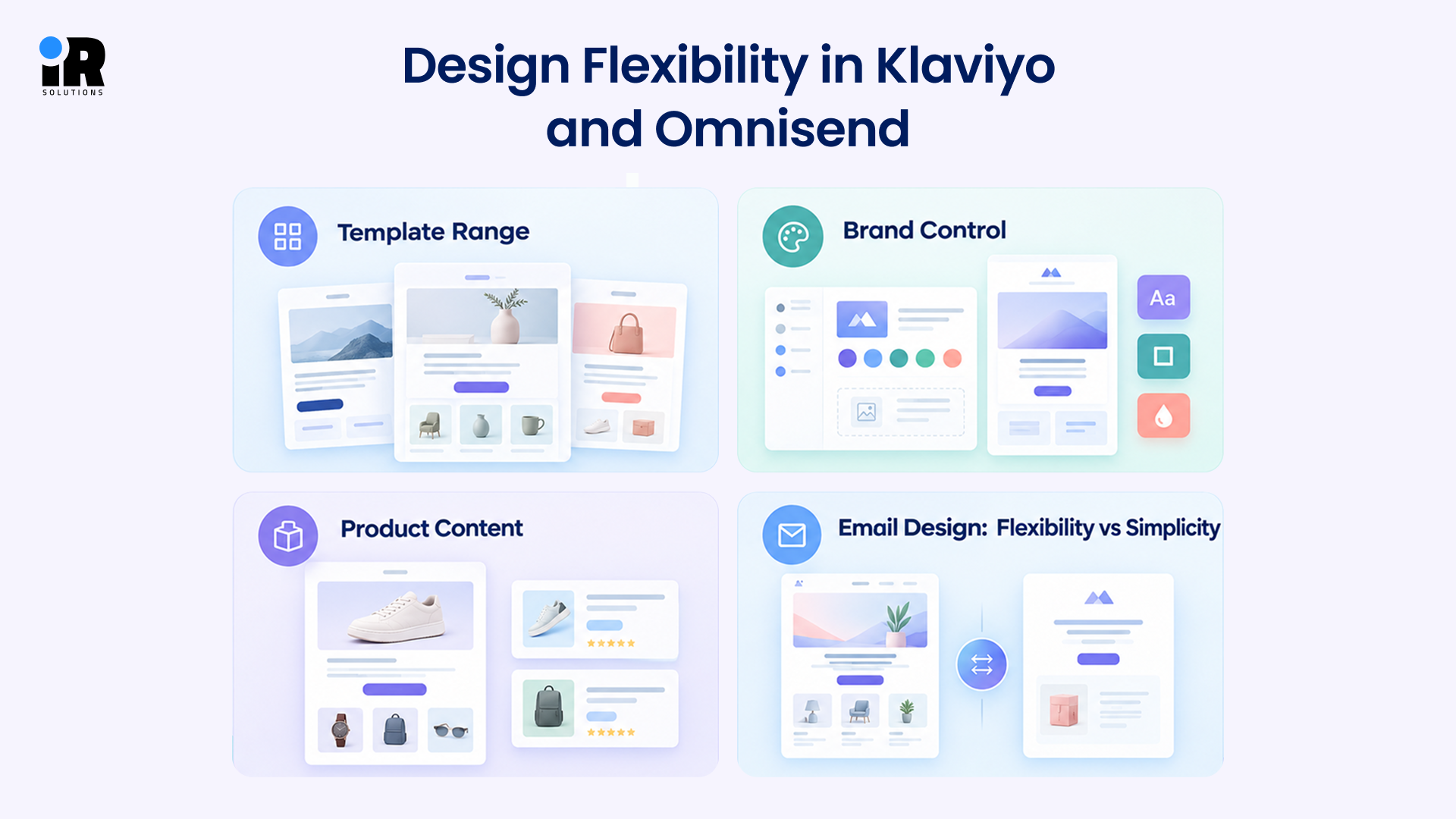
Both platforms give you several ways to design and customize your emails, but the level of control is different. If your brand relies on specific layouts, visuals, and styling, this section will help you see which platform gives you more flexibility.
Template Range
Klaviyo covers seasonal, promotional, and standard ecommerce layouts. Omnisend's templates are more plug-and-play swap in your logo and colours, and you are ready in under an hour. Both cover what most stores actually need.
Brand Control
Both support full custom HTML for designers building from scratch. Klaviyo's saved content blocks update globally, so a footer change reflects across every template at once. Omnisend supports saved blocks too, with slightly fewer options. Both editors include mobile preview before sending.
Product Content
Klaviyo pulls products dynamically from your store and personalises recommendation blocks based on browse and purchase history. Omnisend does the same, with a faster setup for basic product grids. Klaviyo gives more control over how those recommendations are targeted.
Email Design: Flexibility vs Simplicity
With a designer, Klaviyo gives you more to work with. Without one, Omnisend's templates are easier to edit and still look professional. Both tools get the job done it depends on how much control you actually need.
Which Platform Is Easier to Use?
For small teams, every hour spent figuring out software is an hour not spent on the store. Ease of use is not a small thing it directly affects how fast you get results.
Setup and Onboarding
Omnisend gets you moving quickly. The setup screen walks you through connecting your store, adding a form, and launching your first automation in a logical order. Most users can send a welcome campaign within a few hours.
Klaviyo takes longer to get comfortable with. The dashboard shows more data and more settings from the start, which can feel overwhelming if you are new to email marketing.
The Email Editor
Both editors are drag-and-drop, so no coding is needed for standard campaigns. Klaviyo's editor has more options but requires more clicks to get where you are going.
Omnisend's editor is more straightforward and faster for putting together a basic campaign layout.
For Different Teams
Omnisend is the easier pick for founders and small marketing teams. You can set up your core flows and campaigns without a steep learning curve.
Klaviyo suits a dedicated email marketer or CRM specialist who has time to explore the platform and build more complex setups.
Neither tool requires technical skills for everyday use, but Klaviyo does reward users who invest time in learning it properly.
Which Platform Has Better Email Automation Features?
This is where the real difference between these two platforms shows up. Automation is where ecommerce revenue gets recovered and retained.
Both platforms support every standard ecommerce flow. But the depth of logic, personalization, and conditional branching differs significantly.
Core Flows
Here is what both platforms can handle well:
- Welcome series: Triggered on signup, with multi-step email sequences.
- Browse abandonment: Sent after a contact views a product but does not add it to cart.
- Cart abandonment: Triggered after a product is added to cart but no purchase follows.
- Checkout abandonment: Triggered after checkout starts but isn't completed.
- Post-purchase: Thank-you emails, shipping updates, and review requests.
- Cross-sell and upsell: Triggered based on purchase history and related products.
- Win-back flows: Sent to lapsed customers who have stopped purchasing.
- Replenishment reminders: For consumable products with a predictable purchase cycle.
- Back-in-stock and price drop: Triggered by inventory and pricing events.
- Birthday and anniversary: Date-based triggers using customer profile data.
Real Ecommerce Scenario
A customer views a jacket, adds it to cart, and starts checkout. They abandon at the payment screen, ignore the first cart recovery email, and have opted in to SMS.
In Klaviyo: You can build a flow that sends an email one hour after abandonment. If the email is not opened within 24 hours, the flow splits and sends an SMS with a discount code. If the SMS is clicked but no purchase follows, a second email fires 48 hours later with personalised product recommendations based on browse history. Every step uses conditional splits with actual data.
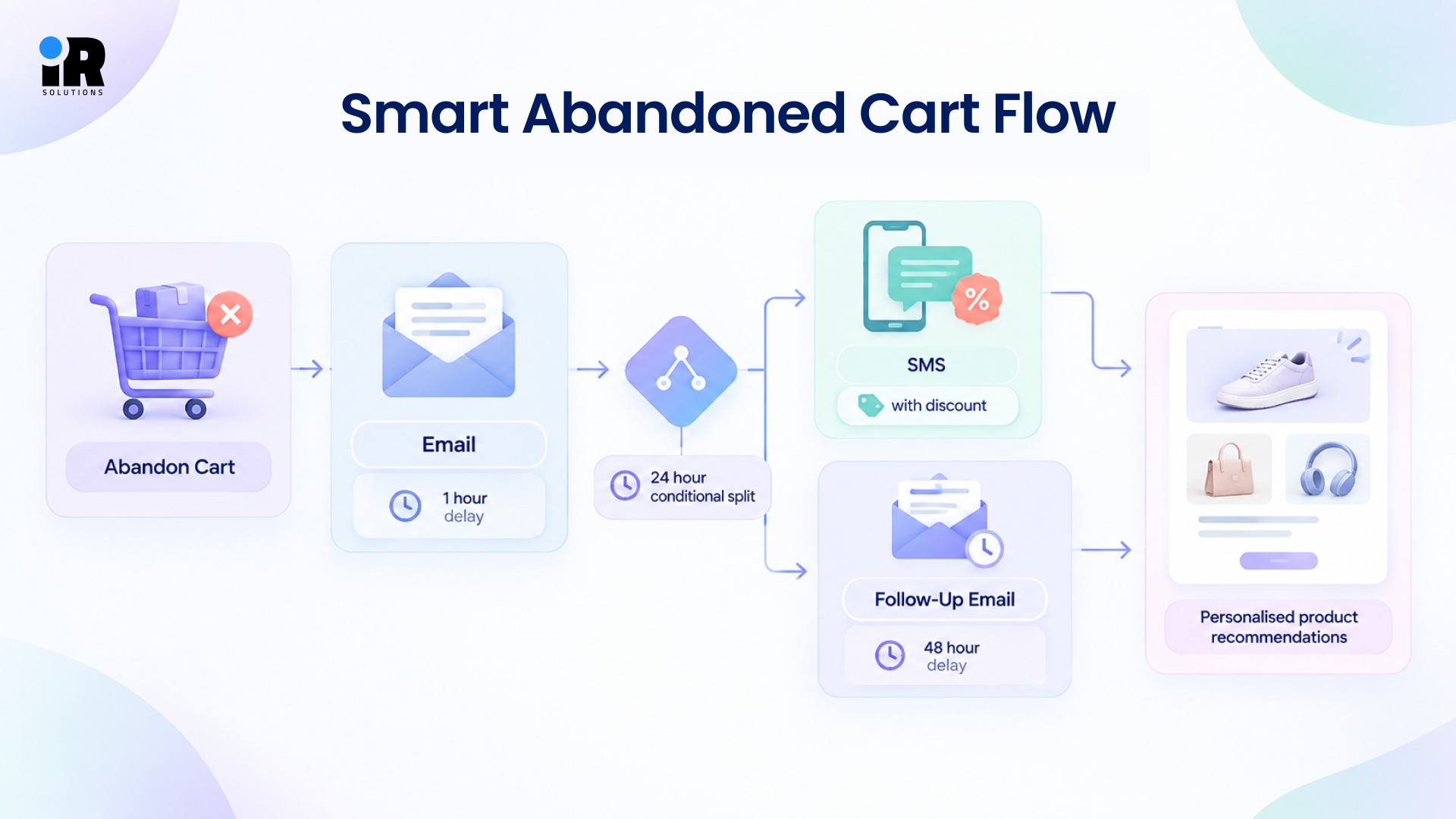
In Omnisend: You can build a comparable flow using email, SMS, and web push in a single automation. The setup is faster and more visual. You can add conditional splits, but the logic options are fewer. The flow covers the journey well without needing advanced configuration.
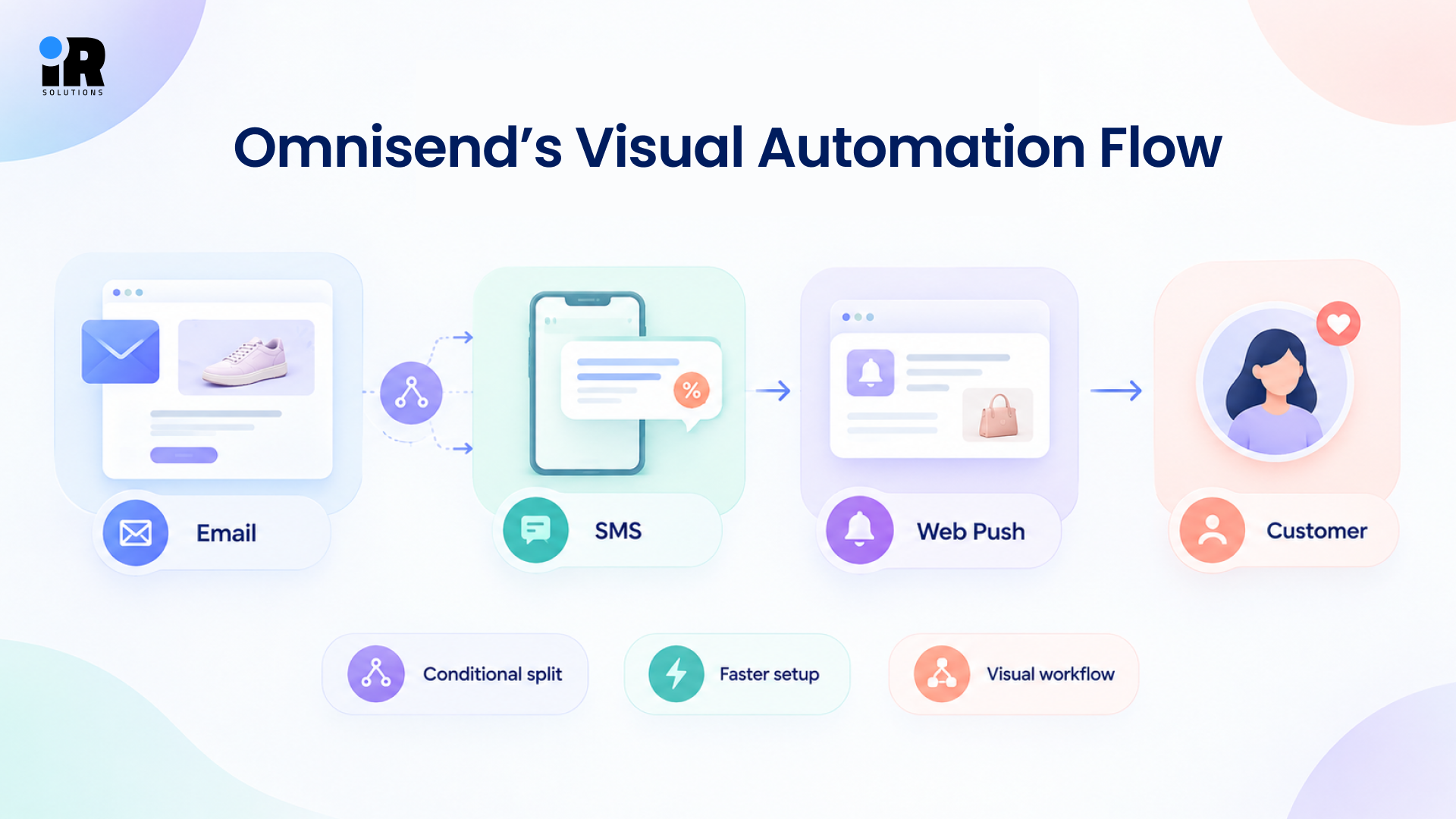
For most stores recovering carts and following up on purchases, Omnisend's automation handles it. For brands that want deep conditional logic, predictive triggers, and personalised product content inside flows, Klaviyo goes further. Klaviyo's abandoned cart benchmarks also show how these flows can contribute to ecommerce revenue across different industries.
Transactional Messaging
Klaviyo supports transactional emails through its API. Omnisend also supports transactional messaging. Both options work, but implementation requires technical setup for custom transaction events.
If you want to build a more detailed cart recovery strategy, our guide to recovering abandoned carts with Klaviyo covers the triggers, timing, and flow structure in more detail.
Third-Party Integrations
An integration number alone tells you very little. What matters is whether the integration actually passes useful customer and purchase data into the platform.
Platform Support
Both platforms connect to the major ecommerce platforms. Klaviyo supports Shopify, WooCommerce, BigCommerce, Magento, and others. Omnisend covers the same core platforms with a similar setup process.
Integration Depth
- Reviews: Both connect to popular review platforms like Yotpo, Okendo, and Stamped.
- Loyalty: Klaviyo integrates with LoyaltyLion, Smile.io, and similar tools. Omnisend also supports loyalty apps.
- Help desks: Gorgias and Zendesk integrations are available on both platforms.
- Subscriptions: Recharge and subscription app integrations work on both, though Klaviyo's data depth makes subscription segmentation more powerful.
- Paid ads: Klaviyo syncs segments to Facebook and Google Ads. Omnisend also supports audience sync.
APIs and Custom Events
Klaviyo's API is mature and well-documented. Developers can push custom events, build integrations, and create highly specific triggers. Omnisend's API is functional but has fewer custom event options for complex setups.
If your store relies on custom-built integrations or unusual data sources, Klaviyo handles that better. For standard Shopify setups using common apps, both platforms work equally well.
User Segmentation and Personalization
Segmentation is the difference between sending the same email to everyone and sending the right message to the right customer at the right time.
What Klaviyo Does Well
Klaviyo stores every customer action as usable data products viewed, orders placed, emails opened, and more. You can build segments from any combination of these, including purchase behaviour, browse history, campaign engagement, predictive scores like churn risk and next order date, and custom events pushed through the API such as loyalty points or subscription status. The depth here is genuinely hard to match.
What Omnisend Does Well
Omnisend supports all the standard ecommerce segments: purchase history, engagement, cart behaviour, and subscriber properties. For most stores, these options cover the majority of needed audiences. The setup is faster and requires less configuration.
Real Segment Examples
Here is how each platform handles specific audience needs:
- VIP customers who have not purchased in 90 days: Klaviyo can build this using predicted lifetime value plus purchase date. Omnisend can build it using order history plus date filters.
- One-time buyers who have not returned: Both platforms handle this with order count filters.
- Browse-but-no-buy in a specific category: Klaviyo supports this natively. Omnisend requires careful event mapping.
- High-value cart abandoners: Both can filter by cart value, though Klaviyo's data is more granular.
- Customers likely to buy soon: Klaviyo's predictive next-order date makes this easy. Omnisend does not have an equivalent predictive feature.
For standard ecommerce segments, Omnisend covers the essentials well. For predictive scoring, RFM-style targeting, and complex multi-condition segments, Klaviyo is the stronger tool.
Reporting and Revenue Attribution
Both platforms report on campaign revenue, flow revenue, and engagement metrics. But how they attribute revenue changes the numbers significantly.
What Both Platforms Track
- Email open rates, click rates, and unsubscribe rates
- Campaign and flow revenue
- SMS performance
- Conversion rates
- Customer lifetime value (to varying depths)
Attribution Windows
Klaviyo and Omnisend both credit a campaign when a customer purchases within a set time after clicking or opening an email. Using different attribution windows can make the same sales show different revenue numbers, and longer windows usually result in more attributed revenue. Instead of choosing a platform because it reports higher revenue, focus on which one gives you a clearer view of your customers’ actual behavior.
Depth of Reporting
Klaviyo: Custom dashboards, cohort reports, product performance, and benchmarking tools. The reporting is detailed and flexible.
Omnisend: Standard ecommerce reports with clear visuals. Easier to read but less customisable.
For brands that make data-driven decisions and need to slice performance by channel, cohort, or product, Klaviyo's reporting is stronger. For teams that need clear campaign summaries without advanced configuration, Omnisend works well.
A/B Testing and Campaign Optimization
Testing is how you improve. But it only matters if you have enough traffic and subscribers to see statistically meaningful results.
What You Can Test
Klaviyo allows testing of:
- Subject lines: The most common test, available on all paid plans.
- Sender names: Test whether a personal name or brand name performs better.
- Send times: Optimised sending and manual time tests.
- Email content: Full content variants including layout and product blocks.
- Automation paths: Split testing inside flows to compare different sequences.
- Omnisend allows testing of:
- Subject lines: Available across plans.
- Email content: Content variants within campaigns.
- Send times: Smart sending and manual time options.
Klaviyo's flow-level split testing is a meaningful advantage. You can test whether a two-email cart recovery sequence outperforms a three-email sequence. That kind of optimisation compounds over time.
When Testing Matters
Testing is worth the setup time when you send to 5,000 or more subscribers regularly. Below that threshold, results often lack enough volume to be reliable. Start by testing subject lines, then move to content and timing once you have a clear baseline.
Deliverability
Neither platform can guarantee inbox placement. It depends on your list quality, sending frequency, subscriber engagement, and the content of your emails. Clean lists and relevant emails can help keep your messages out of spam.
Technical Setup
Both platforms support branded sending domains with SPF, DKIM, and DMARC authentication. Both handle bounce processing and suppress invalid addresses automatically. Both give access to spam complaint data through feedback loops.
Deliverability Tools
Klaviyo: Sender health monitoring inside the platform, engagement-based list management, and the ability to segment by engagement for re-engagement campaigns. Dedicated IP support is available on higher-tier plans.
Omnisend: Similar tools for bounce handling and suppression. Also supports dedicated IPs at enterprise tiers.
Before changing your subject lines or send times, it is also worth checking what is causing your open rates to fall. Why email open rates drop covers common causes and ways to improve engagement.
Customer Support
When it comes to getting help, both Omnisend and Klaviyo offer tutorials and knowledge bases to guide users through their platforms, but the level of support they provide tells a very different story.
Omnisend gives you 24/7 live chat and email support even on its free plan, which is something you don't see very often. On top of that, the Omnisend Academy gives you access to guides, workshop recordings, and practical marketing resources to help you grow beyond just the basics. They also ask for your feedback directly inside the dashboard, which shows they're actually listening to their users.
Klaviyo, on the other hand, only offers email support for the first 60 days on its free plan. After that, you need a paid plan to continue getting support. Most users may feel comfortable with the platform by then, but questions and problems can still come up later. Losing access to email support can be frustrating when you need help with an important issue.
If reliable support is something you value, Omnisend is the stronger choice here, no question about it.
Signup Forms and Landing Pages
Your forms are the front door of your email list. A poorly targeted form fills your list with low-quality contacts. That hurts your deliverability, your engagement rates, and ultimately your revenue.
Form Types
Both platforms offer:
- Popups: Timed or scroll-triggered overlays.
- Flyouts: Slide-in panels that are less disruptive than full popups.
- Embedded forms: Placed directly within page content.
- Exit-intent forms: Triggered when a visitor moves toward closing the tab.
Form Targeting
Klaviyo: Targeting by page URL, device type, visitor behaviour, and existing subscriber status. A/B testing forms is available.
Omnisend: Similar targeting options with slightly simpler configuration. Landing pages are also available for lead capture outside the main site.
SMS and Email Consent
Both platforms support dual consent capture for email and SMS within the same form. This is important for compliance and for building a matched email-plus-SMS subscriber base. Omnisend makes this capture flow slightly simpler to configure for new users.
SMS Marketing and Web Push Notifications
SMS can be a useful way to reach customers quickly, especially for timely offers and reminders. But sending too many messages or sending them to the wrong audience can annoy customers and lead to more unsubscribes. Web push notifications can add another way to reach shoppers without relying only on email.
Klaviyo SMS:
- Available as part of the Klaviyo platform with separate SMS credit pricing.
- Strong compliance controls including quiet hours, opt-out management, and consent tracking.
- Integrates tightly with email flows. You can build email-to-SMS fallback sequences within the same automation.
- International SMS is supported, though pricing varies by country.
Omnisend SMS:
- SMS is included within the Omnisend platform alongside email and web push.
- Similar compliance controls with quiet hours and opt-out management.
- Multichannel flows combining email, SMS, and web push are easier to build in a single visual workflow.
- International SMS availability varies by region.
Web Push Notifications
Omnisend includes web push notifications on its paid plans. Klaviyo does not currently offer web push.
If web push is a channel you want to use for cart recovery or promotional messaging, Omnisend has a clear advantage.
Using SMS Responsibly
SMS subscribers have higher expectations than email subscribers. They opted in to receive direct messages. Send SMS when the message is time-sensitive, genuinely valuable, or directly relevant to a recent action. Reserve SMS for cart recovery, order updates, flash sales, and back-in-stock alerts. Daily promotional SMS messages lose opt-ins quickly.
If SMS is part of your strategy, these Klaviyo SMS marketing best practices can help you plan messages, timing, and campaigns more effectively.
Do the AI Features Actually Make a Difference?
Every platform has AI tools now. The real question is whether those features save you time on tasks that matter, or whether they are just checkboxes on a pricing page. Here is what each platform actually offers and what is worth paying attention to.
Klaviyo AI Tools
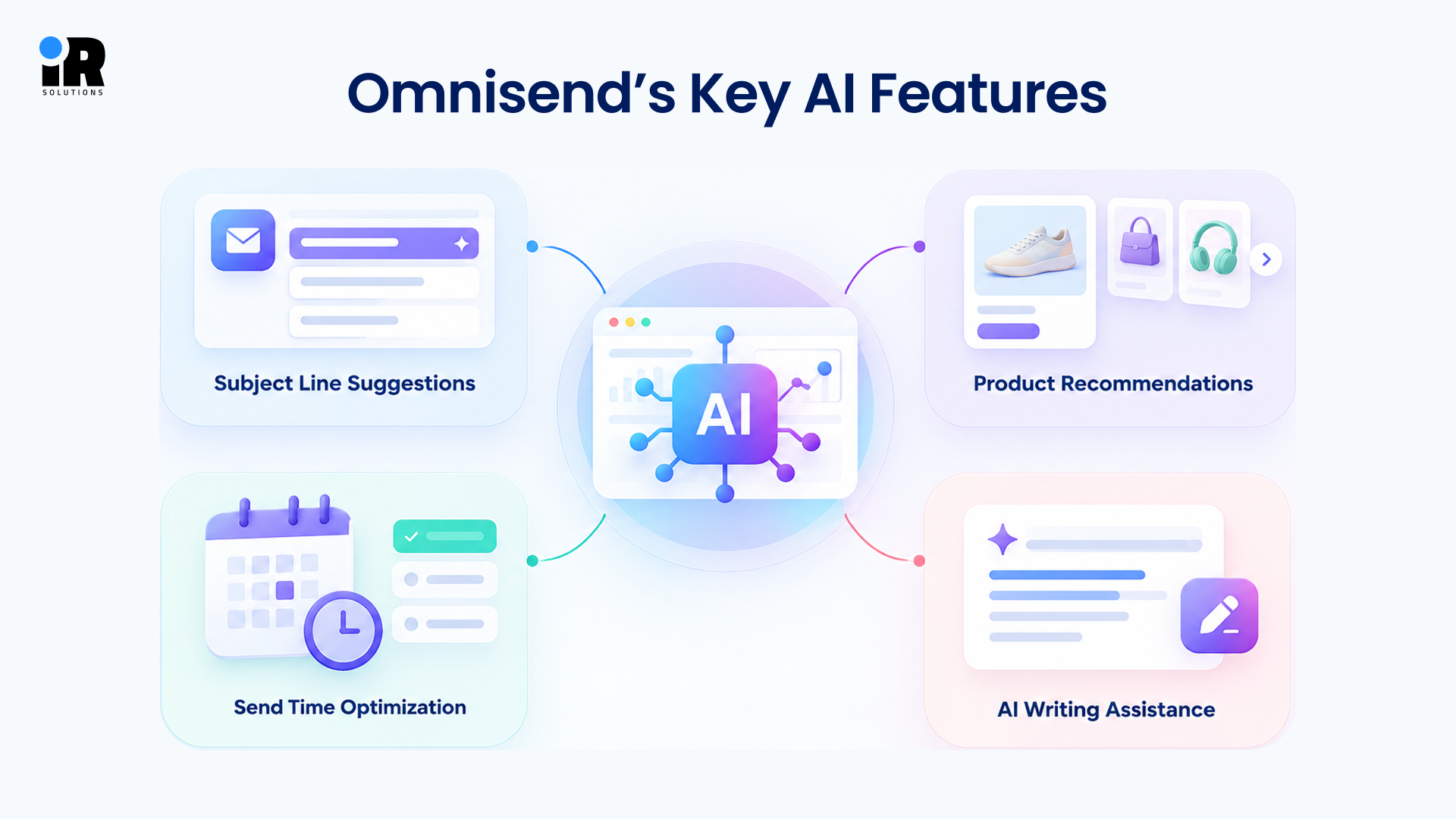
Klaviyo's most useful AI feature is its predictive analytics. It calculates predicted lifetime value, churn risk, and next order date for each customer, and you can use those scores directly in segments and flows. Beyond that, Klaviyo offers subject line suggestions inside the campaign builder, send time optimisation that adjusts delivery per subscriber, AI-generated copy suggestions, and audience ideas surfaced from your customer data.

Omnisend AI Tools
Omnisend covers the core AI tools most ecommerce teams actually use. You get subject line suggestions in the campaign editor, product recommendation blocks powered by purchase and browse history, send time optimisation on paid plans, and writing assistance for campaign content. It is a solid set of features without anything as distinctive as Klaviyo's predictive scoring.
What Actually Helps
Predictive analytics is where Klaviyo's AI genuinely earns its place. Knowing which customers are likely to churn or likely to buy again soon means you can act before it is too late, rather than sending the same campaign to everyone and hoping.
Subject line tools and copy suggestions are useful for saving a few minutes, but they rarely move the needle on results. AI features on both platforms sit behind paid plans, so check current plan pages before assuming a feature is included at your tier.
Pricing Comparison
Pricing can change over time, and the cost depends on factors such as your contact list and how much you send. Check the current pricing on the Klaviyo and Omnisend websites before deciding which platform fits your budget.
Contacts | Klaviyo Email | Omnisend Standard |
Free plan | Up to 250 active profiles | Up to 250 contacts |
1,000 | $30/month | $20/month |
5,000 | $100/month | $81/month |
10,000 | $150/month | $132/month |
25,000 | $400/month | $282/month |
50,000 | $720/month | Not listed in Omnisend's current comparison |
The Real Cost Calculation
The price gap grows as your contact list gets larger. At 10,000 contacts, Omnisend costs about $132 per month compared with $150 for Klaviyo. At 50,000, it is $413 versus $720. Also consider your email volume, SMS needs, and other tools before deciding. The cheaper plan may not always mean a lower overall cost.
How Klaviyo and Omnisend Compare
This comparison looks at the key areas that matter for ecommerce, including automation, design, segmentation, reporting, pricing, and support. Each category gives the edge to Klaviyo, Omnisend, or both when the two platforms offer similar value.
Category | Verdict | Why |
Ease of use | Omnisend | Simpler setup and an easier dashboard to navigate |
Email design | Both | Both offer flexible templates and strong ecommerce design options |
Automation | Klaviyo | More advanced workflows, conditions, and customer data |
Integrations | Klaviyo | Larger integration ecosystem and strong API options |
Segmentation | Klaviyo | More detailed customer data and predictive targeting |
Reporting | Klaviyo | More detailed reports, dashboards, and customer insights |
A/B testing | Klaviyo | More testing options across campaigns and flows |
Deliverability | Both | Both provide the main tools needed to manage deliverability |
SMS and web push | Omnisend | Supports multiple channels with a simpler setup |
Forms and list growth | Both | Both offer useful forms and list-building features |
AI features | Klaviyo | More advanced predictive and AI-powered features |
Support | Both | Both provide support options based on the plan |
Pricing | Omnisend | Generally costs less at similar contact levels |
Migration | Omnisend | Built-in tools make switching from another platform easier |
Klaviyo vs Omnisend for Shopify
Both platforms have official Shopify apps with strong native integrations. The difference is in what each platform does with the Shopify data it receives.
Data Sync
Klaviyo pulls every Shopify customer, order, product, and event into its profile system. That means you can segment by specific products purchased, checkout steps reached, collections browsed, and discount codes used. The sync is deep and keeps historical data.
Omnisend also syncs Shopify data well. Products, orders, and customer properties flow in reliably. For standard Shopify stores running common workflows, Omnisend's sync covers everything you need.
Shopify-Specific Features
- Checkout abandonment: Both platforms trigger on Shopify checkout events.
- Dynamic products: Both support live product blocks pulling from the Shopify catalog.
- Discount codes: Both generate unique Shopify discount codes within automations.
- Shopify Plus: Both work with Shopify Plus. Klaviyo's deeper API connection suits larger Plus brands better.
For Different Shopify Store Types
Shopify startups: Omnisend is easier to launch quickly and costs less at smaller list sizes.
High-growth DTC brands: Klaviyo's data depth, predictive features, and integration ecosystem suit fast-growing stores better.
Your email marketing platform is only one part of the ecommerce experience. A well-built store also plays an important role in how customers browse, shop, and complete purchases. Ecommerce website development can help businesses create a stronger foundation for the overall shopping experience.
WooCommerce and BigCommerce
Both platforms connect to WooCommerce and BigCommerce. The core features work similarly across platforms, though Shopify gets the most optimised native experience on both tools.
Klaviyo vs Omnisend: Migration and Switching Costs
Switching platforms is not just a technical task. It involves moving data, rebuilding flows, recreating forms, and checking integrations. You may also spend extra time testing campaigns and monitoring deliverability after the switch.
Migration Checklist
Before switching, work through each of these steps:
- Audit first: List every form, list, segment, flow, template, and integration you use currently.
- Export data: Pull contacts with consent data, custom properties, tags, and historical performance records.
- Map fields: Confirm that custom fields and contact properties translate correctly into the new platform.
- Authenticate your domain: Set up SPF, DKIM, and DMARC on the new platform before sending a single campaign.
- Rebuild flows: Recreate essential automations and test them with internal emails before going live.
- Prevent duplicates: Pause sending on the old platform before activating flows on the new one.
- Retain history: Export performance reports from the old platform before closing the account.
- Monitor 30 days: Watch deliverability, unsubscribe rates, and revenue attribution for a full month after the switch.
When to Switch and When Not To
Switch when you have genuinely outgrown the current platform's features, when the cost difference is material, or when a new integration requirement cannot be met. Do not switch because of a bad month, a template limitation that can be worked around, or because a competitor's blog made the other platform sound better.
Sometimes the better investment is optimising what you already have rather than paying migration costs and learning curve time on a new platform.
Conclusion
After comparing these two platforms across the major areas that matter for ecommerce, there is no single winner for every store.
Klaviyo is the better choice when your team needs advanced segmentation, predictive analytics, detailed reporting, and highly personalized automation. It offers more depth for teams that are ready to invest time in building complex customer journeys.
Omnisend is often the better choice when your team wants faster setup, email, SMS, and web push in one platform, along with more controlled costs at smaller list sizes.
The right platform is the one your team can use consistently. A powerful tool that sits half-configured is not an asset. A simpler platform that your team manages well every week can deliver better results.
If you choose Klaviyo and need help with setup, migration, or automation, you can hire a Klaviyo expert to build your flows, improve segmentation, and set up your email and SMS strategy.
Frequently Asked Questions
Is Omnisend cheaper than Klaviyo?
Yes, Omnisend is generally less expensive at comparable contact counts. At 10,000 contacts, the difference can be meaningful. But pricing alone should not drive the decision. Your actual send volume, SMS usage, and feature requirements should shape the comparison. Check current pricing directly on both platforms before committing.
Is Klaviyo better than Omnisend for Shopify?
Both platforms are shopify-friendly. Brands looking for more in-depth data sync and predictive capabilities will find Klaviyo to be a better fit. Omnisend is ideal for lean teams that require a rapid multichannel execution without all the setup. The correct response relies on the size of your team, list size, and the degree to which your automation system truly requires to be advanced.
Does Klaviyo offer web push notifications?
No, Klaviyo does not currently offer web push notifications as of mid-2026. If web push is part of your channel strategy, Omnisend includes it on paid plans. This is a genuine advantage for Omnisend in multichannel setups where cart recovery and promotional pushes are part of the plan.
Which platform has better email automation?
For brands that require more in-depth conditional logic, predictive triggers and customer data personalisation at the flow level, Klaviyo provides greater functionality. Prebuilt ecommerce flows are powerful with Omnisend, but the builder is much simpler. For most stores, you will find that Omnisend's automation features a pinch of magic when it involves normal situations. Klaviyo takes it one step further when your brand has multiple steps in the lifecycle flow.
Which is better for SMS: Klaviyo or Omnisend?
SMS works great on both platforms for U.S.-based stores. Klaviyo integrates SMS deeply with email flows and the compliance controls are robust. Omnisend makes it easier to create multichannel flows, such as email, SMS, and web push, in a single workflow. When using SMS services for international communications, verify the availability and rates of the country you're targeting from both platforms. The compliance controls, quiet hours, and opt-out management are similar in both tools.
Is Omnisend easier to use than Klaviyo?
Yes, Omnisend is easier to learn. Onboarding is quickest, the dashboard is easier and the automation builder is more visual. Klaviyo offers a lot more features but has a learning curve. For a founder working on marketing, Omnisend makes you more effecient. If you're an email marketer or a CRM expert, Klaviyo's capabilities are more than worth the price.
Can I migrate from Klaviyo to Omnisend?
Yes. The migration includes your contacts including consent data, rebuilding flows and templates, remapping custom fields, and authenticating your sending domain before sending campaigns. It also requires a monitoring period after the switch to watch deliverability and engagement. When planning the transition to be done properly and without disrupting the list, expect at least 2 to 4 weeks.
Is Klaviyo worth the higher price?
It can be, when your team actually uses its advanced segmentation, predictive analytics, and custom reporting. For a brand with a growing list, strong Shopify integration needs, and a marketer who spends time in the platform, the investment pays back. For a small store using only basic campaigns and cart abandonment emails, the price difference may not be justified.
Which platform is best for a small ecommerce business?
For most small stores, Omnisend offers better value. It costs less, sets up faster, and covers the core flows most small stores need: welcome series, cart abandonment, post-purchase, and occasional campaigns. If your store is growing quickly and your marketing needs are getting more complex, plan to evaluate Klaviyo as you scale past 10,000 to 15,000 active contacts.
Do I need a Klaviyo expert to set up my ecommerce email marketing?
Basic setup can be done internally using Klaviyo's help centre and templates. But expert support becomes genuinely valuable in specific situations: migrating from another platform, fixing a deliverability problem, building custom segmentation strategies, setting up complex multi-channel flows, cleaning a damaged list, and managing SMS compliance. If you are using Klaviyo as a serious revenue channel, having an expert audit your setup at least once is worth the cost.