


Key Takeaways
- Klaviyo is built for growing ecommerce brands that want a fast setup and straightforward day-to-day management.
- Listrak is built for enterprise retailers with complex, multi-channel marketing needs.
- Klaviyo offers transparent pricing while Listrak requires a custom quote.
- Klaviyo connects with 350+ tools while Listrak covers around 50+ integrations.
- Both platforms support email, SMS, automation, and AI-powered personalization features.
Ecommerce businesses need marketing platforms that can handle customer data, automate campaigns, and support communication across multiple channels. Which platform a team picks also affects how smoothly marketers can run campaigns and scale without running into problems.
Listrak and Klaviyo both cover ecommerce marketing, such as email, SMS, automation, segmentation, and personalization, both platforms offer all of it. But they are not built for the same business. Klaviyo is focused on getting teams up and running fast. Listrak is aimed at larger retailers running more complex, multi-channel programs.
The differences between the two become clearer when you compare their pricing, automation, segmentation, AI features, integrations, scalability, and overall usability. This guide compares Listrak vs Klaviyo across these areas to help businesses understand which platform better matches their marketing goals, team needs, and growth plans.
Listrak vs Klaviyo: Platform Overview
Before you compare features, you need to know what each platform was actually built for. They come from very different starting points and are designed for very different types of businesses.
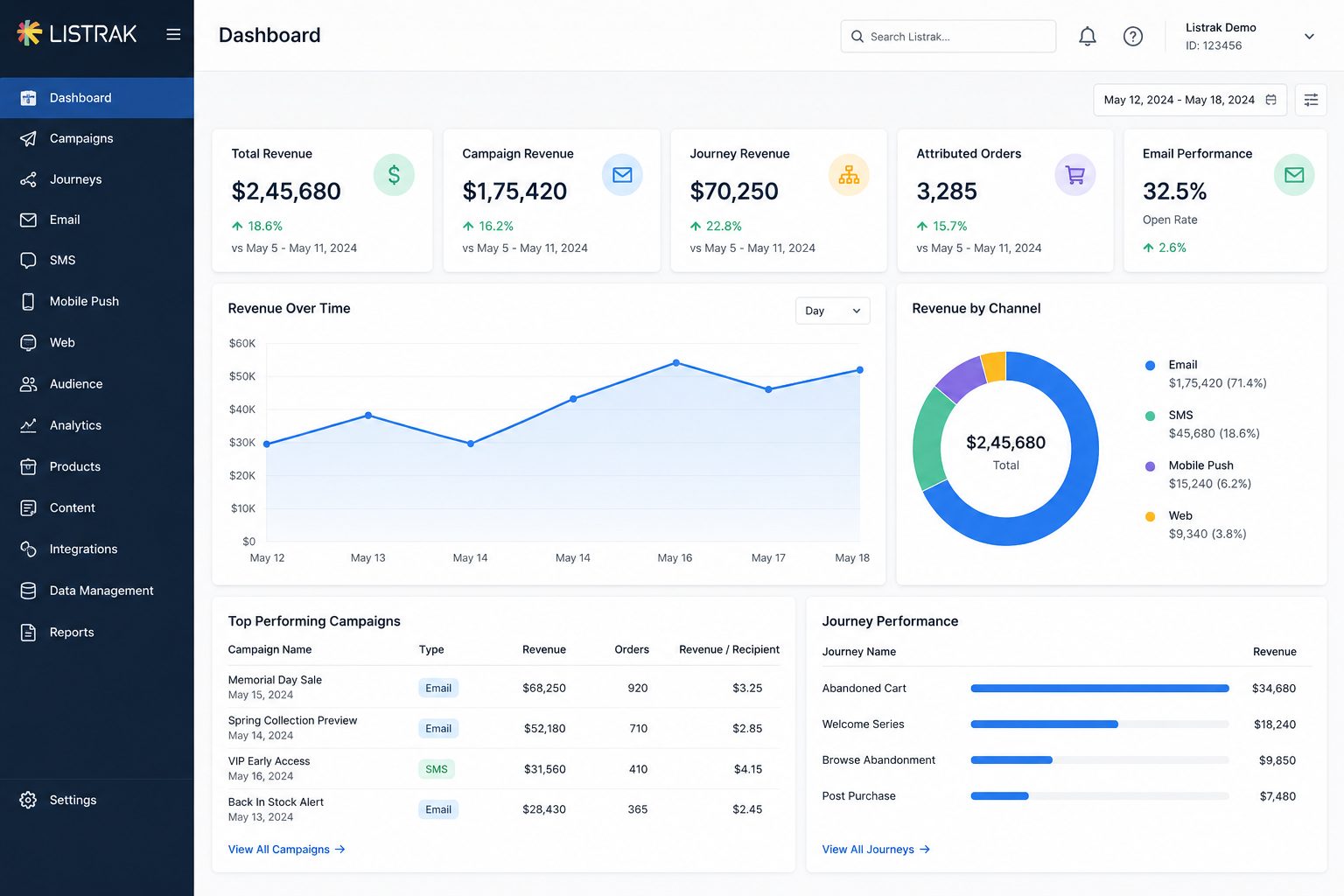
Listrak is a marketing platform built for retailers and enterprise ecommerce. It brings email, SMS, mobile push, and web personalization together in one place. The platform brings customer data together to help retailers build more complete customer profiles and understand behavior across marketing channels. It uses machine learning and predictive analytics to help brands reach the right customers at the right time. Listrak is a strong fit for large businesses with complex customer data and multi-channel marketing needs.
Klaviyo is a marketing platform built around email and SMS automation for ecommerce brands. It creates detailed customer profiles using behavioral, purchase, and engagement data from connected tools. The flow builder lets marketers set up automated sequences without any coding knowledge. Klaviyo has strong ecommerce integrations, including Shopify, and connects with a wide range of third-party tools. It is easy to set up, simple to manage, and a natural fit for growing DTC brands.
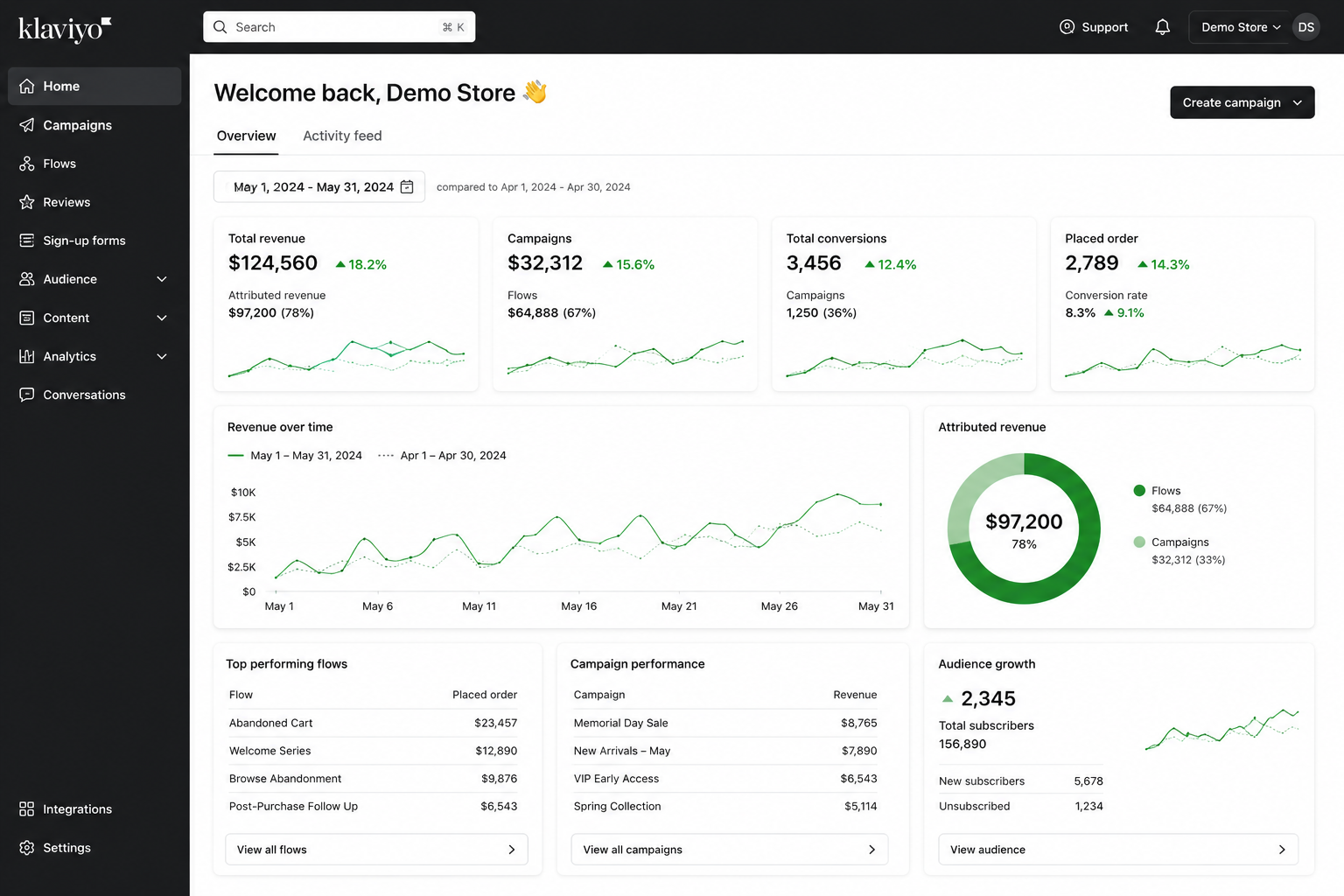
Before using Klaviyo, take a closer look at what the platform offers, its main features, and how it can support your marketing efforts.
The Role of Listrak and Klaviyo in Email Marketing
Email remains an important sales channel for ecommerce brands. Both Listrak and Klaviyo give you the tools to create, send, and track email campaigns. However, these tools work quite differently. Here is what each platform offers for everyday email marketing.
Listrak Email Marketing
Listrak has a drag-and-drop editor called Composer that lets you build emails without writing a single line of code. You can add product recommendations based on what a customer has browsed or bought before. Personalized content blocks mean two customers can open the same email and see completely different products, offers, or messaging.
For example, a returning customer who recently browsed winter jackets might see those exact products at the top of the email, while a first-time visitor sees your bestsellers instead.
You can add ready-made templates to match your brand, and emails render properly on both mobile and desktop. Listrak also covers the standard stuff like A/B testing, automated email sequences, and campaign reports that show you what actually worked.
Klaviyo Email Marketing
Klaviyo also has a drag-and-drop email editor, making it easy to create emails without coding. Its template library includes layouts for common ecommerce emails, such as promotions, product updates, and abandoned carts.
You can personalize emails based on customer activity, purchase history, and other customer details. For example, customers can see product recommendations based on what they have viewed or purchased.
Klaviyo also includes A/B testing, automated flows, and revenue reports that help you see which emails are bringing in sales.
Listrak and Klaviyo Segmentation and Personalization
Segmentation decides who gets your message, when they get it, and how relevant it feels. The more accurate your segments, the better your results. Both Listrak and Klaviyo go well beyond basic list filters, but they handle customer data in different ways and suit different levels of complexity.
Listrak Segmentation and Personalization
Customers are segmented in Listrak based on real-time behavioral data, purchase history, and predictive signals. Profiles update automatically as behavior changes, so your targeting stays accurate without manual updates. The predictive layer helps identify customers that are likely to make purchases soon and those that may be at risk of walking away. Product preferences can then be used to develop personalized emails and website recommendations. This is most useful when dealing with a large database that has lots of customer information and complicated segmentations.
Klaviyo Segmentation and Personalization
With Klaviyo, marketers can segment customers in a flexible way, based on their behavior, purchases, engagement, and even other profile information. You can target by purchase behaviour, engagement, predicted lifetime value, churn risk, and so much more. Data automatically syncs from Shopify or other connected platforms in real time without any manual effort. Segments can be as narrow as a single product SKU or the number of orders placed. Every message is personalized with dynamic content and send-time optimization powered by AI.
The difference between Listrak Automation and Klaviyo Automation
Automation lets you send the right message to the right person without doing it manually every time. It saves time, reduces mistakes, and keeps your marketing consistent even when your team is not actively working. Both Listrak and Klaviyo cover the core ecommerce automation, but how they build and manage those workflows is quite different.
Listrak Automation and Customer Journeys
Listrak builds automation around Journey Hub, a tool for creating multi-channel customer flows. It covers welcome series, abandoned cart, browse abandonment, post-purchase, and win-back campaigns. Journeys are triggered based on real-time behavior and can switch between email, SMS, and push in one flow. Conditional logic and time delays give you control over exactly how each journey runs. It suits brands with complex, multi-touch customer programs that go beyond simple email sequences.
Klaviyo Automation and Flows
Klaviyo automations and flows are built using a visual drag-and-drop editor. Pre-built templates cover all the key ecommerce sequences, so you can get started without building from scratch. Flows trigger from events like cart additions, page views, purchases, or segment changes. Conditional splits let you send different messages based on customer behavior or predicted actions. Email and SMS work together inside a single flow, and most marketers can set it all up without any technical help.
Abandoned cart flows are another important part of Klaviyo automation, especially for recovering sales from unfinished purchases. Klaviyo abandoned cart flows blog can help you recover those lost sales.
Listrak and Klaviyo SMS and Mobile Marketing
SMS gives ecommerce brands another direct way to reach customers, making it a useful addition to email marketing and other digital channels. Both Listrak and Klaviyo treat SMS as a core channel, not just an add-on. This section covers what each platform offers for text messaging, mobile push, and how SMS fits into the broader marketing workflow.
Listrak SMS and Mobile Marketing
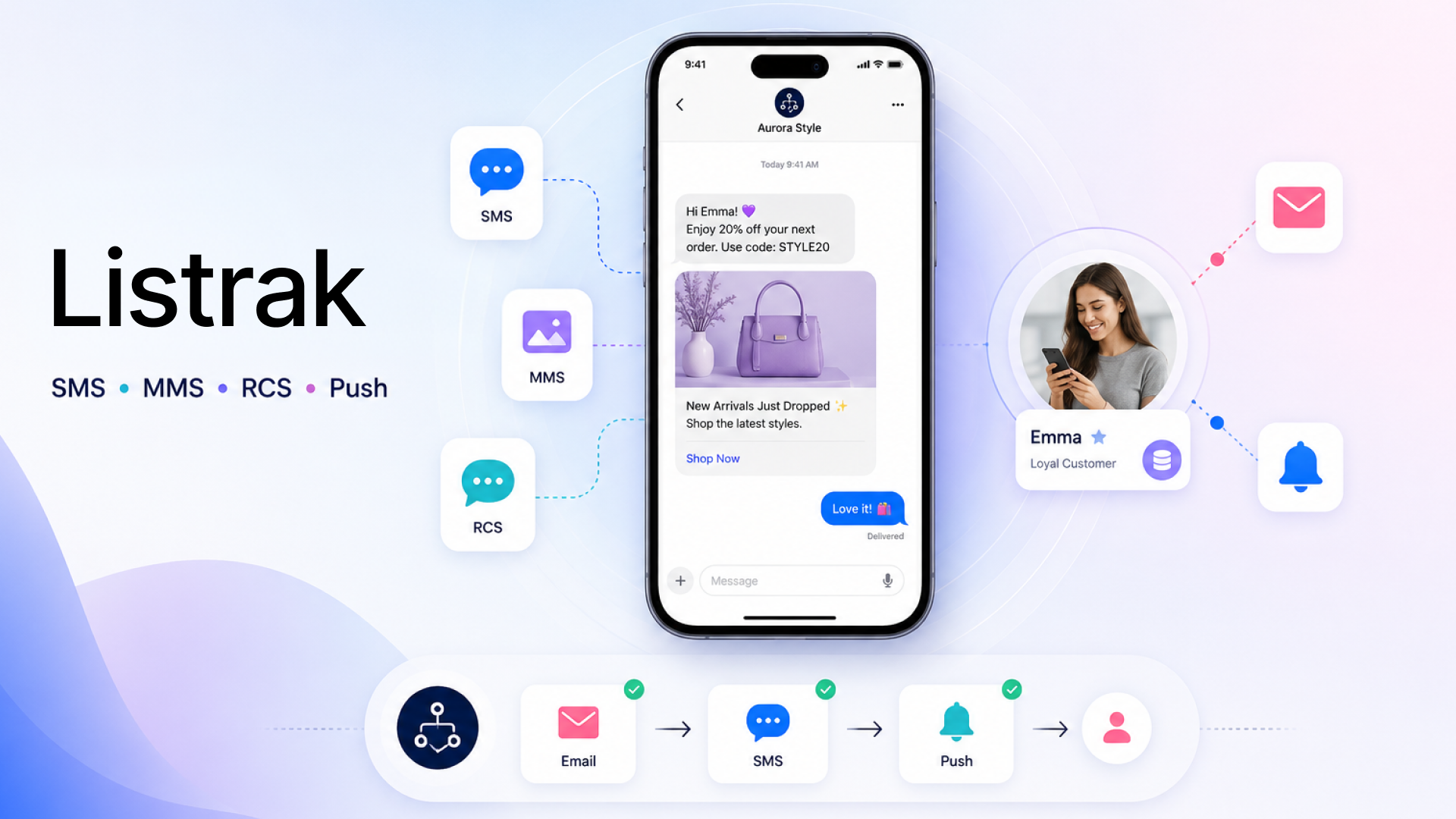
Listrak supports SMS, MMS, and RCS alongside email and mobile push. SMS uses the same customer profile data as email, so messaging stays consistent across channels. Two-way messaging lets customers reply directly to texts for a more conversational experience. SMS automation runs inside Journey Hub and works alongside email in the same flow. Mobile push is also available for brands with a dedicated app.
Klaviyo SMS and Mobile Marketing
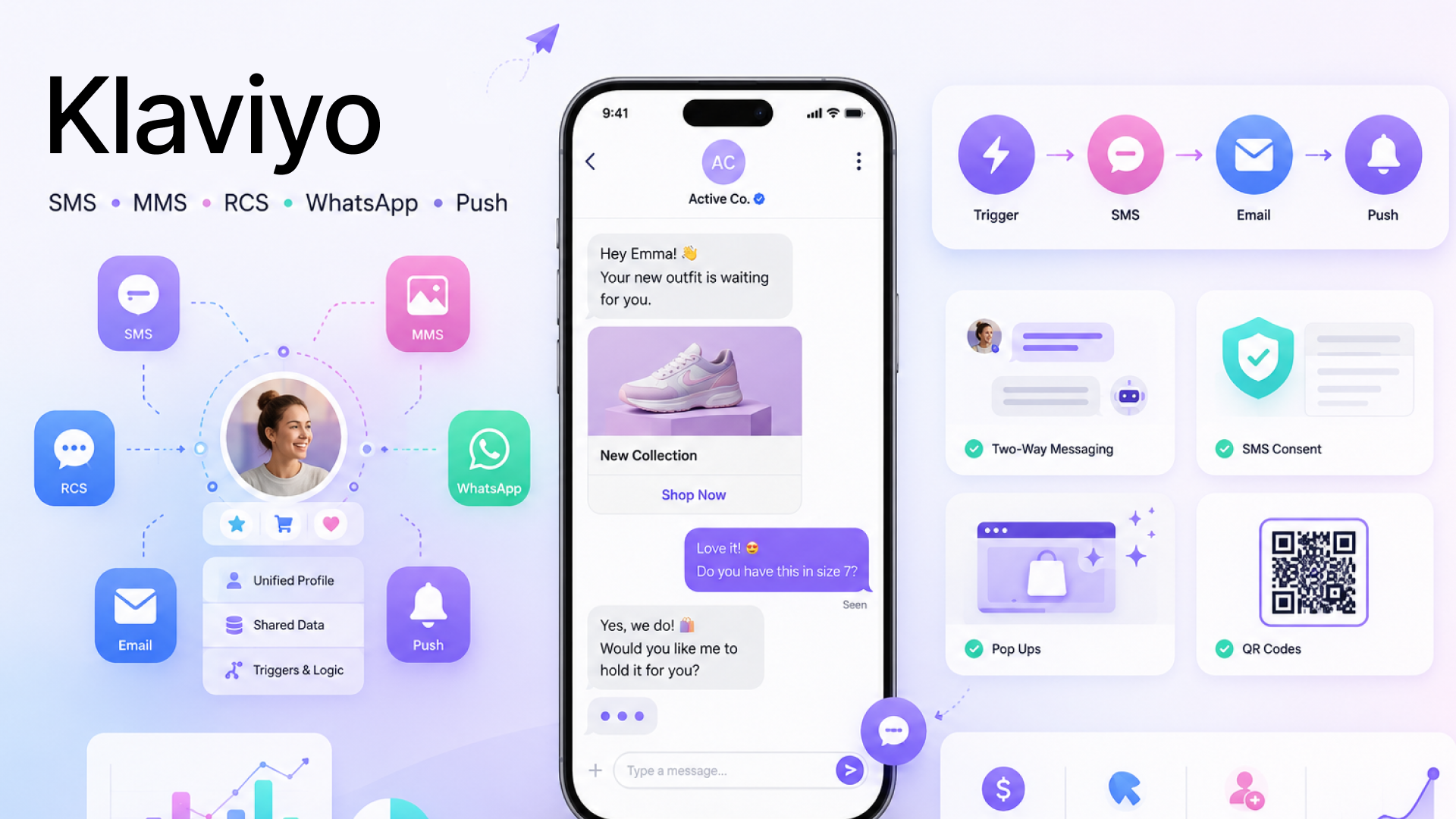
Klaviyo supports SMS, MMS, RCS, WhatsApp, and mobile push alongside email. SMS flows share the same trigger system and conditional logic as email flows. Klaviyo also supports two-way messaging and conversational experiences across supported channels. Sign-up tools include pop-ups, QR codes, and email CTAs to collect SMS consent easily. Reporting shows SMS revenue, click rates, and opt-outs alongside email performance in one view.
If you want your SMS campaigns to drive more clicks and conversions, Klaviyo SMS best practices are worth following.
Listrak vs Klaviyo: Predictive Analytics and AI
AI and analytics help you understand your customers and make smarter marketing decisions. They tell you which customers are close to buying, who might be about to stop, and which campaigns are actually driving revenue.
Listrak Predictive Analytics
Listrak uses AI to read customer behavior and get ahead of what someone might do next. It can estimate how likely a customer is to buy, churn, or eventually become one of your high-value regulars.
Those predictions feed into better segmentation and more relevant messaging. Listrak can suggest products based on what a customer has shown interest in or purchased before. It can also figure out the best time to send an email by looking at when each customer tends to actually open and engage.
All of this shows up inside Listrak's reporting tools, where you can dig into the data and use it to sharpen your campaigns and tighten up your targeting.
Klaviyo AI and Analytics
Klaviyo applies AI across both the creative and analytical sides of marketing. It can predict a customer's future value, how likely they are to leave, and whether they're likely to place another order.
It also helps with tasks like drafting marketing content and making sense of customer data, which saves time when you're managing a lot of campaigns at once. Product recommendations are based on browsing activity and purchase history, so each customer sees suggestions that are actually relevant to them.
The reporting shows revenue broken down by campaign, flow, and customer group. That makes it easier to see what's working, what's not, and where to focus next.
Listrak and Klaviyo Integrations
No marketing platform works on its own, infact it needs to connect with your online store, CRM, analytics tools, and other systems you already use. Good integrations help customer data move between tools and keep your marketing running smoothly. Here is what Listrak and Klaviyo offer.
Listrak Integrations
Listrak offers 50+ integrations that connect with ecommerce, customer data, analytics, and other marketing tools. Its integrations are mainly focused on larger businesses with more complex systems.
Some of its key integrations include:
- Shopify, Shopify Plus, BigCommerce, and Adobe Commerce
- Amperity for customer data and CRM
- Google Analytics and Facebook Pixel for tracking
- Yotpo for customer reviews
- Custom REST API for connecting with other business systems
Klaviyo Integrations
Klaviyo connects with 350+ integrations, giving ecommerce brands plenty of options for connecting their existing tools. Its integrations cover ecommerce platforms, CRMs, payment systems, review tools, and analytics.
Some of its key integrations include:
- Shopify, Shopify Plus, BigCommerce, WooCommerce, and Magento
- Salesforce, HubSpot, and Zoho for CRM
- Stripe, Square, and PayPal for payments
- Yotpo and Trustpilot for customer reviews
- Google Analytics and Facebook Pixel for analytics
- Custom API for connecting with tools outside its built-in integrations
Listrak and Klaviyo Pricing
Klaviyo uses self-service plans where your cost depends on active profiles and the channels you use. Listrak does not publish fixed pricing, you get a custom quote based on your size, channels, and setup. Either way, check the official pricing page before committing since both can change.
Pricing Factor | Klaviyo | Listrak |
Pricing Model | From $20/month | Custom pricing |
$20/month | Custom quote | |
Mobile Messaging | From $5/month | Custom quote |
Enterprise | Custom pricing | Available |
Free Option | $0/month | Contact Listrak |
Implementation | $0 self-service | Typically involves a more tailored setup |
Listrak and Klaviyo for Omnichannel Marketing
Most customers do not stick to one channel. They browse on their phone, open emails on a laptop, and respond to texts in between. Omnichannel marketing connects all of those touchpoints, so your messaging feels consistent wherever the customer is. Listrak and Klaviyo both support cross-channel marketing, but they do it at very different levels of complexity and channel depth.
Feature | Klaviyo | Listrak |
Drag-and-drop builder with HTML/CSS editing, dynamic content, and product recommendations | Composer drag-and-drop editor with AI-driven product blocks and dynamic personalization | |
SMS and MMS | Integrated SMS flows, two-way messaging, custom keywords, MMS | SMS, MMS, and RCS with two-way messaging via Journey Hub |
RCS Messaging | Available | Available |
Mobile Push | Included in cross-channel flows | Available for brands with a dedicated app |
Web Personalization | Not included | Built in and tied to the unified customer profile |
Cross-Channel Flows | Email and SMS share one flow with unified triggers | Email, SMS, push, RCS, and web personalization in one journey |
Channel Switching | Based on engagement or customer preferences | Switches mid-journey based on real-time customer behavior |
Customer Profiles | Unified profiles updated in real time from all connected tools | 360-degree profiles with cross-device tracking across all channels |
Reporting | Revenue attribution by channel, flow, and segment | Performance tied back to customer lifetime value |
Best For | Growing ecommerce brands managing email and SMS | Enterprise retailers running complex, multi-channel programs |
Listrak Omnichannel Marketing
Listrak is well-suited for brands that need to coordinate messaging across multiple channels at once. Its Journey Hub connects email, SMS, RCS, mobile push, and web personalization inside a single customer flow.
The platform tracks activity across devices and can switch channels mid-journey based on live behavior. It suits enterprise brands running complex, multi-channel programs that go beyond just email and SMS.
Klaviyo Omnichannel Marketing
Klaviyo connects email with multiple mobile and digital channels, while keeping campaign and automation management within the same platform. Flows share the same triggers and conditions across channels, so email and SMS work together without extra setup.
A single campaign calendar shows everything running at once, making daily management easy. It works well for brands that want their core digital channels operating as one joined-up program.
Listrak vs Klaviyo: Pros and Cons
Both platforms have real strengths, but they serve different business needs. Listrak suits enterprise brands needing deep cross-channel tools, while Klaviyo works best for ecommerce teams wanting speed and simplicity. Knowing where each one falls short saves you from a costly switch later.
Listrak Pros and Cons
Listrak is built for brands that need more control, more channels, and more data working together in one place.
Pros
- Runs email, SMS, RCS, push, and web personalization together from a single connected platform.
- Predictive analytics can help identify purchase likelihood, churn risk, and other customer signals.
- Handles large databases, multiple brands, and complex multi-touch customer journeys without slowing down.
Cons
- Not a great fit for small teams or anyone without technical support on their side.
- Custom pricing only, which makes it hard to plan your budget before speaking to sales.
- Its integration ecosystem is more focused than Klaviyo's broader range of ecommerce and marketing integrations.
Klaviyo Pros and Cons
Klaviyo is designed for online stores that want to get up and running fast without a steep learning curve.
Pros
- Strongly focused on ecommerce, with integrations and features designed around online customer journeys.
- Clean interface and simple flow builder that most marketers can pick up within a few days.
- Public pricing scales with your list size, so you always know what you are paying for.
Cons
- Costs can increase as your active profile count and messaging usage grow, so larger businesses should evaluate pricing based on their expected volume.
- Some enterprise retailers may find Listrak's broader cross-channel and personalization capabilities better suited to highly complex marketing programs.
- Very large brands with complex journey needs may eventually find Klaviyo too limiting to grow with.
Which Platform Should You Choose?
The right choice comes down to your business size, your team, and what you actually need day to day.
Listrak works better for enterprise retailers managing large customer databases, multiple brands, or campaigns across several channels at once. It suits teams that have dedicated marketing or technical resources and need web personalization, mobile push, RCS, and predictive analytics all working together.
Klaviyo is the better fit for growing ecommerce brands that want to get up and running without a complicated setup. If you run a Shopify store or a DTC brand, it plugs right into your existing tools. Email and SMS in one place, straightforward pricing, and most marketers can figure it out without a developer.
Conclusion
Both Listrak and Klaviyo are powerful platforms, but they're designed for different businesses. Listrak is built for large retailers with complex marketing needs, multiple channels, and teams that have the technical know-how to get the most out of it. Klaviyo offers a more suitable solution for ecommerce businesses looking for an easy-to-integrate platform, low maintenance, and pricing visibility.
The selection should be based on the requirements of your business at your current stage. Consider the number of people you're working with, your budget, your channels, and how complex your customer journey really is. Listrak is more suited to businesses that require advanced customer data and complex multi-channel marketing. If you want a more user-friendly platform and an easier ecommerce marketing workflow, then Klaviyo might be the more suitable platform.
There is no universally right answer, only the right fit for your situation. Choose the platform that matches how your team works and where your business is headed over the next few years. The tool that fits your workflow will always outperform the one that looks better on paper.
Frequently Asked Questions
Is Listrak better than Klaviyo?
Neither platform is better than the other in every situation. Listrak works better for large enterprise retailers with complex, multi-channel marketing needs. Klaviyo works better for growing ecommerce brands that want something easy to set up and manage. The right choice depends entirely on your business size, team, and goals.
How much does Listrak cost compared to Klaviyo?
Klaviyo offers a free plan, while paid pricing varies based on active profiles, products, and messaging usage. Listrak uses customized pricing based on the retailer's requirements, so businesses should contact Listrak for a current quote.
Can small businesses use Listrak?
Listrak is not really designed for small businesses. It is built for enterprise retailers with larger budgets, dedicated technical teams, and complex marketing operations. Small businesses would likely find it expensive and difficult to manage without proper support. Klaviyo is a much more practical choice for smaller teams.
Does Klaviyo work with Shopify?
Yes, Klaviyo has a very strong native integration with Shopify. Klaviyo integrates closely with Shopify, allowing ecommerce businesses to connect customer, purchase, and behavioral data with their marketing activities. It is one of the main reasons so many Shopify store owners choose Klaviyo as their marketing platform.
Which platform is easier to learn?
Klaviyo is far more user-friendly. Most marketers can feel comfortable in the platform without any technical background in just a few days. Listrak has a higher learning curve and is best suited for teams with either a dedicated marketing operations or technical support team to help manage it.
Do both platforms support SMS marketing?
Yes, both Listrak and Klaviyo support SMS marketing. With Klaviyo, you can manage both email and SMS in the same flow and do so easily. Listrak supports RCS as well as mobile push in addition to SMS, providing even more enterprise brands with choices for getting to customers through various channels.