


Key Takeaways
- Both platforms handle ecommerce automation, segmentation, Shopify connections, abandoned-cart recovery, and reporting for online stores.
- Klaviyo is built heavily around B2C customer behavior, products, purchases, and lifecycle marketing for online shops.
- ActiveCampaign pairs ecommerce features with broader marketing automation and contact-based workflows that can include nurture and sales steps.
- ActiveCampaign's capabilities vary more noticeably by plan, especially automation limits, SMS, segmentation, and CRM add-ons.
- Klaviyo now positions itself as a broader B2C CRM, not simply an email and SMS platform.
- The better fit depends on your ecommerce data needs, automation complexity, sales process, team skills, and total cost.
An abandoned cart is a missed conversion opportunity, but not every shopper needs the same follow-up. The email platform you choose affects how quickly you can identify that behavior, trigger the right message, and stop reminders once a purchase happens.
ActiveCampaign and Klaviyo can both send cart reminders, build segments, run automations, and track revenue. The real difference sits in how each one organizes your customer data and automation logic.
Klaviyo is built mainly around shopper profiles, store behavior, product activity, and full purchase history. ActiveCampaign blends ecommerce data with a wider marketing system for nurture, tags, and sales steps.
A platform can look suitable at first and still become limiting as your customer data, automation, or reporting needs grow. Comparing those requirements before you commit can reduce unnecessary migration and rebuilding later.
This comparison helps you avoid that costly detour by showing what each platform does with real store data. You will see where each tool shines, where it needs extra setup, and what it really costs.
This guide compares both tools through the practical, daily needs of a growing online store. We will not crown one universal winner, because the right answer depends on your business.
If you need more background before comparing the platforms, read our guide to what Klaviyo is and how it works.
ActiveCampaign vs Klaviyo: The Core Difference
Before the details, here is the short answer on how the two platforms really differ.
Klaviyo centers on B2C customer profiles, purchases, products, behavioral events, and lifecycle marketing. Its current B2C CRM brings marketing, service, analytics, and customer data together on the Klaviyo Data Platform.
ActiveCampaign combines ecommerce data with flexible automation, site tracking, custom fields, tags, and nurture sequences. Optional Enhanced CRM features add pipelines and deals for teams that run sales workflows too.
The table below puts the main differences side by side for quick scanning and comparison.
Area | Klaviyo | ActiveCampaign |
Core orientation | B2C/ecommerce lifecycle | Broad marketing automation |
Ecommerce data | Strong behavioral and purchase focus | Ecommerce + broader contact data |
Automation | Ecommerce lifecycle flows | Flexible multi-step automations |
Segmentation | Customer and ecommerce behavior | Ecommerce + tags, fields and behavior |
SMS | Part of Klaviyo marketing ecosystem | Add-on on eligible plans |
CRM approach | B2C customer relationships | Enhanced CRM for sales workflows |
Predictive ecommerce insights | Strong focus | Different predictive/AI capabilities |
Revenue reporting | Ecommerce-centered | Ecommerce + broader marketing reporting |
Typical fit | Ecommerce/DTC-heavy businesses | Ecommerce combined with wider nurture/sales journeys |
These rows describe orientations, not scores, so no column in this table declares an overall winner.
Use the table as a starting map for your decision, not as a final verdict on either tool. The rest of this guide shows how each row plays out inside a real store.
Ecommerce Integrations and Customer Data
Both tools connect to your store, but the real question is what data arrives and how you use it.
A Shopify or WooCommerce logo on an integrations page tells you very little about usable depth. What matters is which customer and store details reach the platform, and what your marketers can do with them.
What Ecommerce Data Klaviyo Uses
Klaviyo pulls in a wide range of store activity and ties it to each shopper profile.
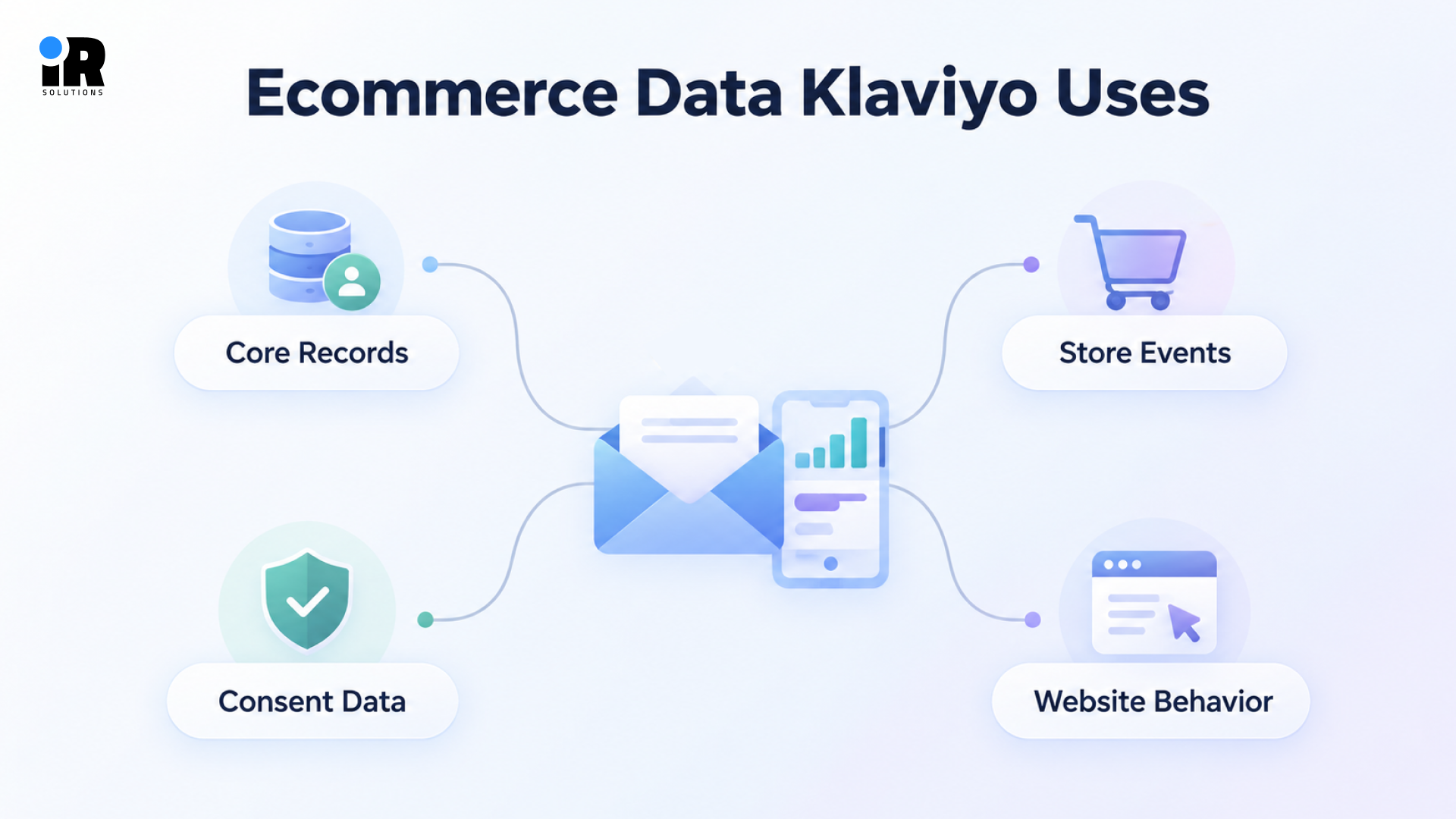
- Core Records: Klaviyo stores customer profiles, orders, the product catalog, and the items inside each completed purchase.
- Store Events: It tracks product views, collection views, searches, cart events, and checkout events as they happen.
- Consent Data: It also records marketing consent and order fulfillment events, so messages follow the shopper's permissions.
- Website Behavior: Onsite tracking adds general browsing activity, so identified shoppers leave a fuller trail across your site.
That data supports segmentation, product recommendations, browse abandonment, cart flows, cross-sells, win-back campaigns, retention, and revenue reporting.
For example, a shopper who viewed a jacket twice can receive a message about that exact jacket.
What Ecommerce Data ActiveCampaign Uses
ActiveCampaign also syncs the core store records, then adds them to its wider contact database.
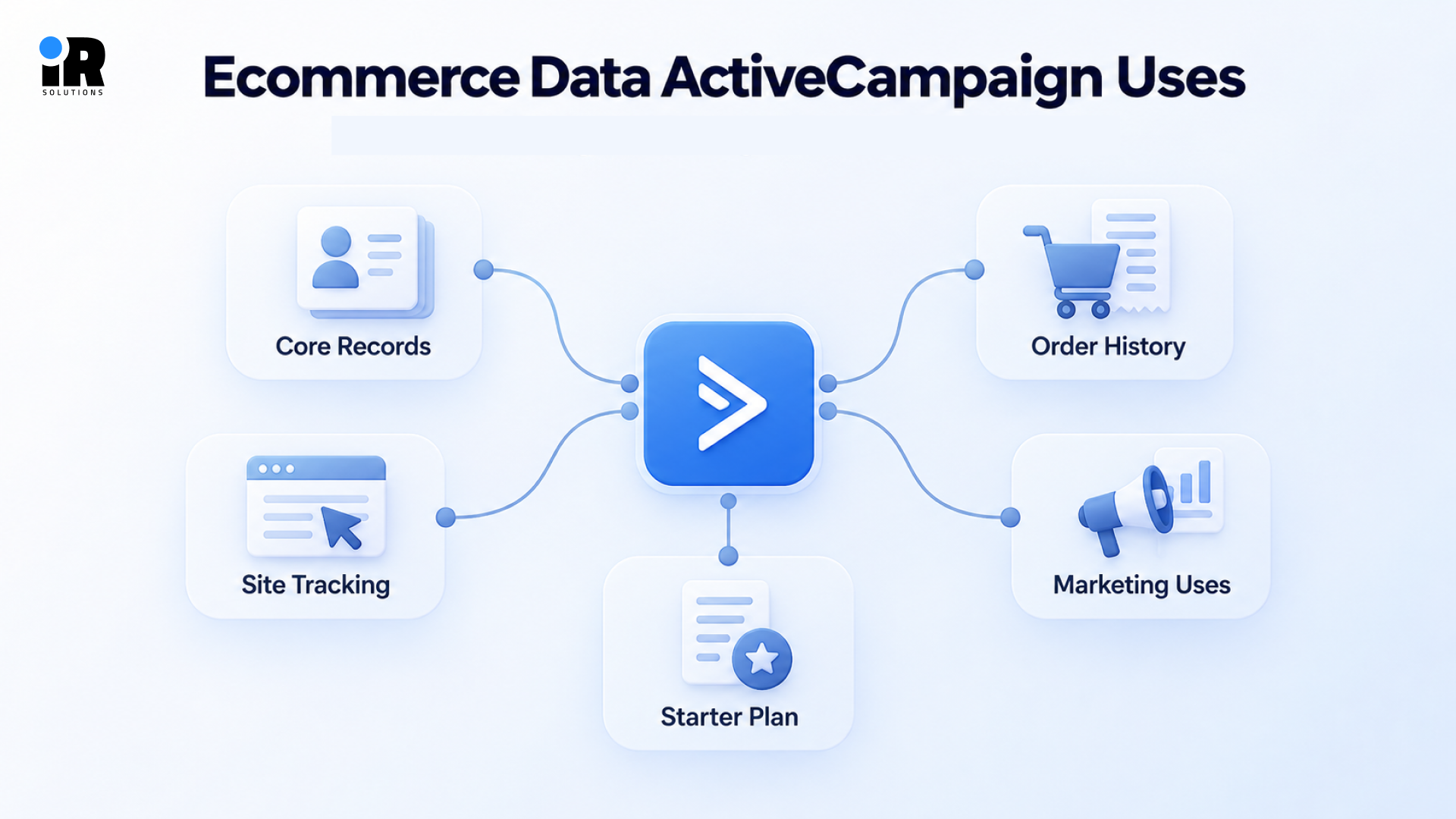
- Core Records: ActiveCampaign receives customers, orders, products, catalog details, purchase information, abandoned carts, and standard ecommerce contact fields.
- Order History: Historical order information can sync as well, where your chosen integration and setup support that feature.
- Site Tracking: Site Tracking adds page visits for identified contacts, which brings activity outside the store into the same record.
- Marketing Uses: This store data can then feed segments, automations, personalized messages, goals, cart recovery, and post-purchase communication.
- Starter Plan: ActiveCampaign currently includes standard ecommerce integrations on Starter, but Shopify historical sync is not available on the Starter plan.
The Shopify Data Difference in Practice
Instead of saying one tool has deeper data, look at what the data lets you do.
- Repeated Views: A shopper keeps viewing Product A but never adds it, so you may send a gentle browse reminder.
- Left Cart: Someone adds Product B and leaves before checkout, which calls for a timely cart reminder with that item.
- Cross-Sell: A customer buys Product A and should receive a suggestion for a complementary product afterward.
- High Value: A repeat customer crosses a spending threshold, so you may move them into a VIP segment.
- Outside Pages: An identified contact keeps visiting a service or category page away from products, which signals a different interest.
Both systems can handle ecommerce events, but they differ in how naturally those events mix with other customer data.
Before you choose, list the five or six messages you most want to send this year. Then check whether each tool can trigger those messages using the customer data you already collect today.
ActiveCampaign vs Klaviyo for Automation
Both platforms offer a visual builder, so the better question is what each one is designed to run.
Klaviyo Flows
Klaviyo flows follow the shopper's journey, from the first visit to long-term loyalty. Common ones include welcome, browse abandonment, cart abandonment, checkout abandonment, post-purchase, cross-sell, replenishment, win-back, VIP, re-engagement, and sunset.
Actions like viewing a product or starting checkout can kick off a flow on their own, with no manual list work. Filters keep out people who already bought, so they don't get reminders for an order they've finished.
You can also split shoppers into different paths based on order value, product type, or past purchases. Product names, images, and prices pull straight from your catalog into each email. Delays let you set the timing, like waiting longer before a replenishment reminder than a cart reminder.
ActiveCampaign Automations
ActiveCampaign handles a wider mix of marketing and sales steps. One automation can use several triggers, branches, ecommerce events, custom fields, tags, site activity, and goals. This makes it a good fit for nurture sequences, contact stages, and workflows that span channels.
One important plan difference is automation depth. ActiveCampaign Starter currently limits each automation to five actions, while Plus and higher plans include unlimited automation actions. That makes plan level especially important for longer ecommerce journeys with multiple waits, conditions, and follow-ups.
A simple cart reminder fits within five actions, so Starter works for basic recovery. A longer journey with branches, waits, and follow-ups may not fit, so plan your workflow first.
Ecommerce Lifecycle vs Broader Customer Journey
Two simple example flows show clearly how the workflow orientation differs between these two tools.
Klaviyo example
Product Viewed
→ Added to Cart
→ Checkout Not Completed
→ Recovery Flow
→ Purchase
→ Post-Purchase
→ Cross-Sell
ActiveCampaign example
Form Submitted
→ Nurture Sequence
→ Website Activity
→ Ecommerce Purchase
→ Contact Data Changes
→ Follow-Up Automation
These examples show different workflow orientations, not that one tool is universally superior.
Segmentation and Personalization
Segmentation helps you send the right message to the right customers, while personalization makes each message more relevant to their interests, behavior, and purchase history.
Klaviyo Segmentation
Klaviyo segments grow out of shopper behavior and purchase data, which keeps audiences tied to real store activity.
- Buyer Types: Build groups for first-time buyers, repeat customers, and people who bought specific products or categories lately.
- Interest Signals: Track products viewed, category interest, cart behavior, and engagement to find people close to buying.
- Value Groups: Customer value, purchase frequency, and lifecycle stage help you reward loyal buyers and spot inactive ones.
- Predictive Filters: Eligible stores can also segment by predictive attributes, which we cover in a later section.
Learn how to create more targeted customer groups with our Klaviyo segmentation for ecommerce guide.
ActiveCampaign Segmentation
ActiveCampaign segments combine store data with the labels and fields you already keep on each contact.
- Contact Labels: Tags, lists, and custom fields let you mark interests, sources, and stages in your own words.
- Store Attributes: Purchase history, revenue, number of orders, order value, and product data all work as segment conditions.
- Behavior Data: Site activity and engagement add another layer, so you can include page visits alongside purchases.
How the Segmentation Approaches Differ
Two sample audiences show the difference far more clearly than any long feature list could.
Klaviyo Example: Target customers who bought running shoes in the last 90 days, viewed socks recently, and have not purchased again.
ActiveCampaign Example: Target contacts who bought a product, visited a specific page, hold a certain custom-field value, and carry a particular tag.
Klaviyo leans toward consumer lifecycle and ecommerce behavior, so its segments read like shopper stories. ActiveCampaign combines ecommerce behavior with a broader contact-data model, so its segments can span the whole relationship.
Email Builder and Ecommerce Content
The editor helps you build the email, but access to product data and ecommerce content has a bigger impact on how useful your messages can be.
Editor and Templates
Both platforms offer drag-and-drop editing, ready templates, reusable sections, mobile previews, and custom HTML when you need it. Most teams will find either editor fast enough for weekly campaigns, so personal taste should settle this point.
Product Blocks and Recommendations
Product blocks pull items straight from your catalog, so they only work as well as your store sync.
Klaviyo builds product blocks and recommendation logic around catalog and behavior data, such as views and past purchases. ActiveCampaign also supports dynamic ecommerce content from synced products and orders, though your setup shapes how much you can show.
Dynamic Content and Personalization
Personalization can use customer properties, purchase history, ecommerce behavior, and dynamic variables inside the message. Conditional content then shows different blocks to different people, such as a repeat-buyer offer for loyal customers.
Both tools handle this well, and the difference again comes from which data you feed them.
Testing
Both platforms let you test subject lines, content, and full campaigns before you send to everyone. Automation testing is available in some form, but confirm the exact options on your plan.
Signup Forms and List Growth
Signup forms are often the first step in collecting customer data, and the information you collect can shape how you segment, personalize, and send messages later.
Klaviyo Signup Forms
Klaviyo offers popup, flyout, embedded, and full-page forms, with targeting, segmentation, and testing built in. Form signups land directly in a profile that already links to ecommerce and customer data.
On Shopify, Klaviyo sign-up forms require onsite tracking to be enabled. Embedded forms also require you to paste the form's embed code where you want the form to appear, while popup, flyout, and full-page forms can be published directly from Klaviyo once form functionality is enabled.
ActiveCampaign Forms
ActiveCampaign forms focus on lead capture, with contact fields, tags, and automation triggers attached to each submission. A new signup can start a nurture sequence right away, whether it begins on a landing page or a form.
How the Use Cases Differ
Klaviyo forms naturally feed B2C and ecommerce customer journeys, such as welcome offers and first-purchase flows. ActiveCampaign forms can do that too, and they also support longer lead-generation and nurture processes.
Choose your approach based on what a signup means for your business. A store selling low-cost products may use a quick welcome offer to encourage a first purchase, while a consultation-based business may use a slower follow-up sequence to build trust before making a sales offer.
Klaviyo vs ActiveCampaign for Abandoned Cart Recovery
Cart recovery is one of the most direct ways to earn revenue back, and both platforms support it.
Klaviyo Cart and Checkout Flows
Klaviyo exposes Added to Cart and Checkout Started as distinct ecommerce events, allowing you to build recovery flows around different stages of cart and checkout abandonment.
- Dynamic Products: Messages can show the exact items left behind, including names, images, and prices pulled from your catalog.
- Purchase Exclusions: Flows can stop once a shopper orders, so nobody receives a reminder after they have already paid.
- Timing Control: You choose how long to wait and how many reminders to send before the flow ends.
- Smart Splits: Conditional splits can offer a discount only to higher-value carts, which protects margin on smaller orders.
If you are setting up abandoned-cart emails, this guide explains how to build the automation in Klaviyo.
ActiveCampaign Abandoned Cart Automations
ActiveCampaign also recovers lost carts, and it is wrong to treat this feature as exclusive to Klaviyo. An automation can use cart data, product details, and the checkout link to send a reminder.
You can then add follow-up sequences, conditions, and other ecommerce triggers to shape what happens next. On Starter, remember the five-action limit, because a longer recovery sequence may need a higher plan.
The best cart reminder is usually short, clear, and sent soon after the shopper leaves. Test timing and offers on either platform before you scale your ad spending or reminder volume.
SMS and Cross-Channel Marketing
SMS can help bring shoppers back to an abandoned cart or share a timely offer, but Klaviyo and ActiveCampaign handle SMS and cross-channel campaigns in different ways.
Klaviyo Messaging
Klaviyo should not be described as simply email plus SMS anymore, because it has grown into a wider B2C CRM.
- Shared Data: Email, SMS, and mobile messaging all draw on the same consumer profile and purchase history.
- Consent Handling: Consent is tracked for each channel, which helps you message only the people who have agreed.
- Lifecycle Coordination: Segmentation and automation can coordinate channels, such as an SMS nudge after an email goes unopened.
ActiveCampaign SMS
ActiveCampaign lets you add SMS to automations and use contact data for personalized messages.
- Automated SMS: Send text messages automatically based on customer actions, timing, or other triggers.
- Cross-Channel Flows: Combine email, SMS, and other steps within the same automation.
- Plan Requirements: SMS requires Plus, Professional, or Enterprise, so Starter does not include it.
- Consent and Availability: Check SMS pricing, country support, and customer consent rules before sending messages.
SMS can work alongside email for cart reminders, timely offers, and lifecycle follow-ups. For practical guidance on consent, frequency, segmentation, timing, and testing, see our Klaviyo SMS marketing guide.
Reporting, Revenue Attribution and Ecommerce Analytics
Store owners need clear numbers to know which emails and flows are bringing in sales. When comparing platforms, check the reports for campaign and flow revenue, conversions, orders, revenue per recipient, customer value, and attribution settings.
Klaviyo Reporting
Klaviyo reporting focuses on ecommerce results, with campaign and flow reports that connect messages to orders and revenue. It also shows revenue per recipient, customer data, benchmarks, and wider ecommerce analytics across your whole account.
ActiveCampaign Reporting
ActiveCampaign gives you ecommerce dashboards, campaign reports, automation reports, and conversion tracking in one workspace. Marketing revenue reporting and contact behavior add context beyond the store, which suits mixed customer journeys.
Predictive Analytics and Customer Insights
Predictions can help you spot changes in customer behavior earlier, but they work best when you have enough past order data to support them.
Klaviyo Predictive Insights
Klaviyo can estimate historic, predicted, and total customer lifetime value, plus churn risk and expected next order date. It also shows the average time between orders for each customer, which helps with timing.
These numbers do not appear automatically for every store, and new shops often wait a while. Klaviyo currently requires at least 500 customers who have ordered and 180 days of order history.
You also need recent orders and some repeat customers before the models can produce useful results. Check the exact rules in Klaviyo's official predictive analytics help article before you count on these features.
ActiveCampaign Predictive and AI-Assisted Capabilities
ActiveCampaign's predictive and AI-assisted features solve a different problem from Klaviyo's ecommerce prediction models. Features such as Predictive Sending, conditional content, and AI-suggested segments focus more on message timing, personalization, audience building, and workflow creation than on forecasting ecommerce CLV or churn risk.
If predictive lifetime value matters to your strategy, check whether your store has enough data to use it. New stores may need several months of order history before these predictions become useful.
CRM Approach: B2C Customer Relationships vs Sales Pipelines
The right CRM setup depends on whether you mainly manage customer relationships or track sales from first contact to closing.
Klaviyo B2C CRM
Klaviyo now describes itself as a B2C CRM that combines marketing, customer service, analytics, and its data platform. The focus stays on consumer profiles, purchases, behavioral events, and lifecycle relationships rather than sales deals.
ActiveCampaign CRM and Sales Workflows
ActiveCampaign starts from contact profiles, tags, custom fields, marketing automation, and site tracking as its base. Optional Enhanced CRM capabilities then add pipelines, deal records, lead scoring, and sales engagement tools.
Why This Matters for Ecommerce
Your business model decides which CRM approach helps, so match the tool to your real customer journey.
- Pure DTC: Consumer lifecycle and store behavior dominate, so a B2C-focused system usually covers what you need.
- Mixed Sales: DTC plus wholesale means sales pipeline features may start to matter for your account managers.
- Services Offered: Ecommerce plus consultations makes longer lead nurture relevant, since not every inquiry buys right away.
- Subscriptions: Subscription stores need both purchase behavior and broader lifecycle automation, so either platform may fit depending on your plans.
Deliverability and List Management
No tool can promise inbox placement, but good list controls make it easier to protect your sender reputation.
Compare how each platform handles authentication, suppression, unsubscribes, engagement segmentation, list hygiene, and sending controls. Also look at deliverability monitoring tools, since they can show problems before your sender reputation suffers badly.
Do not assume either platform automatically gives you better inbox placement than the other one. Real results depend on sender reputation, authentication, list quality, audience engagement, content, and your sending behavior.
A clean, engaged list sent through properly authenticated domains will usually perform better on either tool. For the technical factors behind inbox placement, see our complete email deliverability guide for online stores.
Ease of Use, Support and Account Management
Ease of use depends more on your team than on the interface, so judge it with your own workload.
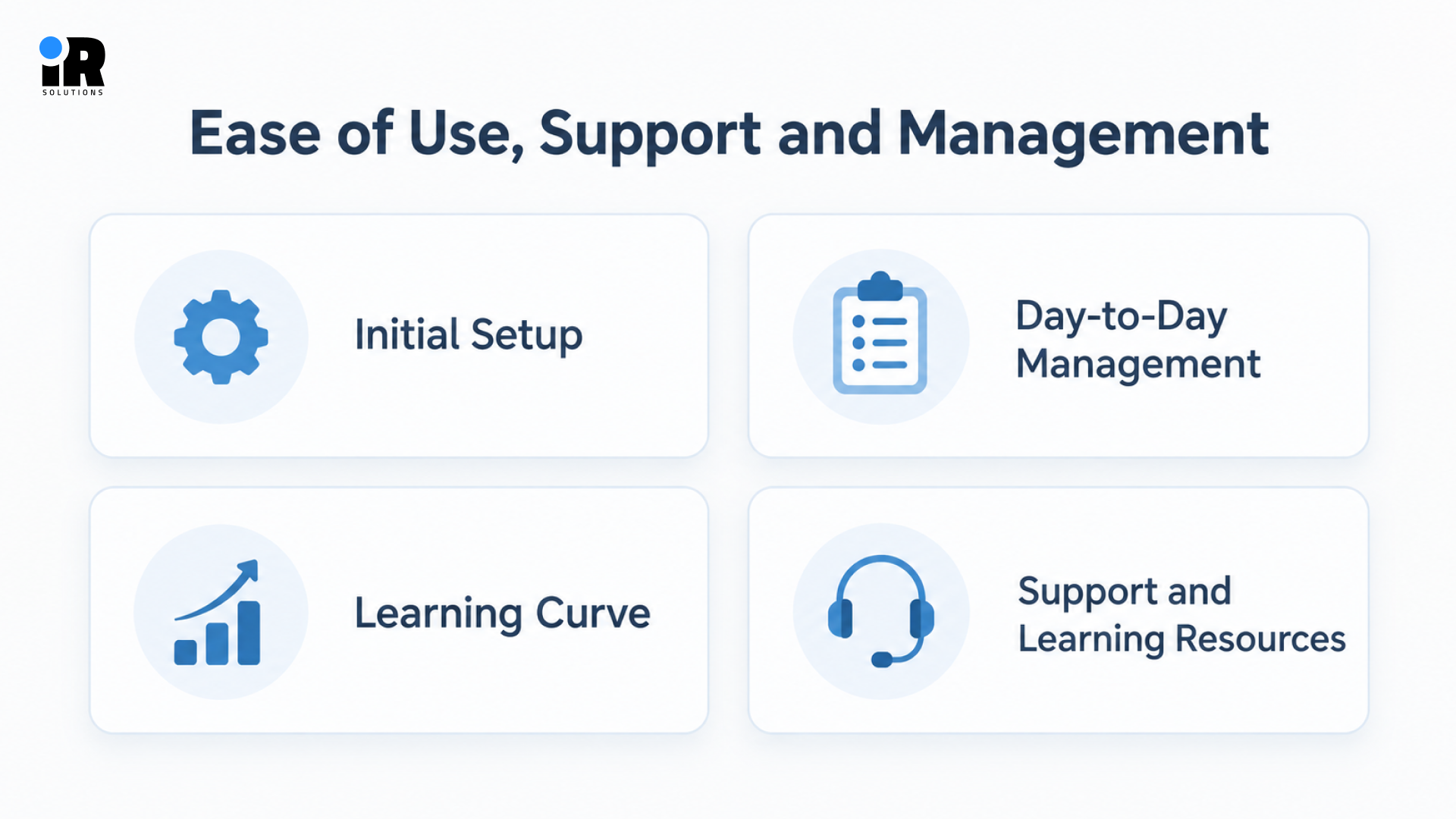
Initial Setup
Both tools need a store connection, tracking setup, and an initial data sync before you can send anything useful. Plan extra time to check that orders, products, and consent records arrived correctly in the new account.
Day-to-Day Management
Daily work includes creating campaigns, editing automations, refining segments, reading reports, and keeping the account maintained. Klaviyo's ecommerce focus can make store tasks feel direct, while ActiveCampaign's flexibility rewards teams that like building custom logic.
Learning Curve
How hard either tool feels depends on team experience, ecommerce maturity, workflow complexity, and your CRM requirements. A beginner with one simple store may learn either quickly, while a complex setup will take time anywhere.
Ask for a trial or a demo, then build one real flow with your own products. That single test teaches you far more about daily use than any long feature list can.
Support and Learning Resources
Compare documentation, training, onboarding, and support options, and note that support availability can vary by plan. Avoid declaring one interface universally easier, because the honest answer changes from team to team.
ActiveCampaign vs Klaviyo Pricing
Prices change often, so start with how each platform charges rather than with a single number.
How Klaviyo Pricing Works
Klaviyo pricing mainly depends on active profiles, email sends, mobile messaging, and any additional Klaviyo products you add. Costs rise as your profile count grows, so a larger list means a larger bill. The current free tier supports up to 250 active profiles and 500 monthly email sends.
See our blog on Klaviyo's current pricing for the exact numbers that match your list size before you decide.
How ActiveCampaign Pricing Works
ActiveCampaign pricing depends on contact count, plan level, send limits, automation features, segmentation, users, and add-ons. Plan choice matters a lot here, because automation, segmentation, SMS, and CRM features change noticeably between tiers.
Starter currently includes standard ecommerce integrations, but it limits segmentation and allows five automation actions at most.
ActiveCampaign's plan structure can change, so check its current pricing and feature comparison before publishing or migrating.
Compare Total Cost, Not Starting Price
A low starting price can hide the features you actually need, so build a full cost estimate instead.
Before you compare any quotes, write down the following items for your own business and your team.
- Contact Count: Count your current profiles or contacts, then estimate your expected growth over the next twelve months.
- Send Volume: Estimate your monthly email volume, because heavy senders may reach plan limits sooner than they expected.
- Text Messages: Add SMS costs if you plan to text customers, including the plan needed for the add-on.
- Team Seats: Count the users who need access, since seat limits can push you toward a higher plan.
- CRM Needs: Price pipelines, deals, and lead scoring if your sales team needs them, because they are separate add-ons.
- Automation Depth: List the workflows you need, then check which plan allows that many actions and conditions.
Also include ecommerce integrations and other add-ons, so the final figure matches what you will really pay. Then repeat the estimate for both platforms using the same growth and volume assumptions every time. For a deeper look at Klaviyo's pricing model and value, read Is Klaviyo Worth It on our blog.
ActiveCampaign vs Klaviyo for Shopify
Both platforms connect well to Shopify, so the useful difference is how each one uses the incoming data.
Shopify Requirement | Klaviyo | ActiveCampaign |
Customer/order data | Yes | Yes |
Product catalog | Yes | Yes |
Abandoned cart | Yes | Yes |
Onsite behavior | Strong ecommerce event focus | Site Tracking + ecommerce data |
Historical sync | Available | Available depending on plan/configuration |
Product segmentation | Yes | Yes |
Ecommerce automation | Extensive lifecycle flows | Strong flexible automation |
Revenue reporting | Ecommerce-centered | Ecommerce + broader marketing |
Klaviyo puts store events at the center, so most features are built around what shoppers do. ActiveCampaign treats Shopify as one data source inside a larger contact system with tags, fields, and site tracking.
If most of your lifecycle marketing depends on Shopify events, products, and purchase behavior, Klaviyo's ecommerce-first structure may feel more direct. If Shopify is one data source inside a broader nurture, service, or sales journey, ActiveCampaign's contact-based model may offer more flexibility.
If you are comparing more than these two tools, see our guide: Shopify email marketing integrations.
ActiveCampaign vs Klaviyo for WooCommerce
WooCommerce stores should check integration details closely, since setup and plan limits can change what syncs.
Compare customer sync, orders, products, historical data, cart recovery, segmentation, and automation triggers on both platforms. Both platforms support WooCommerce, but the depth of data and the setup steps are not identical.
Test a small sync first, then confirm that orders, products, and carts appear correctly before you build flows. Always verify each WooCommerce integration against current official documentation, because details shift with plugin updates.
Which Platform Fits Your Ecommerce Setup?
Neither tool wins everywhere, so match your own situation to the strengths described in the lists below.
Klaviyo May Fit More Naturally When...
- Store First: Ecommerce is your main business model, and Shopify behavior drives most of your marketing decisions each week.
- Event Driven: Browse, cart, and checkout events are central to your plan, and you use product recommendations heavily.
- Lifecycle Focus: Lifecycle flows drive retention, and detailed consumer segmentation matters more than broad contact management for your team.
- Data Depth: Ecommerce predictive data is valuable, and marketing and service data should share one B2C profile.
ActiveCampaign May Fit More Naturally When...
- Mixed Journeys: Ecommerce is only one part of the customer journey, and services sit beside your products.
- Longer Nurture: Lead nurture runs longer, and site activity outside the store is important to your follow-up.
- Sales Stages: B2B or wholesale sits beside DTC, and sales pipelines matter to how your team works.
- Custom Logic: Automation spans marketing and sales stages, and tags, custom fields, and contact-based processes are central.
The choice depends on whether ecommerce behavior mainly drives your customer journey or a wider mix does. That wider mix can include nurture, CRM, and sales activity running alongside your online store orders.
Switching Between ActiveCampaign and Klaviyo
Moving from one platform to another is a good time to clean up your data, review old automations, and remove anything you no longer need.
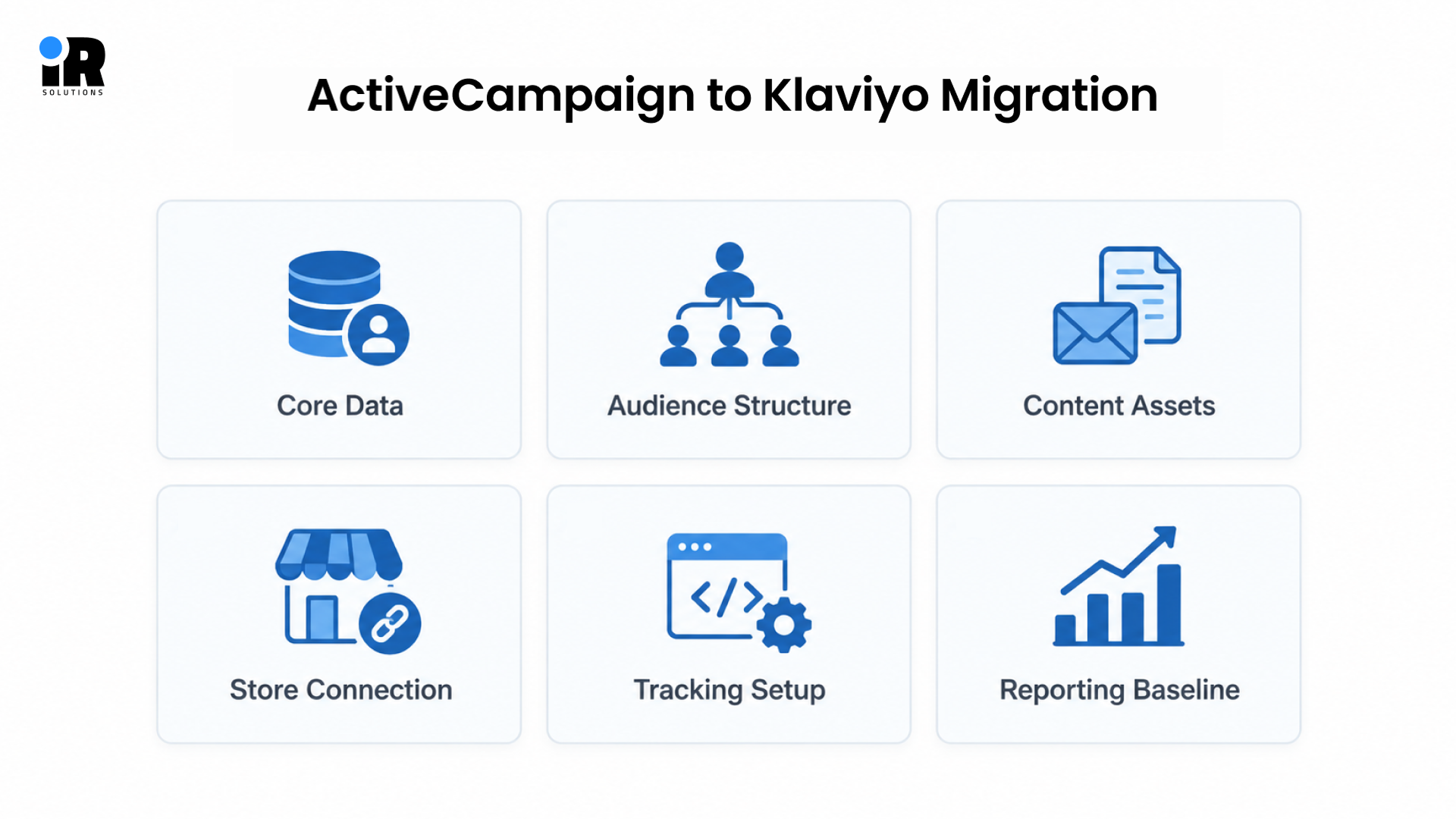
- Core Data: Move contacts or profiles with their consent status and suppression data, so nobody receives unwanted messages.
- Audience Structure: Rebuild lists, tags, and segments, remembering that each platform stores audience logic in a different way.
- Content Assets: Recreate templates and automations, and expect to adjust triggers, filters, and product blocks along the way.
- Store Connection: Reconnect the ecommerce integration, then confirm that historical order data synced correctly before you send any campaigns.
- Tracking Setup: Install the new onsite tracking on your site and test that every key event fires as expected.
- Reporting Baseline: Record current attribution settings and key numbers first, so you can compare results fairly after the move.
Don’t rebuild every automation exactly as it was. ActiveCampaign and Klaviyo handle triggers, segments, data, and ecommerce events differently, so simplify and improve your workflows during migration.
Use a staged approach, keep the old account for reference, and verify data, consent, tracking, and automations before going live. Avoid running the same campaigns from both platforms at once.
Conclusion
Both platforms can run a strong ecommerce program, so the smarter question is which one fits your business. Klaviyo may fit more naturally when shopper behavior, product data, purchases, and ecommerce lifecycle flows drive most of your marketing.
ActiveCampaign may fit more naturally when ecommerce sits alongside longer nurture journeys, services, wholesale relationships, or sales workflows. Price matters too, but only after you count profiles, sends, SMS, users, and add-ons honestly.
Start with your own data: list your top messages, your growth plans, and your team's skills. If possible, build one representative workflow in each platform using your own store data before committing. Use the test to compare setup effort, available data, segmentation, workflow logic, reporting, and day-to-day usability.
Avoid judging the platforms on short-term revenue alone, because small test audiences and different attribution settings can distort the comparison. Need help choosing or switching platforms? Our email marketing experts can review your setup and recommend the right next step.
Frequently Asked Questions
What is the main difference between ActiveCampaign and Klaviyo?
Klaviyo centers on consumer profiles, store behavior, and lifecycle marketing, which suits businesses built mainly around online shops. ActiveCampaign combines ecommerce data with broader marketing automation, nurture sequences, and optional sales tools for mixed customer journeys.
Is ActiveCampaign or Klaviyo better for ecommerce?
Neither is better for every store, because the right choice depends on your customer journey and goals. Klaviyo often fits store-led businesses, while ActiveCampaign suits stores that also run nurture or sales processes.
Does ActiveCampaign work with Shopify?
Yes, ActiveCampaign connects with Shopify and syncs customers, orders, products, and abandoned carts into your account. Current pricing lists ecommerce integrations on the Starter plan, so check your plan details first.
Does Klaviyo work with Shopify?
Yes, Klaviyo integrates with Shopify and uses customer, order, product, cart, and browsing data for segmentation and automation. Its onsite tracking and embedded forms also work through the Shopify integration setup for your connected store.
Does ActiveCampaign support abandoned cart emails?
Yes, ActiveCampaign supports abandoned cart automations using cart data, product details, and checkout links from your store. Remember that Starter limits each automation to five actions, which may shorten your reminder sequence.
Which has more advanced automation, ActiveCampaign or Klaviyo?
They are advanced in different ways, so neither can be called the clear winner for every team. Klaviyo goes deep on ecommerce lifecycle flows, while ActiveCampaign offers flexible automations across marketing and sales stages.
Does ActiveCampaign have CRM features?
Yes, ActiveCampaign offers contact profiles, tags, and custom fields, plus optional Enhanced CRM capabilities for sales teams. Klaviyo also positions itself as a B2C CRM, so the old CRM gap claim is outdated.
Which costs more, ActiveCampaign or Klaviyo?
It depends on your contact count, send volume, plan level, SMS needs, and CRM add-ons. Compare total yearly cost for your own store rather than relying on the lowest advertised starting price.
Do ActiveCampaign and Klaviyo support WooCommerce?
Both platforms offer WooCommerce integrations, but sync depth, historical data, and setup steps can differ between them. Verify the current official documentation for each integration before you commit to either platform for your store.